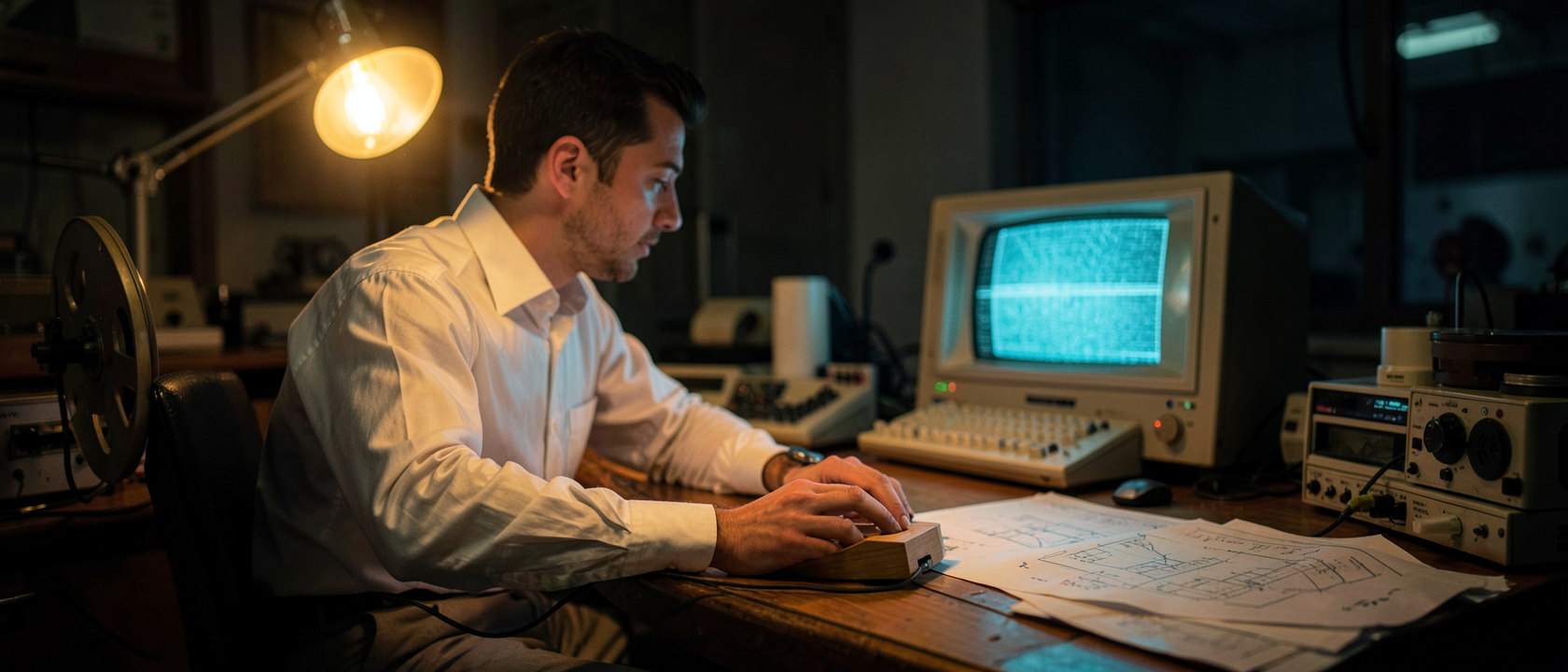
A Butter Dish, a Bowling Ball, and a Secret Navy Lab
The mouse under your hand looks unremarkable: plastic shell, a scroll wheel, maybe two buttons. Trace it back far enough, though, and you land on a classified British radar project from 1946 and a Canadian military lab in 1952, where engineers wired a five-pin bowling ball into a tracking system. One later prototype reportedly even used a butter dish for its casing. That popular story leaves out a lot.
The Man Who Got the Credit vs. the Man History Forgot
A ball-based cursor device existed as early as 1946, roughly two decades before Doug Engelbart’s name became linked to “inventing” the mouse. Ralph Benjamin, the engineer behind that earlier design, built something functionally close to what came later. Yet Engelbart ended up in the textbooks, while Benjamin’s name barely registers outside specialist circles.
Born Classified
In 1946, Ralph Benjamin worked for Britain’s Royal Navy Scientific Service on the Comprehensive Display System, a radar plotting setup. His device used a metal ball pressed against two rubber wheels, one for side-to-side motion, one for up-and-down, turning the ball’s roll into a moving point on a screen, the same mechanism behind a trackball, years before most computers existed.
In 1952, engineers Tom Cranston, Fred Longstaff, and Kenyon Taylor at Ferranti Canada hit on nearly the same idea for a Royal Canadian Navy tracking system, using a standard five-pin bowling ball as the rolling element. Both devices worked, and both were classified military systems, so their creators couldn’t publish, patent for profit, or take public credit.
Engelbart Turns the Idea Inside Out
By the early 1960s, Douglas Engelbart at Stanford Research Institute wanted a better way to work with a computer than a keyboard, joystick, or light pen. In 1964, engineer Bill English built a prototype that flipped the trackball concept: instead of a ball turning wheels inside a fixed housing, two wheels pressed directly against the desk while the whole device moved in the user’s hand.
The change was simpler to build and matched how a hand naturally slides across a surface. Tested later against light pens, trackballs, and joysticks, the mouse won across the board, even with users who had never touched one before.
The Demo People Thought Was Faked
On December 9, 1968, at the Fall Joint Computer Conference in San Francisco, Engelbart showed the mouse to roughly 1,000 computer professionals alongside hypertext, video conferencing, and real-time collaborative editing, projected onto a screen 22 feet (6.7 meters) tall. Every one of those ideas would take decades to become ordinary.
It looked so far ahead of its time that some in the audience reportedly accused Engelbart of staging it. It wasn’t. The presentation later earned the nickname “the Mother of All Demos,” a label first attached in a 1994 book, long after the world had caught up to what it had actually seen.
The Inventor Who Made Almost Nothing
Engelbart and English were employees of Stanford Research Institute, not independent inventors, and that detail made all the difference. The patent, filed in 1967 and granted in 1970 for the “X-Y Position Indicator for a Display System,” belonged to SRI, not to them.
Engelbart never collected a cent in royalties. SRI reportedly earned around $40,000 licensing the design to Apple, roughly $130,000 in today’s dollars by one estimate, before the patent expired, just as the Macintosh was about to put a mouse on desks everywhere.
From Lab Prototype to Steve Jobs’s Deodorant Cap
Bill English moved on to Xerox PARC, engineering a version that used a rolling ball to drive internal rollers, the design that became the industry standard for two decades.
Steve Jobs later toured Xerox PARC and saw that mouse; the story goes he was floored that Xerox wasn’t rushing it to market. Back at Apple, he pushed his design team to build one cheap and durable enough for ordinary buyers. As the anecdote is often told, they sourced ball parts from deodorant containers and even tried a butter dish for the casing. Apple’s mouse debuted with the Lisa, then shipped with a rubber ball on the 1984 Macintosh, with a single button instead of Xerox’s three.
Nobody Knows Who Said “Mouse” First
Even the name has no clear author. Engelbart himself said no one could remember who coined it, only that the device looked like a mouse with a tail, so the name stuck. That cord originally exited under the user’s wrist and was later moved to stop it from tangling.
An invention with no single inventor, built in secret in 1946, rebuilt with a bowling ball in 1952, and reinvented again in 1964 by people who knew nothing about either earlier version, ended up with a name nobody can claim either. That is the part worth remembering next time someone hands you a “simple” gadget and calls it obvious.