The Grin That Isn’t
Take a good look at Jack Skellington’s face. Wide jaw, high cheekbones, an upward-curving mouth line. Your brain clocks it as a grin, maybe even a friendly one. And yet the entire plot of The Nightmare Before Christmas (1993) hinges on the fact that this character is deeply, articulately miserable. The smile is not a character choice. It is a skull, whose anatomy happens to match, almost point for point, the facial geometry a human brain reads as happiness.
The film was directed by Henry Selick and produced by Tim Burton, whose original 1982 poem the story grew from. It opened wide on October 29, 1993, and its central visual paradox has been running ever since.
Your Brain Is Easy to Fool (On Purpose)
Humans are wired to find faces in almost anything. Researchers call the tendency face pareidolia: rapid-fire pattern recognition that reads emotional states before conscious thought catches up. The specific cue for “happy” is an upward curve at the corners of a mouth-like feature. A skull’s jaw line supplies exactly that shape, automatically, with no expressive intent behind it.
In Jack’s case the effect runs backward. The grin the audience perceives is a structural accident, not a signal from the character. His actual emotional state is the opposite of what that jaw line implies, and the gap between the two is what makes him stick in the memory. Rendering that face in stop-motion required sculpting 400 interchangeable heads so animators could capture minute shifts in expression across 109,440 total frames.
The Pumpkin King Who Was Over It
Within the film, Jack holds the top position in Halloween Town: the Pumpkin King, its undisputed creative leader. The opening sequence is essentially a town-wide tribute to him, and it cuts almost immediately to Jack alone on a hill, sighing into the dark. His unhappiness is specific: he has perfected Halloween to the point where nothing about it surprises him anymore. That kind of creative exhaustion, being genuinely excellent at something and finding the excellence hollow, reads as an adult feeling, which is part of why the film connected with audiences well outside its original target age group.
Sandy Claws and the Holiday Heist That Nearly Worked
Jack’s response is not rest or reflection. He stumbles upon Christmas Town, decides he can master Christmas the way he mastered Halloween, rebrands Santa Claus as “Sandy Claws,” arranges for the real Santa to be kidnapped, and personally takes over worldwide Christmas delivery. His Halloween-native interpretation produces gifts that terrify children. Military intervention eventually shoots his sleigh from the sky, but the more precise point is what happens just before: his version of Christmas causes fear instead of joy, meaning he fails at the exact thing he set out to master. The story does not give him a villain’s defeat. It gives him a craftsman’s humiliation.
Disney released the film under the Touchstone Pictures banner, considering it too dark for their main label. It cost $18 million and earned roughly $50 million domestically, with cumulative worldwide earnings eventually surpassing $100 million. In 2023, the Library of Congress selected it for preservation in the National Film Registry.
The Crossover Nobody Planned For
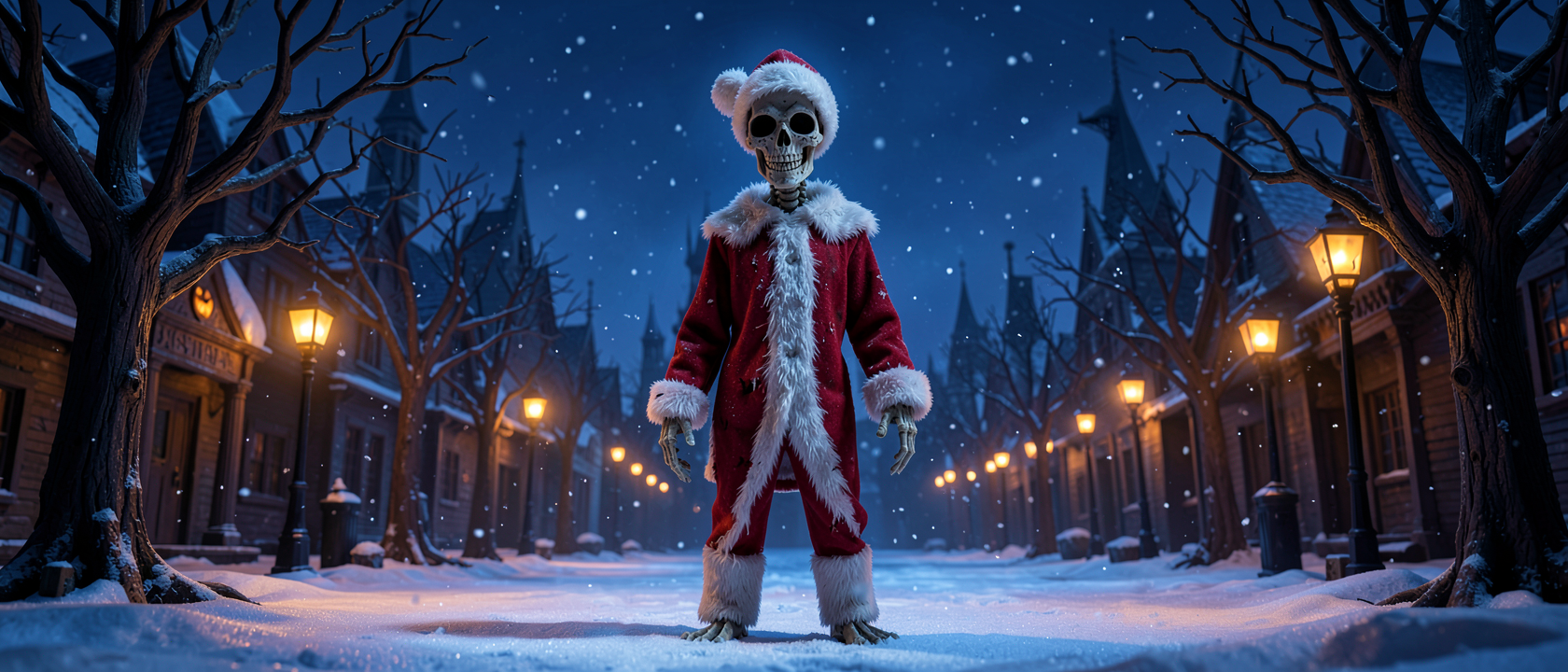
Because Jack belongs structurally to both Halloween and Christmas, ruler of one, failed stand-in for the other, his image sells in October and in December without any stretch of logic required. That duality is written into the plot, not added as a marketing layer. The design studio Dooomcat, run by Alison Acton and Jim Charalampidis, made this explicit with a design called “Scary Santa,” sold through NeatoShop: Jack was a scary Santa, briefly and literally.
He Is Not a Jolly Skeleton in a Hat
Widespread affection for Jack has quietly softened him into a lovably spooky, good-natured figure who was in on the joke all along. The actual story is harder than that. His Christmas experiment causes genuine harm, his redemption is real but compressed, and the film ends with him returning to the role he very nearly wrecked. Strip away the plot and what remains on the shelf is just a grinning skull, convincing, decorative, and missing every point the film took 76 minutes to make.