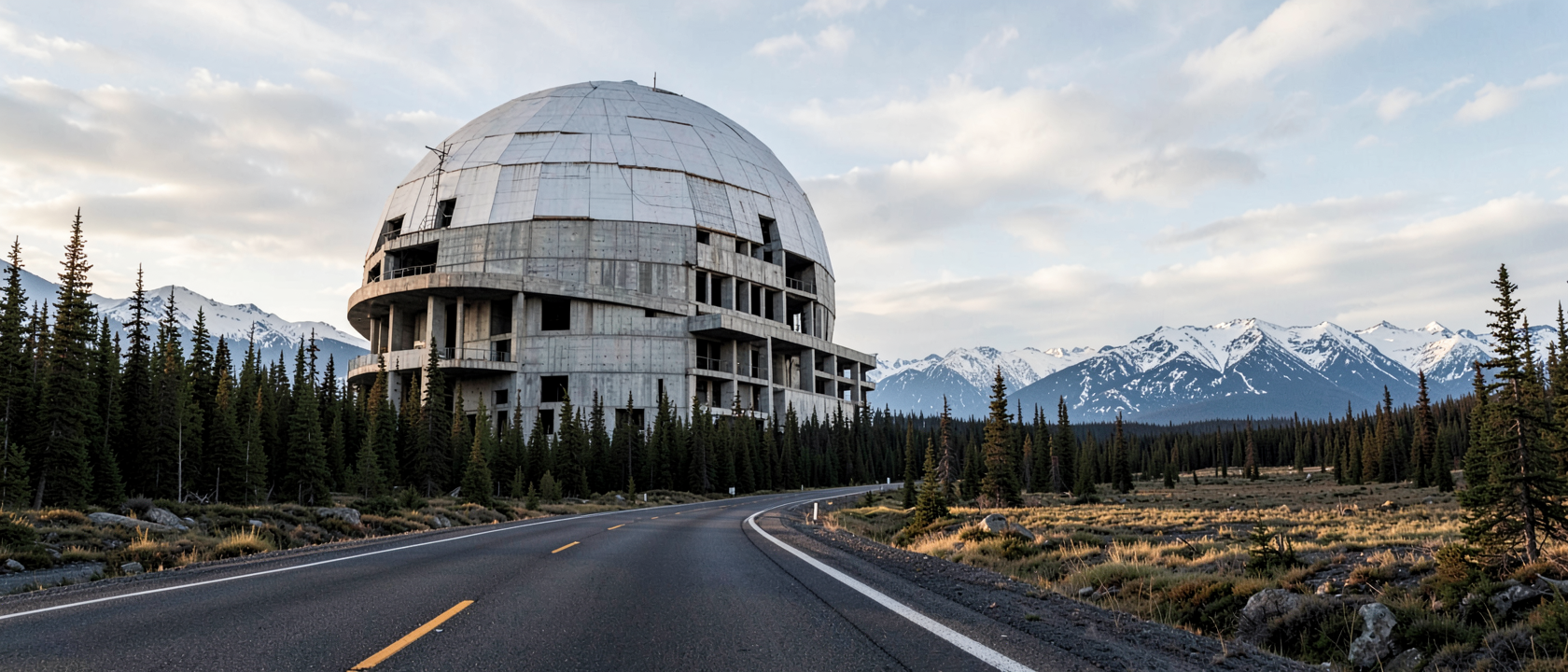
An Igloo the Size of an Apartment Building
Drive the Parks Highway near Cantwell, Alaska, and a four-story igloo rises out of the trees, 80 feet (24.4 m) tall and 105 feet (32 m) wide, visible to pilots flying above 30,000 feet. Former Alaska Railroad worker Leon Smith broke ground in 1971, planning 58 wedge-shaped rooms around a three-story atrium, hoping to open a motel by July 1973. It never did. Inspectors flagged undersized windows, among other code violations, and the project stalled. About 20 miles (32 km) outside Cantwell, the building still stands empty, a landmark precisely because it never became what it was meant to be.
A Whole Category of Buildings Shaped Like Everyday Things
An igloo hotel that never held a guest sounds like a one-off. It isn’t. Around the world you’ll find buildings shaped like robots, shells, eggs, teahouses on stilts, and even a chicken head the size of a billboard. Each one, in its own way, solved a real problem, legal, promotional, or navigational, and once you notice the pattern, roadside oddities stop looking so random.
A Shape You Can’t Drive Past
Before it ever failed an inspection, Igloo City was built for one job: make drivers slow down and remember the name. That’s the logic behind “programmatic” architecture, buildings shaped like their own function, so a passing car can’t miss them. Water towers built to look like giant fruit or objects follow the same logic elsewhere in the country: the shape becomes the advertisement, and the water inside is almost beside the point.
When the Shape Does the Work
In Marietta, Georgia, a 56-foot (17 m) chicken head has loomed over a restaurant since 1963, put up by owner Tubby Davis and designed by Georgia Tech student Hubert Puckett. He sold the business to his brother in 1966, and by 1974 Kentucky Fried Chicken had taken over the building. High winds damaged it in 1993, and the company considered tearing it down, but public support kept it standing. Giving directions by “the Big Chicken” was already routine, and unconfirmed local lore adds that pilots near the nearby air base use it as a checkpoint too.
Elsewhere, similarly shaped novelty buildings, an egg-shaped pod reclassified as art to dodge a rejected building permit, a robot-shaped bank tower, a spiral house modeled on a nautilus shell, are widely reported in architecture circles, though the specific details of who built them and when are harder to pin down with certainty.
Buildings as Metaphors
Not every strange shape solves a problem; some make a statement. A robot-shaped bank headquarters in Bangkok is said to have been designed with eye-like windows and antennae doubling as lightning rods, meant to announce that banking was becoming computerized. A house in Mexico City is said to mimic a nautilus shell’s spiral so closely that residents feel like they live inside one, with barely a straight wall in the place. Neither claim has been fully nailed down here, but both point to the same idea: a building’s shape can carry an argument all by itself.
Or Sometimes It’s Just One Architect’s Whim
Then there are buildings that answer to no institution, ad campaign, or legal loophole at all, like the teahouses reportedly built by Japanese architect Terunobu Fujimori, perched on forked tree trunks so visitors have to climb a ladder just to reach them. No permit drama, no marketing budget. Just one person’s private sense of how a space should feel, built anyway.
Loose Ends Worth Chasing
A few things stay open: what exactly tripped up Igloo City’s inspection beyond those undersized windows, whether the egg-shaped pod in Belgium ever found a buyer, and how many of these other oddball buildings match their own legends once you dig into the paperwork. That’s less a gap in the research than a feature of buildings this odd, the stories outrun the records, and the records are still out there somewhere, waiting for someone curious enough to find them.