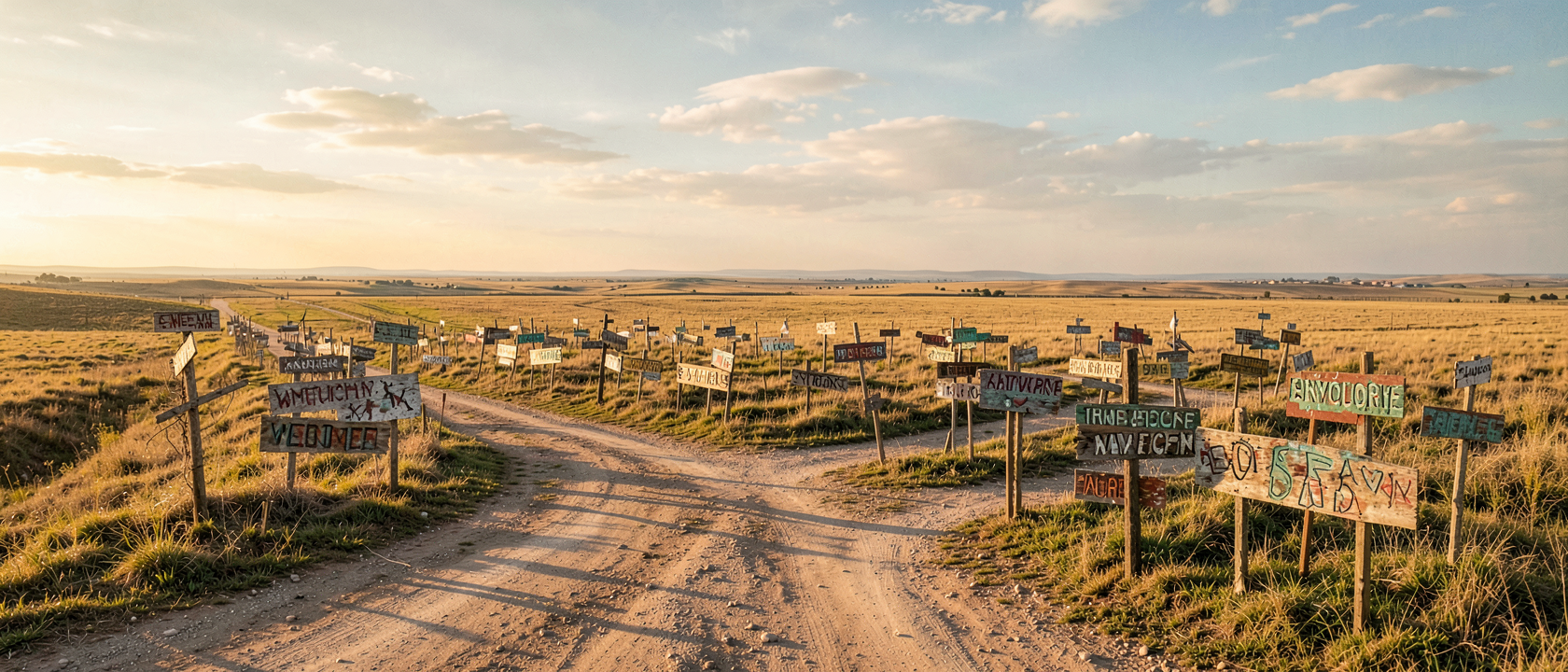
The Map That Translates America
Almost any U.S. town, river, or lake carries a name that began as a phrase in a Native American language before settlers adopted it and let the original meaning fade. National Geographic, working with graphic designer Oliver Uberti, built an interactive map that restores those meanings, translating hundreds of place names across the country.
The project began in spring 2008, after an editor learned that the U.S. Board on Geographic Names had just renamed sixteen valleys, creeks, and other sites that used the word “squaw.” That raised an obvious question: how many other names still carried meanings nobody had bothered to translate? Finding out took nearly a year, a process the team likened to solving one giant typographic puzzle.
What Your Hometown Might Actually Mean
Some translations are just fun. Malibu, California, comes from a Chumash phrase rendered as “it makes a loud noise all the time over there,” a nod to the surf. Topeka, Kansas, traces to a Kaw phrase meaning “a good place to dig potatoes.”
Chicago carries the same bluntness. One common rendering behind the name is “at the skunk place,” pointing to a wild onion plant that reportedly gave the area its smell. Yosemite comes from a Miwok word usually translated as “they are killers,” the name the Miwok used for the Ahwahneechee people living in the valley, though some researchers read it closer to “grizzly bear clan.” None of these are insults, just honest descriptions from people who actually lived there.
Then There’s Loleta
Not every name on the map is played for laughs. Loleta, a small community in Humboldt County, Northern California, about 15 miles (24 km) south of Eureka, started out as Swauger’s Station, named for the rancher whose land held the local railroad depot. Sometime in the 1890s, residents renamed it Loleta, said to come from the local Wiyot language and mean “pleasant place at the end of the tide water.”
The story stuck for generations, in what is now a town of 828 people according to the 2020 census, treated as a gentle nod to the Wiyot people of Humboldt Bay. Nobody seems to have checked the translation closely. It turns out they should have.
What a UCLA Linguist Found
William Bright, late Professor Emeritus of Linguistics and Anthropology at UCLA, compiled “Native American Placenames of the United States,” a scholarly dictionary of roughly 11,000 American place names drawn from Indigenous languages. Loleta is one of his entries, and his account doesn’t match the town’s own story.
According to Bright, the name was picked in 1893 by a resident, Mrs. Rufus F. Herrick, who believed she was using a real Wiyot word. The actual Wiyot word for that location, katawóio’t, meant something else entirely, unrelated to tides or scenery. Whatever Herrick thought she had named the town after, it was never a genuine Wiyot translation.
The Prank Behind the Name
So where did “Loleta” actually come from? Bright traces it to research published by linguist Karl V. Teeter in 1958. Teeter later worked closely with the last living native speaker of Wiyot and wrote the first full modern grammar of the language, which gives his fieldwork real weight.
In that version, when Herrick asked an elderly Wiyot man for a fitting name, he gave her the phrase “hós wiwítak,” which translates roughly to “let’s have intercourse!” Herrick, who spoke no Wiyot, apparently misheard the ending, softened it, and landed on “Loleta” without knowing what she’d actually been told.
Why This Kept Happening
Loleta is extreme, but the pattern is common. Many Indigenous-derived place names were adopted secondhand, from translations settlers had no way to verify themselves. Sometimes that produced an honest mix-up. Other times, as here, a joke got mistaken for a poetic phrase and quietly became permanent, while a tidier origin story was repeated for generations because it sounded better than admitting nobody really knew.
Bright’s version, based on Teeter’s 1958 fieldwork, is widely cited, and a separate 1970 study of California place names reached a similar reading of the same phrase. Still, it remains one scholarly reconstruction of a century-old exchange, not a recording. That gap between the polished story a town tells about its own name and what the original language actually says is exactly what National Geographic’s map keeps turning up.