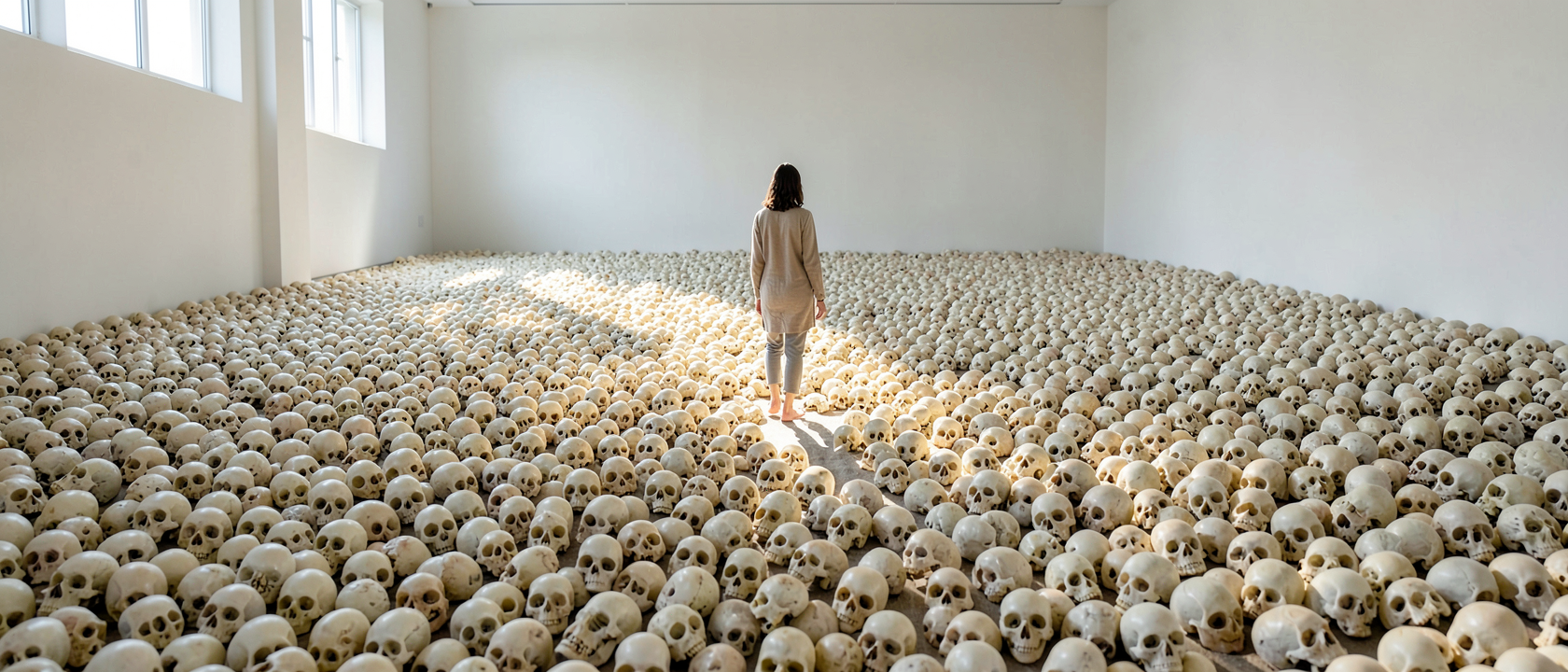
Walk Across the Skulls
At the Ardel Gallery of Modern Art in Bangkok, an exhibition called “What Will You Leave Behind?” turned an entire gallery floor into a carpet of hand-built porcelain skulls, laid edge to edge from wall to wall. Accounts of the piece differ on the exact count, some put it around 100,000, others closer to 125,000, but every version agrees on the part that matters: there was no rope, no glass case, no small sign asking visitors to keep their distance. People were told, plainly, to walk on it.
Step onto that floor and the skulls give a little before they crunch, the way dry snow does, or a bowl you didn’t know was cracked. Bare feet feel every ridge and hollow. Shoes flatten some of it into a fine white dust. Either way, nobody crosses the room without leaving a mark on thousands of tiny faces, or having one left on them.
The Obvious Question
Art about death usually stays at arm’s length. Skulls sit in glass cases, on hazard labels, on pirate flags, on tattooed skin. So why would an artist hand-build tens of thousands of them, fragile and precise, and then invite a room full of strangers to grind them underfoot?
It isn’t shock for its own sake. There’s a specific reason for putting something that delicate exactly where feet will land, and most people don’t understand it until they’re already three or four steps into the room.
Meet Nino Suwannee Sarabutra
The artist behind the floor is Nino Suwannee Sarabutra, a Thai ceramicist who studied ceramic arts at Silpakorn University in Bangkok, then spent nearly 20 years working as an advertising creative before turning to art full time in 2008. Her reasoning is simple: we’ve all seen a thousand skulls already, and none of them make us flinch anymore. A picture of death is easy to scroll past.
Feeling one shift and crack under your own foot is different. It turns an idea you can think about calmly into something your body registers before your brain has time to catch up. That gap, between knowing you’ll die someday and actually feeling it, is what Sarabutra built the whole piece to close.
The Scale of the Thing
Making one porcelain skull is a small job. Making tens of thousands of them is a different project entirely. Sarabutra didn’t do it alone: her family, friends, neighbors, and students all helped shape them, so the gallery floor ended up carrying the handwork of a whole community, not just one artist.
Every skull shares roughly the same size and shape, but no two came out exactly alike, the way no two fingerprints do, each one holding some small dent or curve that only happens when a hand, not a machine, shapes it. Stand back and the floor reads as one continuous pale surface. Kneel down and it turns into a field of separate little objects, each made by someone who will likely never meet most of the people who end up stepping on their work.
The Question on the Wall
Before leaving, visitors were asked one question: if today were your last day on Earth, what would you leave behind? Their answers were collected and projected onto the gallery wall, then archived on Sarabutra’s website, so the piece kept growing with every person who walked through.
Some answers were heavy. Some visitors wrote simply “nothingness.” Others turned it into a joke, offering “my body, for medical research.” Read together, the wall stopped being a museum label and became more like an ongoing conversation, one stranger’s private answer sitting next to the next stranger’s, so the installation never really finished. It kept getting written by whoever walked in.
Not Morbid, Motivating
Sarabutra has said she doesn’t see the skulls as images of fear or sadness. To her they’re liberating, a way of pointing at every opportunity still available, every life still there to live, and a reminder to take that seriously and make the most of it. The work also draws on an old Isan proverb from Northeastern Thailand: death follows every step you take, less a warning than a nudge to notice how you spend the steps you have.
None of this is a new idea. Cultures have kept skulls around for centuries as a plain, physical way of remembering that time runs out, a tradition sometimes called memento mori, Latin for “remember you will die.” What’s different here is doing it as a floor you cross with your own body, in a room full of other people doing the exact same thing.
So notice what happened when you read the first paragraph of this piece: a flinch, a laugh, a shrug, maybe something closer to relief. Whatever it was, that reaction is the whole point Sarabutra built her floor to produce.