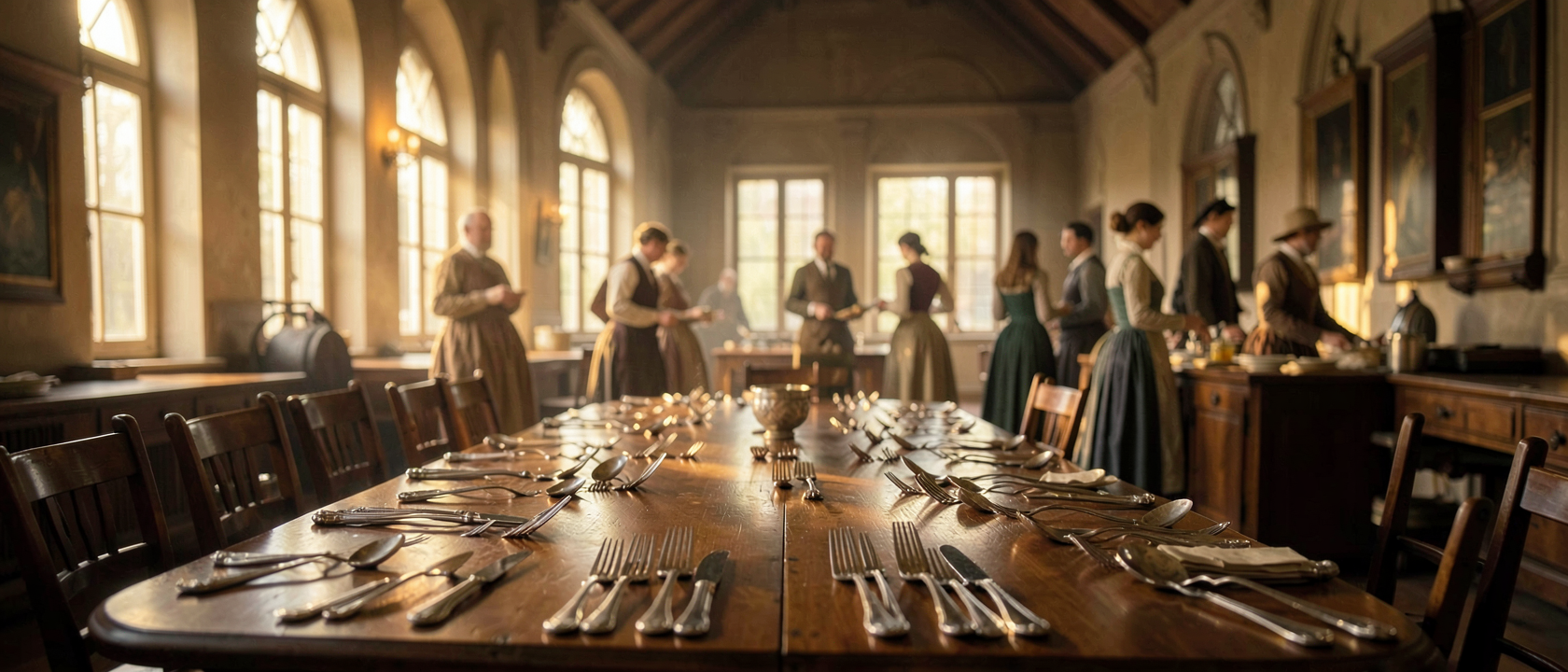
There’s a Commune in Your Kitchen Drawer
Open the silverware drawer in many American homes and there’s a good chance you’ll find Oneida flatware, pure wedding-registry Americana. The name comes from a real place that once held one of the stranger religious communities in US history. Before the company made forks and spoons, its members shared spouses, raised children together, and treated private romantic love as a form of selfishness.
How Does That Math Even Work?
A community built around shared marriage and communal child-rearing somehow produced one of the most ordinary household goods in American life. The answer runs through one preacher’s conviction, a set of rules for intimacy most of us would barely recognize as marriage, and a financial crisis that forced the experiment into business.
Meet John Humphrey Noyes
John Humphrey Noyes was born September 3, 1811, in Brattleboro, Vermont, the son of a US congressman. He graduated from Dartmouth College in 1830, bound for law, until a religious conversion in 1831 pushed him toward the ministry instead. At Yale Divinity School, a second experience in February 1834 convinced him he had reached total spiritual perfection, freedom from sin itself. The claim cost him his preaching license, but it also became his core logic: if a person could be made perfect, exclusive marriage was not virtue but possessiveness, selfishness wearing a wedding ring.
The Theology Becomes a System
In 1836, Noyes founded his first community in Putney, Vermont, built around what he called complex marriage, where every man was, in theory, married to every woman. Facing arrest for adultery, the group moved to Oneida, New York, in 1847, founding the Oneida Community in 1848; Noyes led it for more than three decades. Children were raised apart from their biological parents so no one formed the kind of exclusive attachment he considered selfish. Far from chaotic, it operated as a structured alternative to the nuclear family, complete with internal rules and oversight.
The Numbers Behind the Experiment
The community grew from 87 founding members to 306 by 1878, sharing one roof: a 93,000-square-foot (8,640 m²) home called the Mansion House, now a National Historic Landmark. Women cut their hair short, gave up the corset, and did the same physical labor as men, felling trees and playing the same sports.
This Wasn’t How Marriage Used to Be
It’s tempting to read Oneida’s pairing of teenagers with much older members as proof that people used to marry young everywhere. That’s a common misreading. Historians generally place the real drop in typical American marriage age in the Baby Boom years of the mid-20th century, not centuries earlier. Oneida’s practices came from one man’s specific theology, not some older, looser American norm. The community was the exception, not the rule.
From Theology to Factory Floor
Money, not doctrine, pushed the commune into commerce. Financial pressure through the Civil War years sent the group into animal traps, chains, and silk goods; the Newhouse trap, invented by a founding member, sold worldwide. In 1877, member Charles Cragin suggested that the community’s colony in Wallingford, Connecticut, try making spoons near the Quinnipiac River. By 1880, the Oneida Community was producing flatware for sale, the first step toward a brand that would outlive the religion behind it.
The Community Dissolves, the Company Survives
New marriage laws passed in 1880 made complex marriage illegal, and the structure holding the community together for more than thirty years collapsed. Noyes, by then deaf, fled to Canada rather than face prosecution; he died in Niagara Falls, Ontario, in 1886, at age 74. Instead of scattering, members reorganized their shared property into a joint-stock company, Oneida Community, Limited, effective January 1, 1881, with shares distributed according to each person’s financial contribution and labor. Harriet Joselyn, a former member, sat on its founding board, an unusual seat for a woman in business at the time.
The Commune You’ve Eaten Off Of
The company outgrew the religion that built it, acquiring the Wm. A. Rogers Company in 1881 and eventually becoming Oneida Limited, one of the largest silverware makers in the world. The brand that landed in kitchen drawers nationwide traces straight back to a house where children didn’t sleep with their parents and nobody was supposed to love just one person. Oneida Ltd. eventually stopped operating as an independent company and became part of EveryWare Global, Inc. The forks stayed in the drawers. The story behind them rarely makes it to the table, which is exactly why it’s worth bringing up at one.