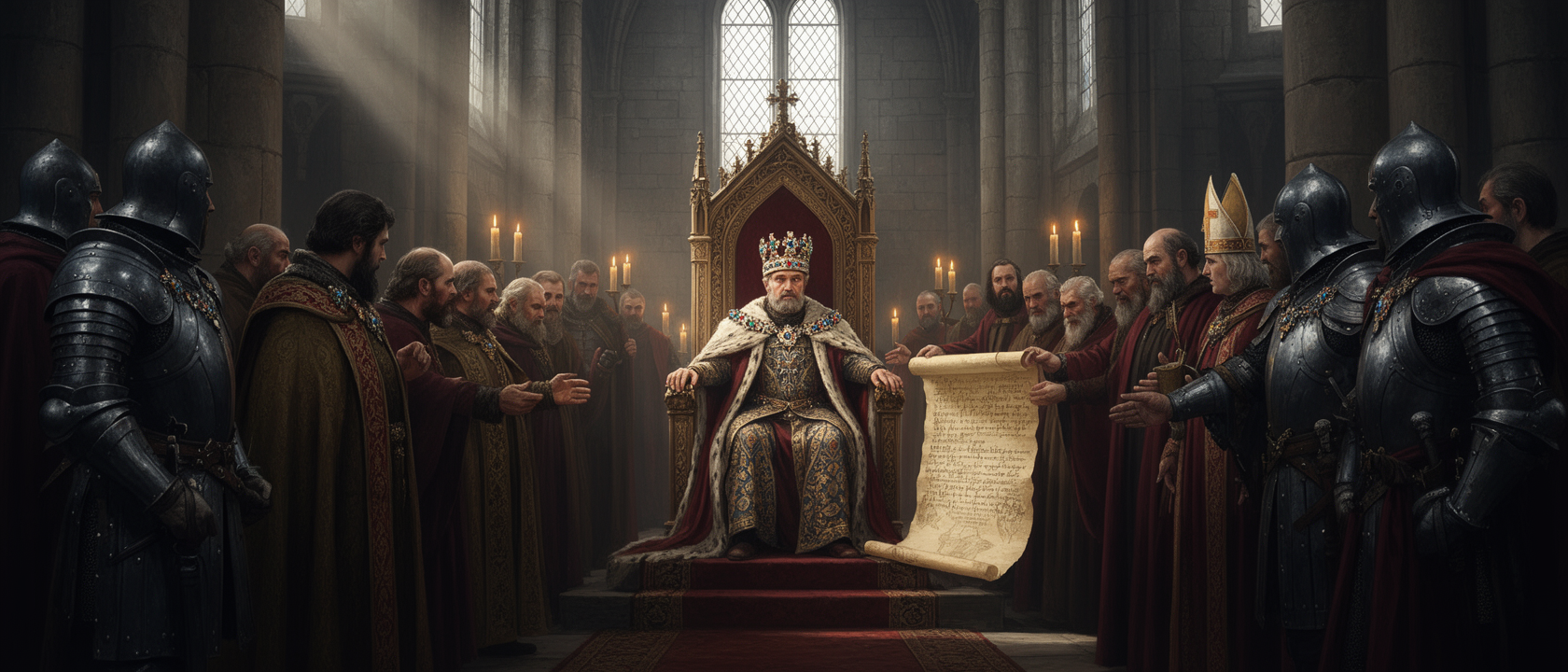
The King Who Couldn’t Rule Alone
The Cinematic Illusion
Medieval kings in movies have a particular habit: they point at someone and that person is arrested, exiled, or executed. No paperwork. No pushback. It makes for great drama. It also bears almost no resemblance to how medieval power actually worked.
Between roughly 476 AD, when the Western Roman Empire collapsed, and 1453, when Constantinople fell to the Ottomans, European monarchs occupied the top of a rigid social hierarchy. The title was real. The power, however, came with strings attached, held by a small group of very heavily armed men.
The Sovereign’s Paradox
A king was theoretically the highest authority in the land, yet he often could not raise a new tax, seize property, or call an army into the field without the agreement of his most powerful subjects. The answer lies in what a medieval king actually controlled directly, which was surprisingly little. He had no standing army, no centralized tax office. What he had was a title, a piece of land, and relationships, and relationships require maintenance.
The Feudal Gear-System
The structure that shaped all of this is feudalism: the king parceled out land (fiefs) to barons in exchange for loyalty and military service. Those barons subdivided their land among knights, who owed around 40 days of military service per year. From around 1000 AD, fiefs became hereditary, making barons wealthy, independent, and hard to dislodge. When a king needed an army, he asked his barons, who asked their knights. If the barons were displeased, the army shrank. William the Conqueror introduced this system to England after his 1066 conquest. His successors had to live inside it.
The Breaking Point
Few moments show this fragility as clearly as the events of 1214–1215. On July 27, 1214, the coalition army King John had financed was routed by French King Philip II at the Battle of Bouvines. The defeat confirmed what many already suspected: John had lost England’s French territories, spent enormous sums, and delivered nothing.
On June 15, 1215, the barons forced John to seal the Magna Carta at Runnymede, a meadow on the south bank of the River Thames. Its 63 clauses placed formal legal limits on the crown, restricting arbitrary taxation, prohibiting illegal imprisonment, and establishing a council of 25 barons to ensure compliance. The arrangement immediately collapsed: Pope Innocent III annulled the charter, neither side complied, and the First Barons’ War broke out. But the charter was reissued under Henry III in November 1216, and again in 1217 and 1225. Four original copies survive.
The Four Pillars of Legitimacy
The Magna Carta was an extreme expression of something that shaped every medieval reign: a king’s authority rested on four foundations simultaneously. The first was ancestry, a clear hereditary claim. The second was religious backing: excommunication, which John himself experienced, handed rivals a moral justification to unseat a king. Third was military credibility. Fourth was recognition by the land-owning aristocracy and clergy who administered the kingdom locally. A monarch who lost two or more pillars was in genuine danger, as John’s career illustrates precisely.
The Infrastructure of Advice
Long before the Magna Carta made limits on royal power legally explicit, institutional structures kept monarchs connected to their most powerful subjects. In Anglo-Saxon England, the witan, Old English for “wise men”, gathered ealdormen, thegns, and bishops to advise on legislation and major decisions. The earliest recorded meeting dates to around 600 AD, under King Æthelberht of Kent.
After 1066, the witan’s role was absorbed by the curia regis (“king’s court”), bringing together officials, bishops, and barons to handle governance, justice, and finance. It operated as both a large Great Council and a smaller permanent body, a direct ancestor of Parliament. Neither was a rubber stamp. Consultation was not a courtesy; it was how decisions acquired the backing that made them stick. A royal command the barons refused to enforce was, in practical terms, not really a command at all.
That gap between formal authority and actual power is what separates the history from the movies, and why every one of the four surviving Magna Carta copies is a record not of royal strength, but of royal limits.