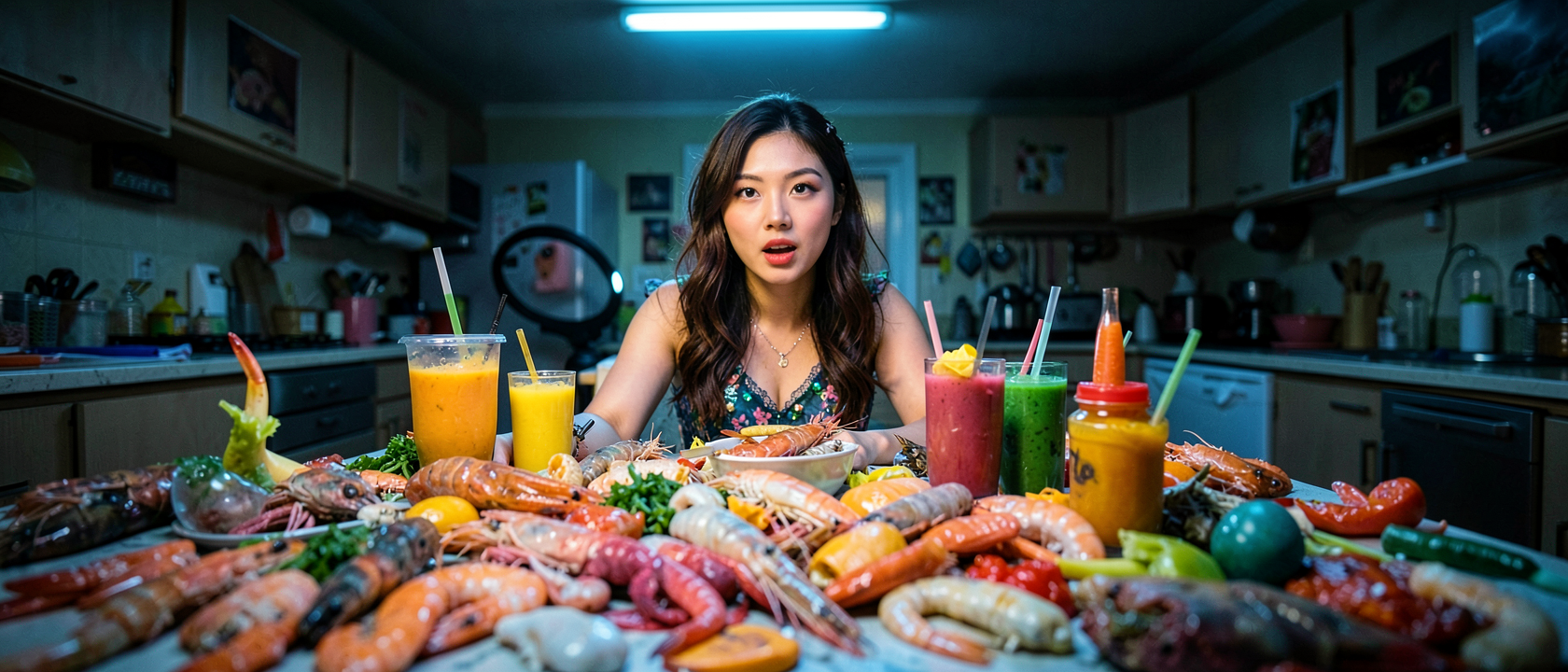
Food Videos Built to Turn Your Stomach
Somewhere in Facebook’s video feeds sits a channel that borrows every visual habit of a genre built on appetite and appeal, then quietly refuses to deliver either. The creator goes by Showry, and her clips look, at a glance, like the glossy eating-broadcast videos that pull in millions of views: close camera, slow bites, food filling the frame.
Except something is off. Instead of making you hungry, the videos tend to do the opposite. Viewers arrive expecting seduction and leave describing something closer to a dare, sexy food content that isn’t interested in being sexy at all.
What “Muk-bang” Actually Means
Muk-bang (먹방) is a South Korean term combining the words for “eating” and “broadcast.” It describes livestreamers, often conventionally attractive, eating large amounts of food on camera for audiences that can run into the millions.
The appeal was never really about the food. Part of it is loneliness, the feeling of eating “with” someone through a screen. Part of it is the crunch-and-slurp satisfaction of exaggerated sound design. Part of it is vicarious indulgence. One muk-bang performer reportedly earned $9,000 a month, a sign of how commercially real the niche became. The visual grammar stays consistent: tight close-ups on mouth and food, slow deliberate bites, near-constant eye contact with the camera, built to feel intimate.
Why Break a Formula That Works?
Muk-bang succeeds because it’s pleasant to watch: appealing hosts, appetizing food, a warm sense of company. Most viral trends try to out-charm the thing they’re copying, not repel the viewer. So why would a creator take that exact formula and strip out the one part that makes it work, unless getting it wrong on purpose turns out to be the more interesting move?
The Subversion: Same Format, Opposite Feeling
Showry keeps almost everything muk-bang viewers expect, close framing, food-focused intimacy, slow pacing. What’s missing is the seduction, and what fills the gap is shock. Her most-viewed video, with 21 million views, shows her wrapped in green plastic wrap shaped like a mermaid tail, sitting inside a refrigerator, singing along to “Under the Sea” while eating octopus and making out with a fish. Other clips have her kissing raw fish, licking raw chicken, or covering herself in blended food. One video, posted to Facebook on September 24, 2015, carried the title “Fucking Fruit Juice.” By late 2015 she had over 580,000 Facebook followers; by mid-2016, that number had passed 1.7 million.
The mechanism is simple once you see it: your brain recognizes the format and preloads an expectation of appeal, maybe flirtation. Then it isn’t delivered. That gap between promise and payoff is what makes the clips memorable and shareable in a way straight parody rarely manages.
Feminist Statement or Just Weird for Clicks?
People genuinely disagree about what Showry is doing, and that disagreement is the real, unresolved state of things. One reading treats her videos as pointed commentary: muk-bang packages mostly female bodies for consumption, and Showry turns that gaze back on the viewer until it curdles. She has lent support to this herself, in an early video, she said seeing pornography for the first time that year pushed her toward spoofing both muk-bang and webcam culture, calling her work “feminist shock comedy” aimed at the stereotype of the oversexualized Asian woman.
The other reading is simpler: it’s internet absurdism, popular because it’s strange, full stop. Even Zeon Santos, the Neatorama writer who first covered the trend on December 22, 2015, admitted he couldn’t decide which explanation fit. Other outlets split the same way: Metro said her clips took the piss out of “sexy” muk-bang videos, while the South China Morning Post’s headline leaned into shock value, calling it “bizarre food porn.” Neither framing is wrong, they’re just reading different things into the same footage.
Nobody Was Sure Who Showry Was, At First
Early coverage, including that December 2015 piece, referred to her casually as “this girl”, a placeholder rather than an identity, with no name or biography attached. That’s how many viral figures work: a nickname circulates, gets repeated, and starts to feel like settled fact even though nothing behind it has been checked.
Fuller detail did eventually surface. Reference sources have since identified her as Seo Ae-jin, performing under the name Showry, a South Korean shock comedian and vlogger active since 2015. Some details, including her exact age, remain unconfirmed, the biography took a while to catch up to how far the persona had already traveled.
The Trick Was Never About the Food
None of this is really culinary. Showry’s videos work because muk-bang had become familiar enough that viewers stopped questioning its formula, and she found the exact pressure point where that familiarity turns into a joke, a critique, or both at once.
That’s a useful skill generally, not just around food videos: noticing when something is coasting on an assumption nobody’s bothered to check lately. The people who get why Showry’s channel is interesting aren’t the ones who watched a clip and felt grossed out, they’re the ones who clocked the format itself being played with, before anyone had to explain the joke.