Picture This: A Wrestler Turns Green
The ring lights are hot, the crowd is on its feet, and Hulk Hogan is backed into the corner. Andre, presumably Andre the Giant, wrestling’s most famous towering opponent, looms on one side, The Undertaker closes in from the other. Every wrestling instinct says this is the part where Hogan tears off his shirt and soaks up the roar before the comeback.
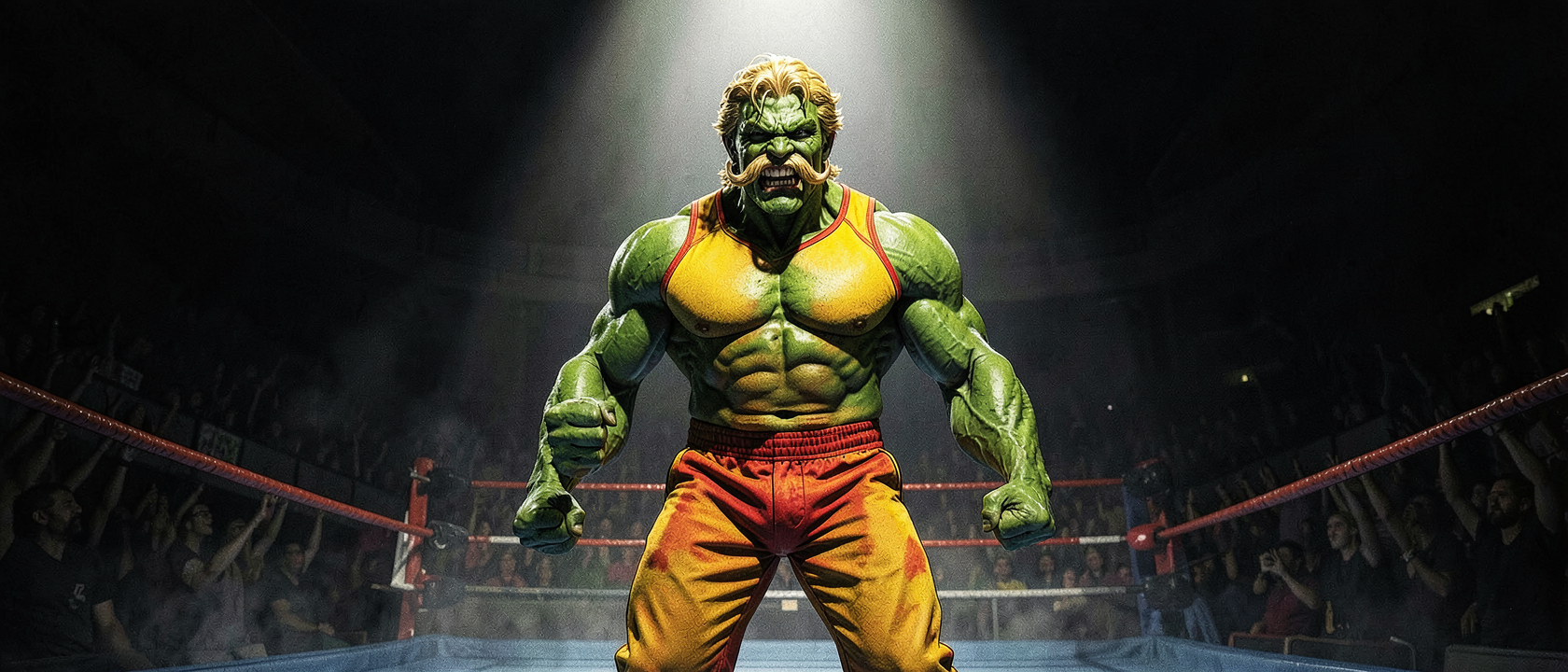
Instead, his skin shifts from tan to a deep, angry green. His arms swell past the sleeves of his tank top, the fabric across his chest pulling tighter until threads groan under muscle that wasn’t there a second ago. He keeps growing until he towers over the other wrestlers, a mountain of rage in yellow trunks.
Nobody asked Hulk Hogan to turn into anything. So why would three different artists sit down and draw exactly this?
Two Hulks, One Ring?
Marvel’s Hulk and Hulk Hogan don’t share a universe. One is a scientist-turned-monster forged by gamma radiation and barely contained anger. The other is a real professional wrestler, built on entrance music, choreography, and crowd work.
So the pairing isn’t obvious. Someone could have sent Hogan turning into a werewolf, a dragon, anything with dramatic flair. The choice to specifically morph him into the Hulk is deliberate, and the reason has been hiding in plain sight the whole time, in a detail most people have heard a thousand times without ever really hearing it.
It Was Always There, in the Name
Here’s the detail: Hulk Hogan’s ring name already has the word “Hulk” built into it. That’s a leftover of 1980s wrestling branding, nothing to do with Marvel at all, until someone decides to make it everything to do with Marvel.
That’s the whole joke, played completely straight. The design, titled “The Incredible Hogan,” runs every beat of the Hulk’s classic transformation through Hogan’s body. Anger builds as Andre and The Undertaker push him too far. His skin turns green, his muscles blow out his shirt’s seams, and the tagline nails it down: “You wouldn’t like him when he’s angry, BROTHER!”, a riff on the Hulk’s own warning line dropped into Hogan’s signature catchphrase.
Then there’s the punchline detail tucked in almost as an afterthought: his mustache stays golden yellow. Everything else gives way to rage and green skin, but the mustache doesn’t move, the one piece of Hulk Hogan that survives being turned into someone else entirely, which is exactly why it lands. The whole gag is built out of a name people already knew, hiding a second meaning nobody bothered to check for.
This Isn’t a One-Off, It’s a Style
The design went up in January 2015, credited as a collaboration between Chris Morkaut, Martyn Dawson, and an illustrator working under the name Stationjack, a freelance designer who posts bits of personal work and inspiration online and sells through an independent shop.
That shop leans on this exact trick again and again: take a name everyone knows, find the word hiding inside it, then build the artwork around that overlap. “Droid Sales” turns Star Wars droids into a used-car-lot pun. “Piglet Snacks” plays on the Winnie the Pooh character’s name. “Jaeger Do” reworks Pacific Rim’s giant robots into a martial-arts joke, and “Maul Martial Arts” does the same with Darth Maul.
Line them up and a pattern shows itself: same formula, different franchise, always a small “oh, I get it” moment waiting at the end.
Puns for Sale: A Tiny Creative Economy
Designs like this one live on NeatoShop, an online marketplace where independent illustrators sell exactly this kind of referential art, shirts, prints, stickers, most of it built on movies, franchises, and cultural in-jokes. Nothing about this suggests any official tie to WWE or Marvel; it’s fan-made parody, sold through an independent storefront.
It’s a small but genuine creative economy, running entirely on shared cultural memory. The joke about Hogan only works if the buyer already has two things stored away separately: what Hulk Hogan looks like, and how the Marvel Hulk transforms. Nobody explains the connection in the design itself, it only works if you supply the second half yourself.
That’s the same move you just made reading this. Nobody had to spell out where the pun was hiding in “Hulk Hogan”, you found it once it was pointed at. That’s the whole skill this kind of art is betting on, and it’s the same one that makes you the person at the table who catches the reference before anyone else does.