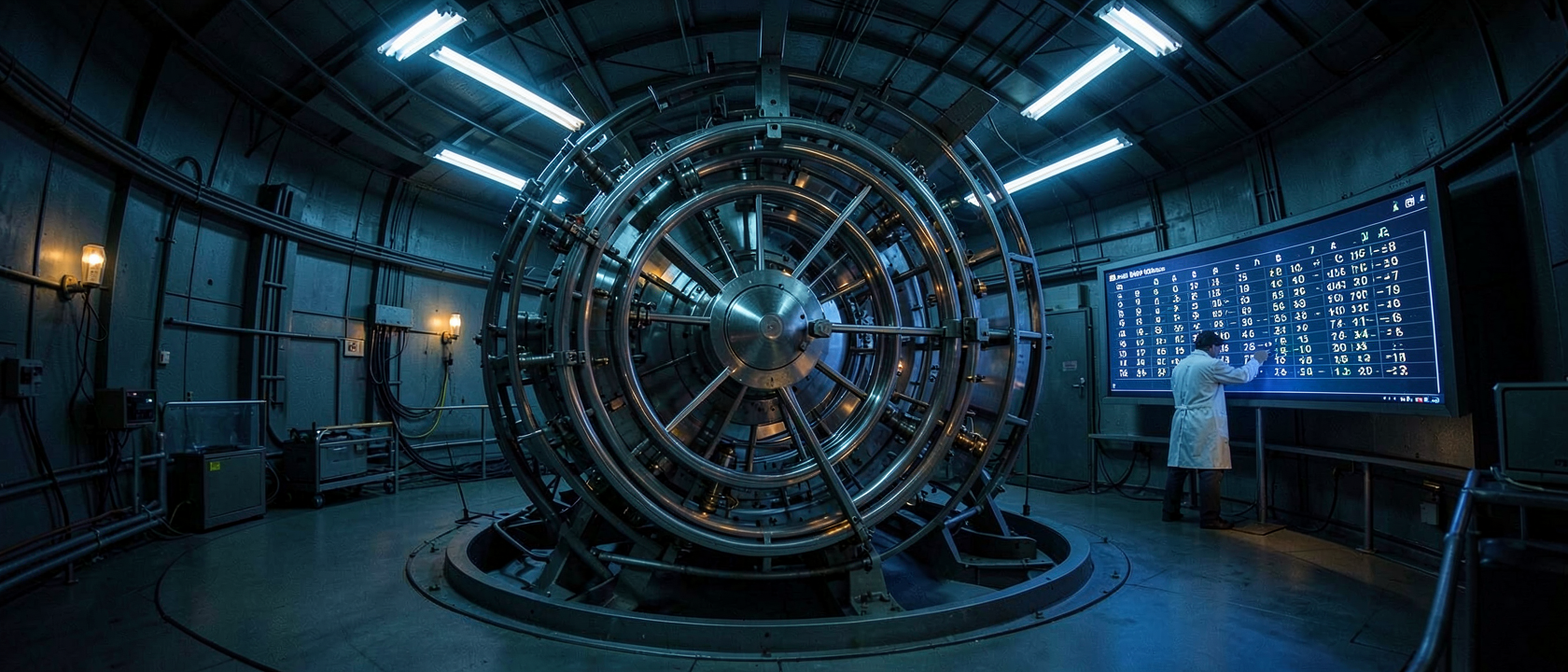
Element 120: The Periodic Table’s Next Impossible Row
The Element That Doesn’t Exist Yet
Element 120 doesn’t exist. Not yet. Chemists call it unbinilium, symbol Ubn, a placeholder name for something no lab has ever produced. If it’s made, it will be the first atom ever to sit in the periodic table’s eighth row, a row that currently exists only on paper. Getting there means going past oganesson, element 118, the heaviest atom anyone has built so far, and the tool that got science this far has just run out of road.
The Projectile That Built an Era
For decades, one isotope carried almost the whole workload: calcium-48, with 20 protons and 28 neutrons. Fired like a bullet into heavier targets, it fused nuclei together to build something new. Physicists call it “doubly magic”: both its proton count and neutron count land on numbers that make the nucleus unusually stable, exactly what you want in ammunition. Calcium-48 is the common parent behind the five heaviest known elements, from flerovium up through oganesson. So why abandon a tool with a résumé like that?
Why You Can’t Just Add More Bullets
Building a new element always comes down to the same move: slam two nuclei together hard enough that their protons merge into one. The limit is how many protons the bullet brings. Calcium-48 carries only 20, and reaching element 120 that way would require targets made from einsteinium or fermium, elements too scarce to exist in usable amounts.
So Berkeley Lab switched projectiles. Titanium-50 carries 22 protons, and in 2024 a titanium-50 beam fired into a plutonium target produced two atoms of livermorium, element 116, confirmed by tracking its decay down through flerovium. It was the first time anything heavier than calcium-48 had built a superheavy element. The next step: fire titanium-50 at californium-249, which carries 98 protons. Twenty-two plus ninety-eight lands exactly on 120.
The Upgrade Nobody Wanted to Need
Titanium-50 solves the proton problem and creates a new one. It’s rare, making up only about 5% of natural titanium, and it’s less stable than calcium-48, carrying just six extra neutrons compared to its protons instead of calcium’s wider cushion. Turning it into a usable beam means vaporizing it in ovens running at 3,000°F (1,649°C), far hotter than calcium-48 ever needed. It’s a straight trade: more reach, in exchange for a tool that demands far more precision and tolerates far less error.
A Project Nearly Ninety Years in the Making
None of this is new ground. Technetium became the first artificial element in 1937, made by Carlo Perrier and Emilio Segrè. Plutonium followed around 1940. Curium arrived in 1944, built by Glenn Seaborg, Ralph James, and Albert Ghiorso, and it was the first element with no natural origin on Earth at all, purely a laboratory product. There are 118 named elements now, and Berkeley Lab has a hand in discovering 16 of them. Element 120 is just the newest line in a project that has been running for nearly nine decades.
What We Don’t Know Yet
Element 120 has not been created. What exists is a plan: a titanium-50 beam, a californium-249 target still being produced, and a prediction called the “island of stability,” the idea that certain superheavy nuclei might last longer than their unstable neighbors instead of falling apart almost instantly. That’s a model, not a result. Even a successful fusion would only answer whether the nucleus can be built, not how long it survives. That part stays a forecast until someone actually watches it happen.