The Storm Started Losing Pieces
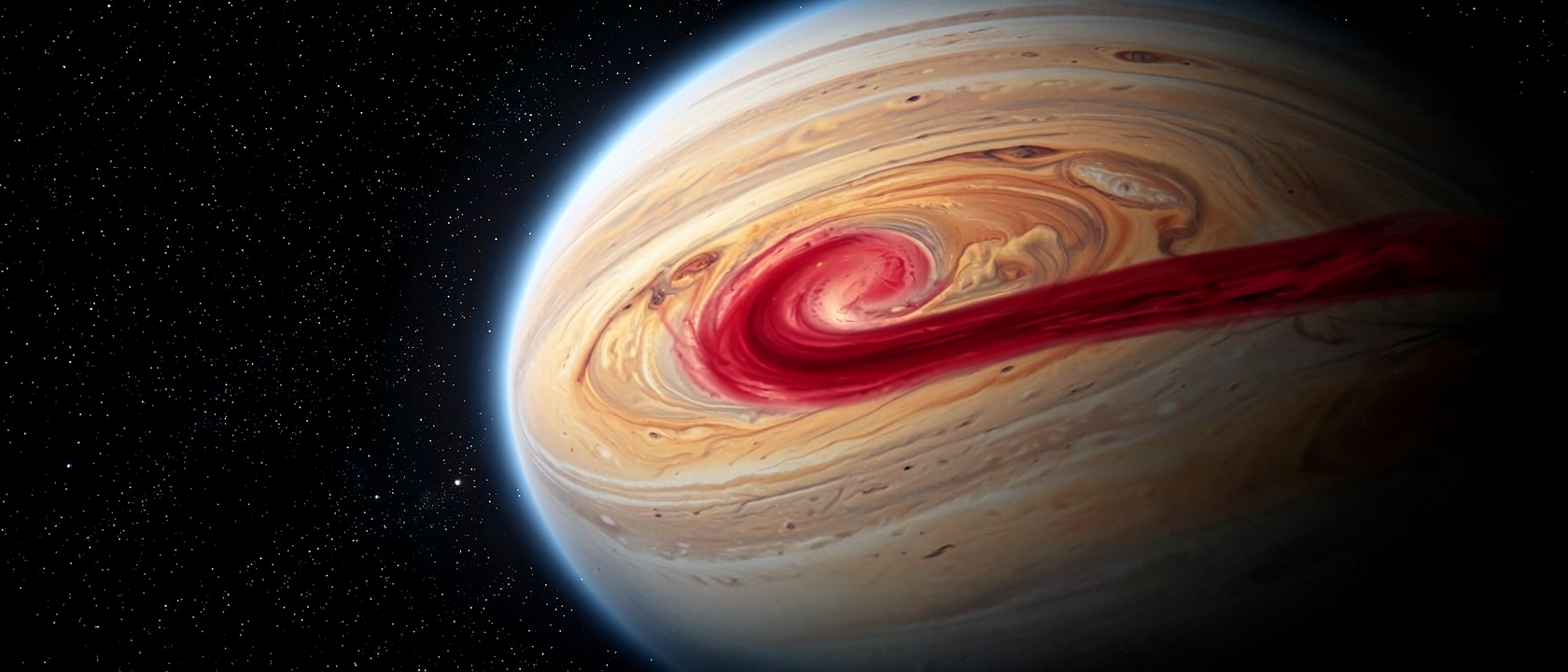
In early 2019, people aiming backyard telescopes at Jupiter noticed something off. The Great Red Spot looked stretched and lopsided, nothing like its usual tidy oval. By April, observers described thin streams of reddish material peeling off the storm’s edge and drifting into surrounding clouds, as if the Spot were coming apart at the seams.
No one watching Jupiter had recorded anything like it before. Veteran observers said the behavior was new to them, and nobody could say what it meant, only that the Spot looked different, night after night, in a way it never had.
One Photo That Made It Real
The image that turned a rumor into a story came from Anthony Wesley, an amateur astronomer in Rubyvale, a Queensland town of about 640 people. On May 19, 2019, he captured a streamer of red material stretching more than 6,000 miles (10,000 km) from the Great Red Spot, long enough to merge with a nearby jet stream. He photographed the same feature again on May 22.
“I haven’t seen this before in my 17-or-so years of imaging Jupiter,” Wesley said. That line, paired with an unmistakable photo, spread faster than any agency statement could have. Other observers, including Christopher Go in the Philippines, who spotted his own reddish extension on the Spot on May 17, were swapping images within days, and a planet most people rarely think about suddenly felt like it was changing in front of them.
Why a 400-Year-Old Storm Freaked People Out
Part of why the flaking felt alarming is the storm’s pedigree. People have tracked Jupiter since telescopes were invented in the 1600s, and a disputed record from Giovanni Cassini in 1665 may describe this very storm. The sighting confirmed as today’s Great Red Spot dates to 1831, meaning the storm had been under watch for more than 200 years.
That history makes the Spot one of the steadiest things anyone can point a telescope at, generation after generation watching the same swirl of gas. When something that stable starts shedding visible pieces, it reads less like weather and more like a mountain quietly losing chunks of rock.
It Had Actually Been Shrinking for a Century
Here’s the part lost in the alarm: the Great Red Spot had already been shrinking for more than a century before 2019. Measurements going back to the late 1800s show a long, gradual decline in size, and by 2012 observers noticed the shrinking had sped up to roughly 580 miles (900 km) per year.
Seen that way, the 2019 flaking wasn’t necessarily a sudden collapse, it may have been an old, slow trend finally becoming visible. NASA’s Juno spacecraft had caught similar flaking before, though such events stayed rare until 2017. Sharper cameras and more attentive observers, combined with a storm already shrinking, made a decades-long process suddenly photographable.
How Big Is “Three Earths Wide,” Really
At its historical peak in the late 1800s, the storm spanned roughly 25,500 miles (41,000 km) across, wide enough that three Earths could line up side by side and still fit inside it with room to spare. More recent measurements put the Spot closer to 10,250 miles (16,500 km) across, the smallest diameter ever recorded for it.
That’s still large by any measure, but it shows how much ground the storm has given up. A decline measured in centuries barely registers year to year, which is why one dramatic month of flaking grabbed attention that the slow version never did.
What Nobody Has Fully Explained Yet
The amateur record from 2019 is remarkably complete: distortion, then flaking, then a photographed streamer, logged night after night by backyard observers. What’s less settled is the mechanism. Researchers who later studied the event traced it to separate storms, called anticyclones, that collided with the Great Red Spot’s edge between 2018 and 2020 and tore off the red flakes. The collisions briefly sped up the storm’s rotation but appear to have stayed on the surface, like the crust on a crème brûlée, without reaching the storm’s deeper structure.
That’s reassuring, but it doesn’t close the case. At its current shrinking rate, the Spot is projected to turn fully circular by 2040, yet nobody knows how long it will keep shrinking, or whether the whole process is a long, slow oscillation. The people staring through backyard telescopes in 2019 were right to think something had changed. Working out exactly why is still in progress.