The Halloween List That Wasn’t About Costumes
On October 27, 2015, Neatorama published a roundup of ten DIY projects inspired by The Walking Dead, promising help for “a Walking Dead themed night of fun.” But there was no simple “dress as a zombie” entry. Instead: special-effects makeup tutorials, edible props shaped like body parts, and a literal road map through a real town in Georgia.
Found now, more than a decade later, it reads like a small time capsule from before TikTok tutorials or Etsy cosplay shops, when “making something for the show” meant a blog post, a craft-store run, and a few photos. The question it leaves behind: what makes someone build a plywood zombie for one night of Halloween?
From Screen to Backyard: Why Fans Go This Far
Lots of shows have devoted audiences; far fewer inspire fans to learn actual effects techniques or plan vacations around them. Part of the answer is how the show was made: its horror ran on practical effects, latex, prosthetics, physical sets, real makeup chairs, rather than CGI built on computers nobody at home owns. Practical effects are reproducible, if a zombie’s rotting skin was built from tissue paper and liquid latex on set, a fan with the same materials can get surprisingly close at a kitchen table.
Hollywood Tricks, Kitchen-Table Budget
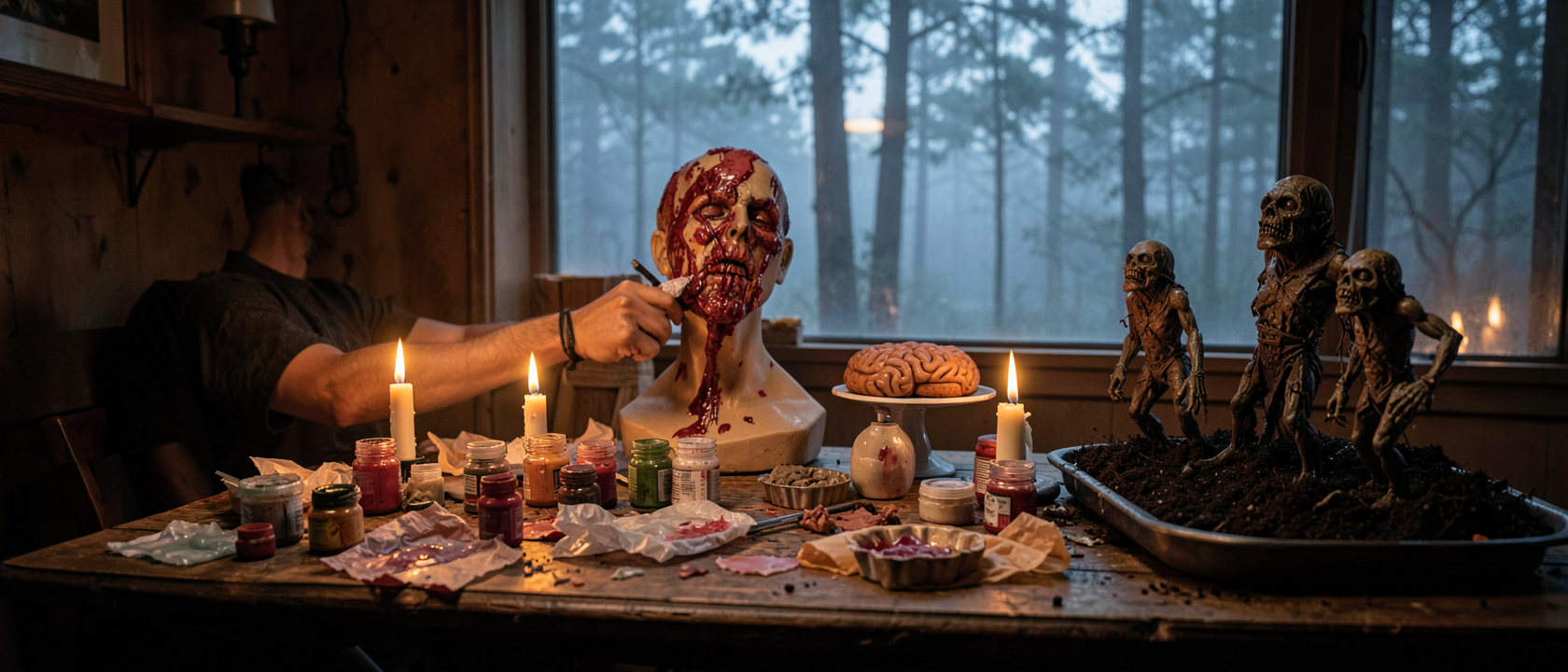
The first tutorial came from Greg Nicotero, one of the industry’s leading special-effects artists and head of the show’s makeup team. Nicotero got his start on George A. Romero’s Day of the Dead in 1985, working under Romero and effects veteran Tom Savini, so the “rotting flesh” look fans copied traced back to real horror-film craft.
His technique is less about expensive products than attention: he’s noted amateurs often stick to white pale and black shadowing, when real decaying skin shows reds, yellows, and browns. The tissue-and-liquid-latex method works the same for fans as for pros: latex dries into a flexible, skin-like film, and tissue underneath creates torn, layered texture cheaply. By a 2014 account, Nicotero ran a shop of 30 full-time sculptors, mold makers, and painters, plus four permanent makeup artists on location with him, and about seven artists total handling makeup on the busiest episodes, when the show needed up to 150 zombies in a single day. Fans doing the same trick in one bathroom mirror were running a miniature version of that production line.
Other entries scaled the idea down: a “corpse rising from the grave” costume from blogger Heather Green, yard zombies built from plywood, paint, and PVC pipe, and zombie-ified Barbie dolls from Amanda Formaro, made with paint and deliberate distressing.
Dinner Party, But Make It Undead
Then the list turns to food. One entry showed how to bake sugar cookies shaped like Daryl’s ear necklace, a grim prop turned party snack. Deviled eggs got dyed green to pass as “zombie eyes” (this one slipped in without its own number). A red velvet cake with raspberry filling stood in as a “brain cake,” the raspberry doing double duty as blood.
None of this requires special-effects skill, just a willingness to ask, “could this be dessert?” The result is gore turned into something you can serve at a party, safe to eat, built to get a reaction over dinner rather than on a screen.
When the Show Itself Leans Into the Dark Side
Not every item came from amateur creativity. One tutorial recreated “The Governor’s Fish Tank,” referencing the show’s aquarium used to hold severed heads. Alongside it sat an entry for officially licensed Walking Dead holiday greeting cards from Skybound, featuring comic-style art and distinctly un-cheerful messages.
This pairing shows that fan enthusiasm and official marketing were feeding each other, the studio itself packaged the show’s grim imagery as seasonal merchandise, right alongside what fans were cooking up at home.
Woodbury, Georgia: A Fictional Town You Can Actually Visit
The most surprising entry wasn’t a craft at all. Blogger Rachelle of Strut Your Stroller built a self-guided tour of real Walking Dead filming locations around Senoia, Georgia, the small town that stood in on-screen for “Woodbury,” the Governor’s community, during season three. The show’s main production was based at a roughly 140-acre property near Senoia, run under the name Riverwood Studios.
Rachelle’s guide pointed fans toward specific, mappable spots, including a restaurant called Big Jake’s that appeared in season 3, episode 15, with a Google map so others could follow the same route. A fictional town became actual GPS coordinates, instead of recreating a scene with props, a fan could just drive there and stand in it.
The Decade When Fandom Became a Hobby, Not Just a Habit
Put the ten entries side by side and a pattern shows up: professional-grade gore techniques, novelty baking, official dark-humor merchandise, and literal tourism, all orbiting the same obsession. The list sits at a moment when DIY blogging, cosplay, and food styling were merging into one shared toolkit, years before fandom had the apps and marketplaces it has now.
Back then, if you wanted to be part of a show’s world, you built the tools yourself, turning a TV set’s tricks into your own backyard, kitchen, and road trip.