One Creature, Zero Brains, Thousands of Bodies
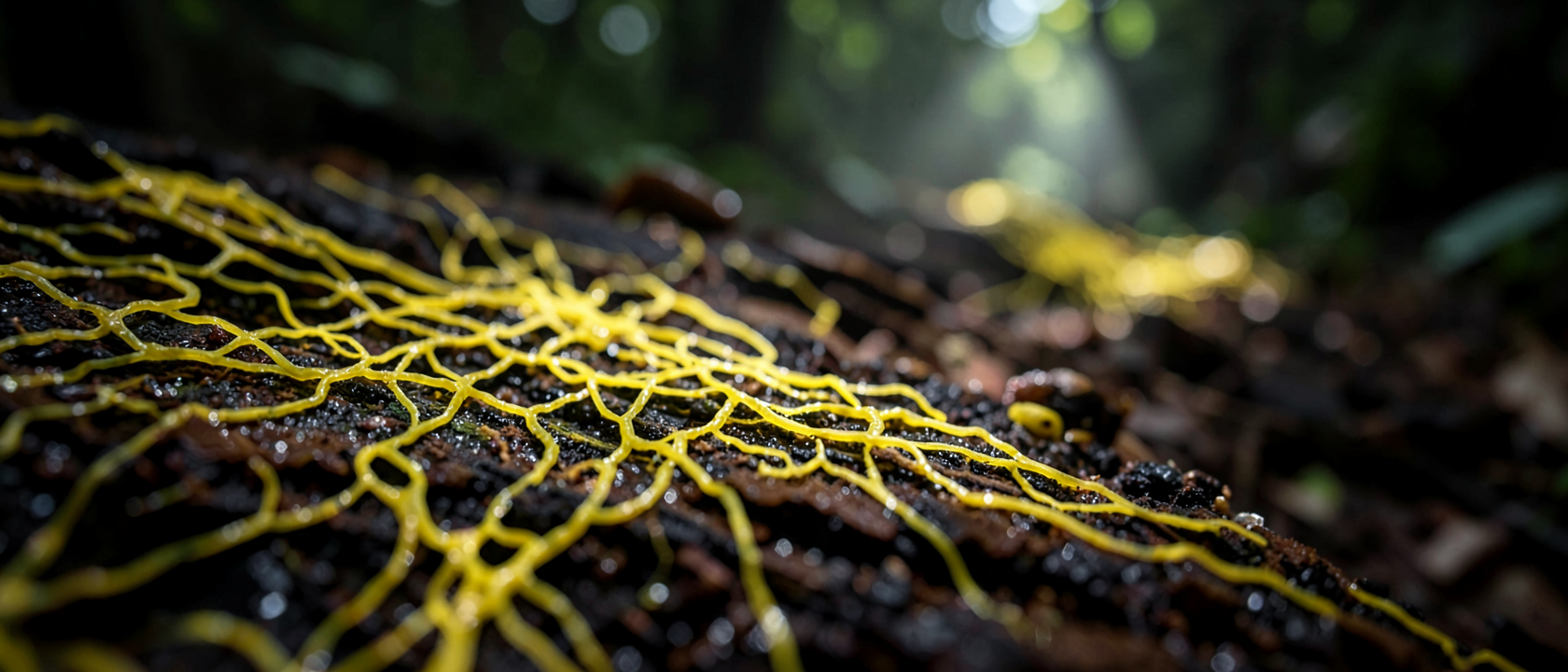
A yellowish film creeps across a rotting log, branching out in finger-like trails as if it’s deciding where to go next. It looks like one animal with a plan. It isn’t. That patch is roughly 20,000 individual cells that, not long before, were living completely separate lives in the soil, with no brain, no nervous system, and no single body holding them together.
That’s the real question here: how does a crowd with no leader and no wiring end up moving like one creature?
Not a Fungus, Not a Plant
The name “slime mold” misleads people into thinking fungus. They aren’t fungi, and they aren’t plants. Researchers at Arizona State University place them in their own lineage, the Mycetozoa, which splits into plasmodial slime molds, cellular slime molds, and the lesser-known Protostelia.
For most of their lives, there’s no “creature” at all, just single-celled amoebas crawling through soil and leaf litter, hunting bacteria the way any ordinary microbe does. Solitary is the default. Merging is the exception.
How Does a Crowd Decide to Become a Body?
Cellular slime mold amoebas feed on bacteria until the local supply runs out. Then something shifts: cells scattered across a patch of dirt start crawling toward each other and streaming together into one mass.
There’s no vote and no cell in charge. It’s the equivalent of a stadium crowd silently linking arms and walking off together, except the stadium is a few inches of soil and nobody said a word.
Chemical Choreography
The trick is chemistry filling in for conversation. As food runs low, cells start releasing a chemical signal. Neighbors detect it and crawl toward wherever it’s strongest, and as more cells join in and release the same signal, the pull gets stronger, like a chain reaction feeding itself.
Estimates for the final count vary by species and conditions, from around 20,000 cells forming one slug-shaped body up past 100,000 in some cases. Either way, there’s no nervous system running the show, just cell-to-cell chemistry with no conductor.
Not Just One Way to Merge
Cellular slime molds aren’t the only design. Plasmodial, or “acellular,” slime molds skip the slug altogether: two cells merge their DNA into one giant single cell that keeps growing, stretching tentacle-like extensions several yards (meters) long and pulsing as material streams between its edges and its core.
These are the organisms behind slime mold’s best-known trick: maze-solving. In lab tests, one spread through every passage of a maze about 1.6 inches by 1.6 inches (4 centimeters by 4 centimeters), then, once food was placed at two exits, reorganized within about 8 hours into the shortest path connecting both.
Acting Smart Without a Brain
Later studies found these same networked slime molds can mimic real-world rail layouts and work through routing problems, all without a single neuron involved. Some even leave a slime trail behind them that works like a memory, helping them avoid ground already explored.
None of that comes from a nervous system, because there isn’t one. It comes from countless chemical exchanges inside one cell producing something that, from the outside, looks a lot like a decision.
Some Cells Give Up Everything
Inside the slug-shaped body, not every cell gets the same ending. About 20 percent move to the top and build a slender stalk to hold the structure upright, producing rigid cellulose to keep it from flopping over, cellulose that also tears those cells apart as they make it.
The rest ride the stalk upward and become spores, the ones that disperse and continue the lineage. Research by David Queller and Joan Strassmann, studying Dictyostelium dug up at the Houston Arboretum, even found some strains are natural cheats, more likely to end up safe as spores while other strains’ cells do the dying.
What We Still Don’t Know
Scientists still don’t have a full picture of what triggers aggregation in the wild, and there’s genuine debate over how far “intelligence” should stretch when no brain is involved. Science writer Carl Zimmer helped bring this research to wider attention, and the field keeps moving as labs decode more of the signaling behind it.
What’s already clear is enough to unsettle a tidy assumption: that “one individual” and “one organism” are always the same thing. For slime molds, thousands of separate selves become a single self, then separate again, and somewhere in between, the line between “me” and “us” just isn’t there.