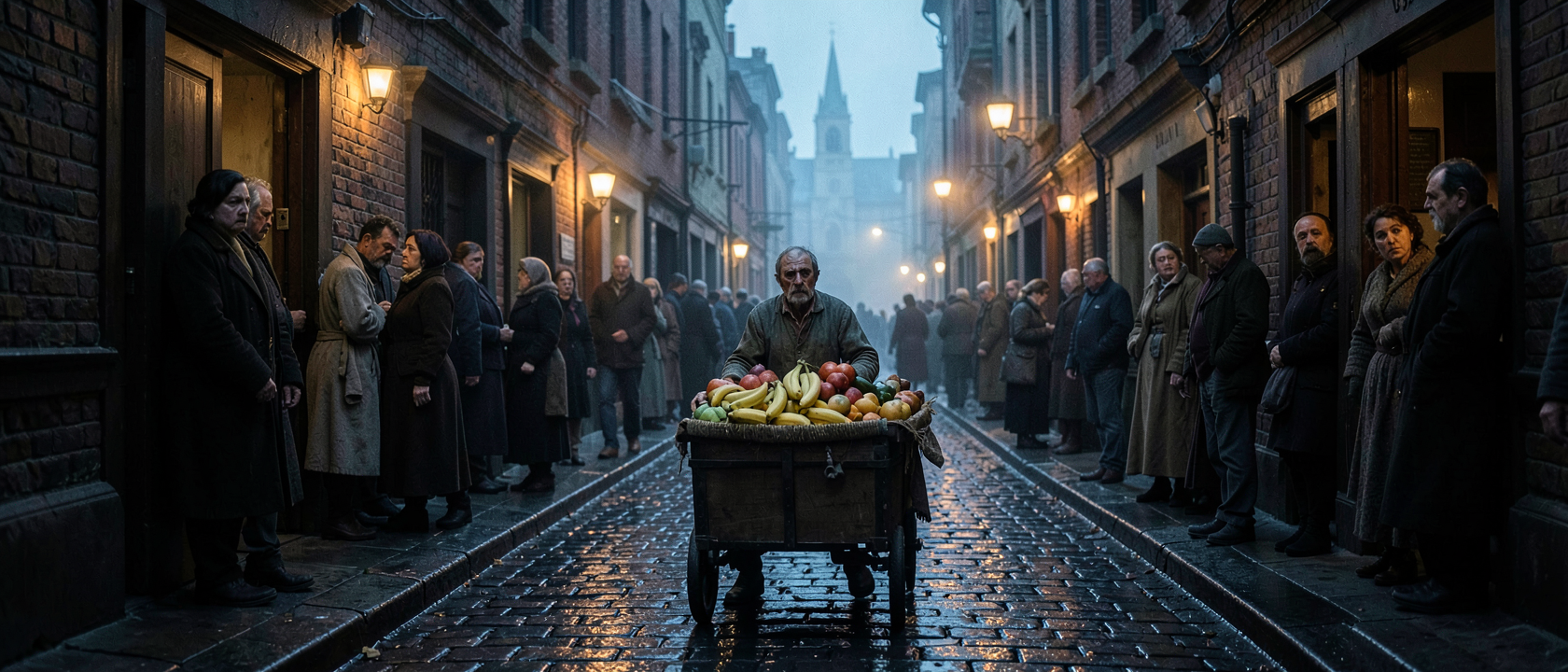
The Banana Man Nobody Would Stand Near
Picture Mulberry Bend in the late 1890s: narrow streets packed with tenements, carts, and more people per block than almost anywhere else in New York. Into that crush came Casoli Paracrotti, a small, ragged Italian fruit vendor pushing a cart of bananas. And when he appeared, the street changed. Religious neighbors muttered prayers and looked away. Superstitious ones reached for talismans, or rubbed the feet of dead rabbits for luck. Children scattered, screaming to each other to stay quiet or “the banana man” would kill them.
He carried no weapon. He had no record of violence against anyone. Yet a man selling fruit from a cart could empty a block faster than any known troublemaker in the neighborhood. What was actually happening here?
More Feared Than the Criminals Next Door
Mulberry Bend had plenty of real danger. Gangs operated in the open. Violence was not hypothetical. So why did none of that inspire the same gut-level dread that a poor banana seller did just by rounding a corner?
That question has nothing to do with Paracrotti’s character and everything to do with human psychology. People are often more afraid of an idea than a fact, especially when that idea comes pre-loaded with centuries of inherited belief. In this case, the belief had a name, and it had crossed an ocean with the people who carried it.
What a “Jettatore” Actually Was
In southern Italian and Neapolitan folklore, a jettatore is someone believed to carry the “evil eye,” known as malocchio. The idea is not that this person curses anyone on purpose. It is that misfortune simply follows them, radiating outward through nothing more than their presence or gaze. No spell required, no intent needed. Just proximity.
Italian immigrants brought this belief with them to New York, and in a tight enclave like Mulberry Bend it still carried weight. Somewhere along the way, Paracrotti became the neighborhood’s jettatore. A string of accidents, illnesses, or deaths among people who had crossed his path got tied back to him after the fact. Once that label stuck, every new misfortune near him was read as further proof, rather than as a separate, unrelated event.
Fifty Deaths, According to Whom?
One widely repeated version of the story claims that more than 50 people died simply from being acquainted with Paracrotti. That number alone should raise an eyebrow, and the evidence gets shakier once you dig into the original newspaper reprints from 1896 and 1897. One U.S. paper’s headline announced he had “killed thirty-three men by accident,” then later in the same article put the death count at 82. A separate reprint of the story, published in Brisbane in April 1897, mentions 26 souls on his conscience instead.
Same man. Same alleged curse. Three wildly different numbers, all from reprints of what appears to be the same syndicated tabloid story, and not one of them comes with a name, a date, or a documented cause of death. That is the pattern worth remembering: a round, frightening number with no sourcing behind it is usually a rumor that has been retold, exaggerated, and retold again, until it starts getting treated as settled fact.
Coincidence, Not Curse
Here is the mundane part of the story. Mulberry Bend was one of the most crowded, unsanitary, and genuinely dangerous places to live in Gilded Age America. Disease spread fast. Accidents happened constantly. Sudden death was, unfortunately, routine there, regardless of who was nearby when it struck.
What people remembered selectively was any misfortune that happened near Paracrotti, while ignoring the much larger number of tragedies that had nothing to do with him at all. That is confirmation bias doing exactly what it does: noticing the pattern that confirms a belief and discarding everything that doesn’t. In an era with little public health understanding and even less reliable record-keeping, superstition stepped in to explain what looked, at the time, unexplainable.
The Price of Being Feared
Strip away the legend and what’s left is a lonely man. No one wanted to be his friend. No woman would consider marrying him. Even at his own Catholic church on Roosevelt Street, he was pushed to the back pew, treated like he carried a contagious disease rather than simply bad luck. He was arrested more than once, though nothing in the record suggests he was actually dangerous or malicious, just careless, by most accounts, and unlucky in ways that got pinned on him rather than on circumstance.
That is the real story under the folklore: a poor immigrant turned into a convenient explanation for other people’s misfortune, punished for nothing he chose or caused. Finding someone to blame when things go wrong is an old habit, and it hasn’t gone anywhere. It just finds a new target each time.