A Teenager’s Strange Little Project
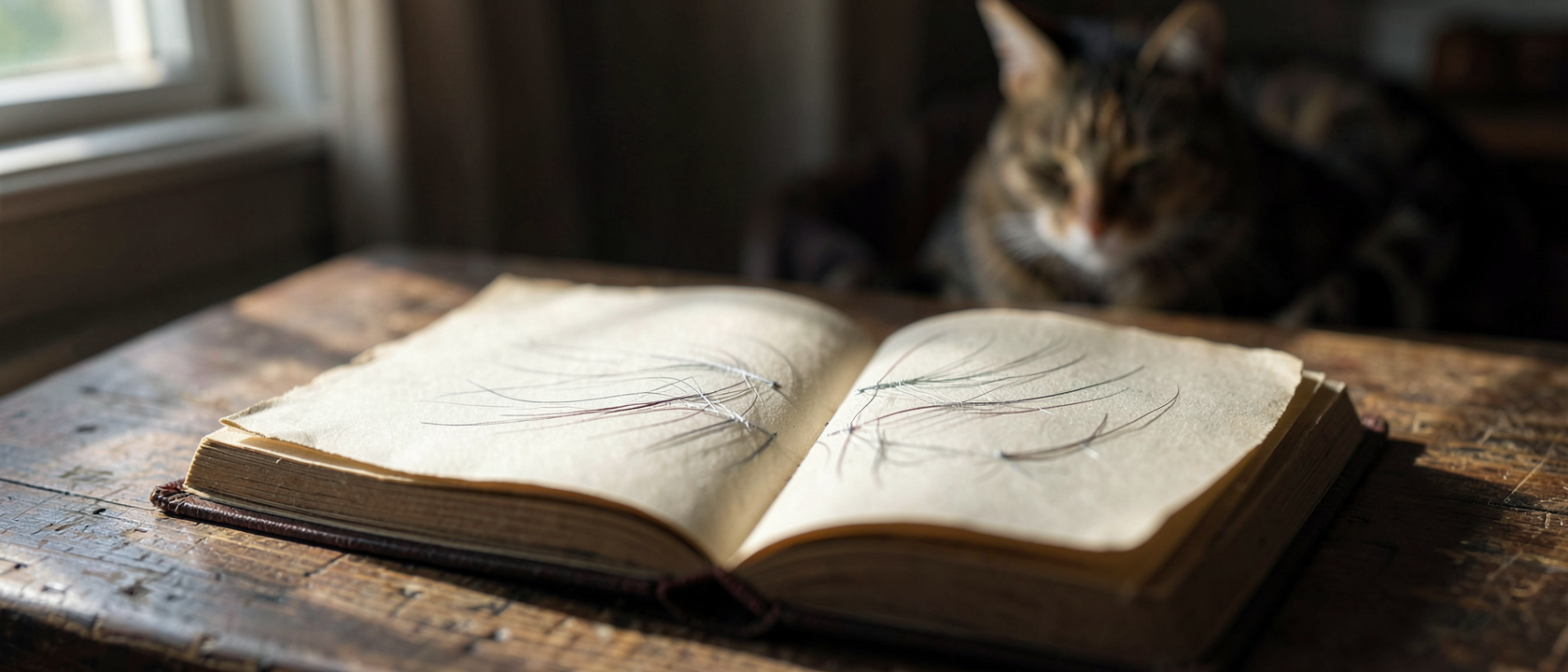
Sometime between 1940 and 1942, a British teenager did something most people would call pointless: picking up her cats’ shed whiskers from the floor, the hearthrug, even under the draft blocker on the back door, and keeping them. She wove each one into the page of a handmade book, dated it, and noted exactly how it turned up. “While playing darts.” “Under edge of linoleum in pantry.” “Dining room hearthrug.”
The girl was Janet Gnosspelius, born July 29, 1926, making her roughly 14 to 16 while she filled the book. Decades later she became a British architect and historical preservationist. None of that mattered yet, she was just a kid with tweezers, a notebook, and a habit that would end up defining her life.
Why Keep a Whisker?
A cat whisker isn’t rare, valuable, or useful once loose on a page. So why date, locate, and bind dozens of them like specimens? A bored kid’s one-off craft project doesn’t explain why the book survived, or why archivists later found it worth a second look. A pressed flower in an old diary is one thing; a dated, cross-referenced log of discarded cat hair is another. What kind of person makes that, and why would it matter to anyone else?
A Trait, Not a Hobby
The answer lies in who Gnosspelius became. As an adult, she ran a wide correspondence, all hand-typed on a battered Imperial typewriter, and edited other people’s work with what her obituary called a “caustic red pen.” Her local history and building conservation work involved mailing samples of old masonry to the Liverpool City Planning Office, each labeled with its provenance and date, demanding restoration rather than loss.
Set beside the teenage whisker book, the thread is hard to miss: find something small, record exactly when and where it appeared, keep it properly. The book was never really about whiskers, it was the first visible evidence of a mind that needed to classify, label, and preserve, years before that instinct had a career to attach to.
A Life Built from Small, Deliberate Details
Everything about how Gnosspelius lived ran on the same setting. Her obituary describes her in jodhpurs and handmade tweeds, cigarette holder in hand, driving a 1939 Sunbeam Talbot, with her cats “signing” many of her letters. She trained at the Liverpool School of Architecture, graduating in 1948 as one of only a few women in her class, then spent about three years on the Martins Bank Building with architect Herbert J. Rowse before building a reputation restoring churches.
In 1972, her report on the threatened Woolton Hall helped get it listed Grade I, the highest level of historic protection in the UK. She led carefully researched local history walks through the 1970s and 1980s, and each spring personally rewaxed a bronze bust of Queen Victoria. None of this was separate from her eccentricity, it was the same close attention applied to a whisker, a stone, or an entire building worth saving.
What Small Archives Tell Us
The whisker book now sits in the Collingwood Archive at Cardiff University, part of her mother’s family records, where archivists describe it as a diary that is “no ordinary one.” A private habit, kept for no audience, became public proof of who she really was, long after the teenager who made it had grown up, built a career, and died.
That’s usually how it works with small things people save: a diary, a shoebox of labeled ticket stubs, a bookshelf sorted by color instead of author. They look like nothing in the moment. Looked at later, they’re often more honest than any obituary, because nobody fakes a whisker book for an audience. If you’ve ever noticed that quiet pattern in someone, the stuff they file for no reason, the labels nobody asked for, you already know what Janet Gnosspelius proved at fifteen. The small, odd habit is rarely small. It’s usually the whole person, showing up early.