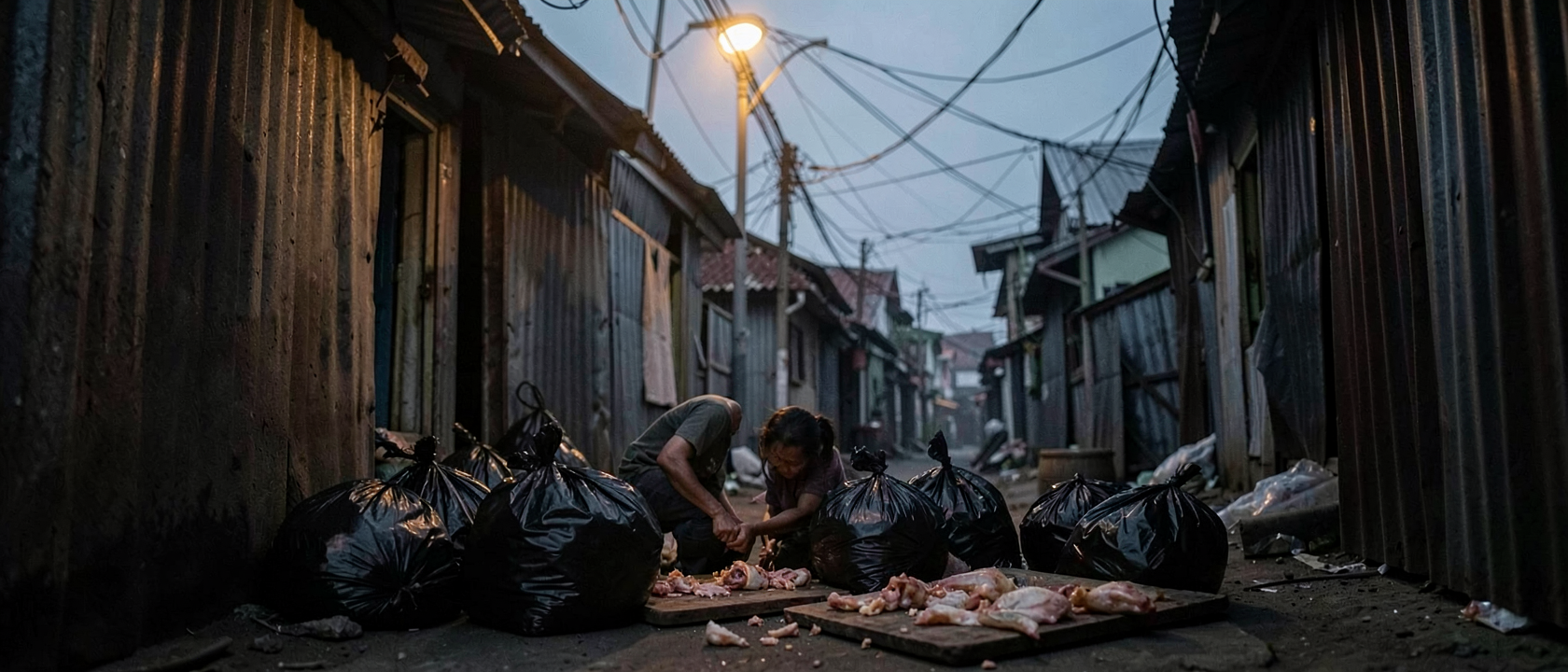
The Woman in the Alley
Felipa Fabon crouches beside a row of trash bags outside a fried-chicken restaurant in Manila, working in the evening light while stray cats circle the bins. Grease pools on the pavement and bones poke through torn wrappers as she sorts through it by hand. This isn’t a one-off errand. It’s a routine she repeats most nights just to get by, before heading home to Tondo, one of the poorest slums in the city.
In Tagalog, the word for what she’s collecting is “pagpag,” which literally means shaking the dust or dirt off something, the kind of word you’d use for a rug or a jacket. In Fabon’s world, it has picked up a second meaning: a dish made from chicken pulled straight out of the trash. CNN reported on her and this trade in 2012, and the word has stuck as the name for it ever since.
Who Pays for Garbage?
At first, the economics seem backwards. Trash is supposed to be the one thing nobody wants; once food hits the bin, we assume its value drops to zero, or below, since someone has to pay to haul it away. So why would anyone hand over money for it, sort it by hand, and sell it again?
Because between a restaurant’s dumpster and a family’s dinner plate in Manila’s poorest districts, a whole informal system forms around that garbage, complete with distinct roles and real prices at every step. Reporters who looked into it called it a hidden food system, one that runs on whatever the city’s middle class leaves behind in restaurant trash.
The Supply Chain of Scraps
It starts with a middleman known locally as a “trash dealer,” who collects discarded food scraps from a restaurant and sells that night’s haul to merchants like Fabon for just over a dollar.
From there, sorting is what turns garbage into an actual product with a price ladder. Pieces that still look like recognizable meat, say, a half-eaten chicken breast, get cleaned, reseasoned, and repackaged in plastic to sell the next morning. Scraps that are mostly bone go into a cheaper pile, about 20 pesos (roughly $0.50) a bag. Fabon starts dividing everything up at dawn, roughly six hours after the night’s supply first arrives.
That price of 20 pesos sounds small from the outside, almost like pocket change. But it only makes sense once you see who’s buying it and what else that money could do for them that day.
Why Twenty Pesos Can Be a Whole Day
One regular buyer, Morena Sumanda, a mother of two, lives in a shanty built on top of one of Manila’s biggest garbage dumps. She can’t pay the 20 pesos until her husband gets home in the evening, because that 20 pesos is a full day’s wage for him. That’s exactly why Fabon’s bags sell the moment they’re ready. Some mornings she has only five on hand, and they’re gone within minutes.
Dumpster Diving Has Two Very Different Meanings
Picture someone going through a restaurant’s dumpster at night. In wealthier countries, that image is often tied to urban foraging: people who dig through commercial trash on principle, to cut waste, save money, or live by a particular set of values. It usually reads as a lifestyle choice, sometimes even a point of pride.
Fabon is doing something that looks almost identical from the outside: same bins, same grease-stained bags, same late hours. The economics underneath, though, run in opposite directions. One version is optional, a statement about excess. The other is the only option on the table, the difference between dinner and nothing. Same gesture, opposite meaning, depending on whether choice is even part of the equation. That’s the part worth noticing: two people can do the exact same thing on the outside for reasons that have nothing in common.
What We Actually Know, and Don’t
Everything here traces back to a single CNN report from 2012, built around Fabon’s account of one night and the following morning. It documents a real, ongoing trade, not a rumor, but it isn’t a citywide survey either.
What the report leaves out matters too. There’s no count of how many people buy and sell pagpag across Manila, no indication of whether the trade has grown or shrunk since 2012, and nothing on what food safety oversight, if any, applies to it. Other sources say the same practice turns up under different names, like “batchoy,” in other slum areas such as Caloocan and Pasig, which hints at something larger than one woman’s morning routine. Exactly how large, though, stays an open question.