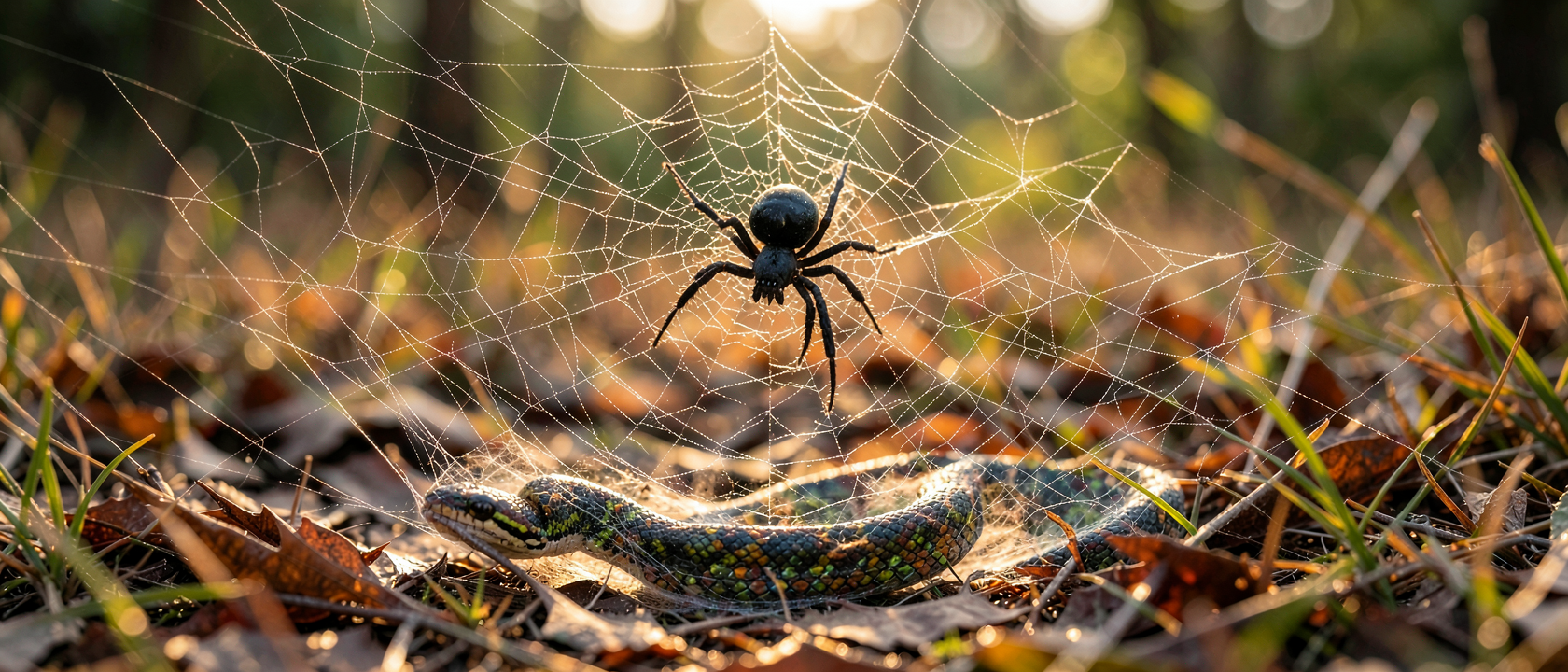
A Candy-Sized Spider Faces Down a Venomous Snake
Picture a spider the size of an M&M standing next to a dead snake many times its weight. That’s not staged, it’s a recorded scene from Australian backyards, where female redback spiders have been found with juvenile eastern brown snakes caught and killed in their webs. The eastern brown ranks among the most venomous land snakes on Earth, and it still loses.
Researchers say these spiders can take down snakes 10 to 30 times their own size, something like a tennis ball bringing down a grown man. It’s been recorded again and again, including on video. The mystery is how something that small beats something that dangerous.
Snakes Aren’t Supposed to Be Prey
On paper, snakes shouldn’t end up on a spider’s menu. Young snakes eat rodents, frogs, bird eggs, and even spiders themselves; size and venom usually keep them safe from anything but a hawk, an owl, or a larger snake. For a spider to flip that order, it needs a trap strong enough to hold something far bigger, or venom sharp enough to drop it fast. The successful snake hunters have both.
A Trap Built for the Ground, Not the Sky
Forget the tidy spiral orb most people picture. The redback’s web is a tangled mess built low to the ground, with sticky threads anchoring into the dirt, a style arachnologists call a tangle web, shared with North American widow spiders.
The clutter is the point: flying insects don’t need a web reaching the ground, but a crawling snake does. When one brushes a trip line, the strand tightens and sticks, and the snake thrashes into more lines with every move. What looks sloppy is built for something that crawls, not flies.
Wrap First, Bite Second
Once a snake is snagged, the spider keeps its distance and throws more sticky silk over the struggling animal, reinforcing the trap before taking any risk. Only once the snake is substantially pinned does it move in to bite.
The bite carries alpha-latrotoxin, a neurotoxin that targets vertebrate nervous systems rather than insect prey. A snake runs on the same basic nervous-system wiring as any other vertebrate, so once the toxin lands, size barely matters, potency does the work, not the volume a tiny spider carries.
Eleven Families, Forty Species, One Trick
The redback isn’t a one-off. A 2021 study by arachnologist Martin Nyffeler and herpetologist Whitfield Gibbons, published in the Journal of Arachnology, gathered 319 recorded cases of spiders feeding on snakes, found on every continent except Antarctica, tracing back to at least 11 spider families and roughly 40 species.
Widow spiders accounted for about half of all recorded incidents. Tarantulas, which hunt actively rather than trap, made up about 10 percent, and large orb-weavers another 8.5 percent, including a golden silk orb-weaver in Florida that caught a 39-inch (1-meter) green snake, the longest victim on record. Most captured snakes were young, averaging 10 inches (26 centimeters), and about 30 percent were venomous themselves. The United States and Australia hold roughly 80 percent of recorded cases; in Europe, the behavior is rarely seen at all. Even Nyffeler still finds it striking: he calls a brown snake losing to a spider “fascinating and a little frightening.”
The Questions Still Open
Nobody has fully explained why venom built for insects proves so effective against a much larger reptile’s nervous system, beyond the fact that alpha-latrotoxin targets vertebrates broadly. Nobody knows exactly how often this happens in the wild either, the 319 cases came from scattered sightings and reports, not systematic tracking, so the real frequency remains an open question.
What’s already clear is that “bigger always wins” has a documented exception sitting in plain sight, in backyards from Queensland to the American South. Next time someone says size settles every fight, there’s a spider no larger than a chocolate candy with a different opinion.