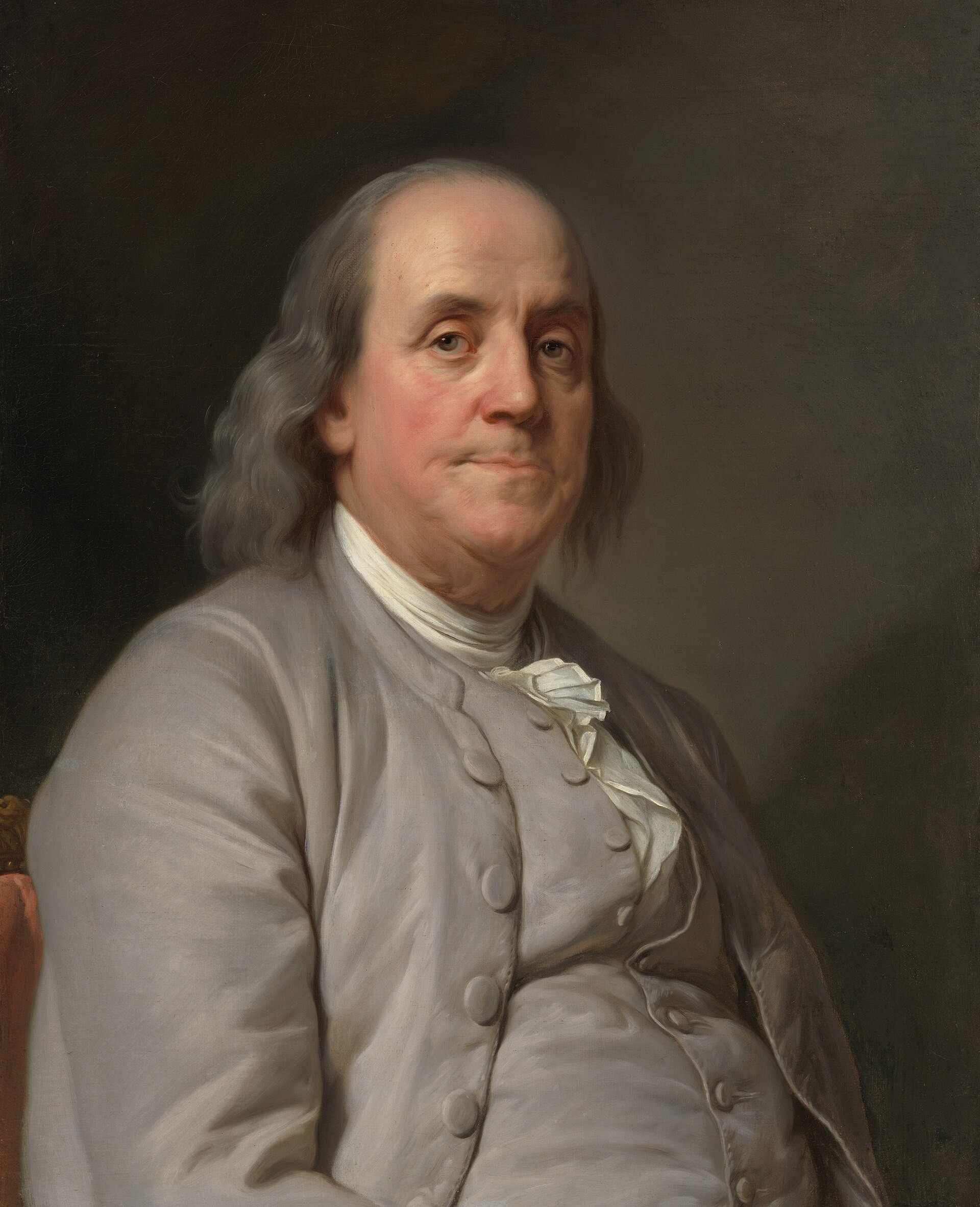
Benjamin Franklin, born on 17 January 1706 in Boston and died on 17 April 1790 in Philadelphia, was an American polymath whose career crossed science, printing, diplomacy, and politics across eight decades. His kite experiment of June 1752 demonstrated that lightning is electrical in nature, and his resulting scientific vocabulary, including the words battery, conductor, and electrician, remains in everyday use. Franklin was the oldest delegate at the Second Continental Congress at 70, a signer of the Declaration of Independence, and the man who secured French military support for the American Revolution during his years as the country’s first diplomat in Paris.
Key facts
- Born: 17 January 1706
- Birthplace: Boston
- Died: 17 April 1790
- Place of death: Philadelphia
- Country: British America; United States
- Occupation: politician; diplomat; polymath; writer
- Field: physics
- Employer: University of Pennsylvania
- Education: Boston Latin School
- Awards: Copley Medal; honorary doctor of the University of St Andrews; Fellow of the American Academy of Arts and Sciences
Early Life and Education
Franklin was born at 17 Milk Street, Boston, and was baptized the same day at the Old South Church’s Cedar Meeting House on what is now downtown Washington Street. His father, Josiah Franklin, a candle and soap maker, had emigrated from Northamptonshire, England, in 1682.
At age 8, Franklin attended South Grammar School, later known as Boston Latin, but left within a year because his family could not pay the fees. His formal schooling ended at age 10. He was, by any ordinary measure, almost entirely self-taught, yet that early departure from school did not slow the pace at which he absorbed ideas from books, observation, and practical experiment.
Printer and Publisher
On October 2, 1729, Franklin and his partner Hugh Meredith purchased the Pennsylvania Gazette, transforming it into the most successful newspaper in Britain’s American colonies. The paper became both his platform and his business foundation.
Franklin also won contracts to print the currencies of Pennsylvania, Delaware, and New Jersey. He described this as ‘a very profitable Jobb,’ a judgment he credited in part to his having published a 1729 pamphlet arguing the case for paper currency, which had brought him to the attention of the colonial authorities who awarded those contracts.
From 1732 to 1758, Franklin published Poor Richard’s Almanack annually under the pseudonym Richard Saunders, with print runs of about 10,000 copies per year. The almanac’s reach extended well beyond the colonies.
Science and Invention
In June 1752, Franklin conducted his kite experiment during a thunderstorm with the assistance of his son William. The experiment demonstrated the connection between lightning and electricity; his account of it appeared in the Pennsylvania Gazette on October 19, 1752. A point worth clarifying: Franklin did not discover electricity. He showed that lightning is a form of electrical discharge, which was itself a significant finding.
From that work he derived practical consequences. He coined the scientific terms battery, conductor, and electrician, all still current, and invented the lightning rod to protect buildings and ships. He refused to patent any of his inventions, stating he never proposed ‘to make the least profit by any of them.’
In 1753, the Royal Society of London awarded him the Copley Medal for his research in electricity. That same year, Harvard and Yale each granted him an honorary Master of Arts degree, the Harvard award being generally considered the first true honorary degree the university had conferred. In 1762, the University of Oxford awarded him an honorary Doctor of Laws.
Together with his cousin Timothy Folger, Franklin produced the first map of the Gulf Stream in 1768, published in London by the firm of Mount and Page. He was the first person to formally name and chart the current.
Civic Institutions
In 1731, Franklin founded the Library Company of Philadelphia, the first successful lending library in the Americas. He did so by persuading 50 founding shareholders to pool their resources and purchase books collectively.
In 1743, Franklin co-founded the American Philosophical Society with botanist John Bartram. It remains the oldest learned society in the United States. Franklin was elected its first president in 1769.
In 1751, Franklin co-founded Pennsylvania Hospital with physician Thomas Bond. It was the first hospital in the American colonies.
Revolutionary Politics and Diplomacy
At 70, Franklin was the oldest delegate to the Second Continental Congress and served on the Committee of Five that drafted the Declaration of Independence. His presence at that table, alongside men decades his junior, reflected a political standing built over a career in Pennsylvania’s colonial affairs.
In December 1776, he was sent to France as America’s first diplomat, charged with winning French military and financial support for the Revolutionary War. The mission succeeded. On September 3, 1783, Franklin, John Adams, and John Jay signed the Treaty of Paris with British commissioner David Hartley, formally ending the war.
In 1787, Franklin served as a delegate to the Constitutional Convention at age 81, making him the convention’s oldest member. He remained engaged with public affairs until the very end of his life: in 1787 he became president of the Pennsylvania Society for Promoting the Abolition of Slavery, and in 1789 his last public act was to submit to Congress a petition calling for the abolition of slavery and an end to the slave trade.
Death and Legacy
Franklin died on 17 April 1790 in Philadelphia. His funeral on April 21, 1790, drew an estimated 20,000 mourners, the largest funeral Philadelphia had ever seen. France declared a three-day mourning period.
In his will, Franklin left £1,000 each to the cities of Boston and Philadelphia, with instructions to hold the funds in trust for 200 years. By 1990, Boston’s trust had grown to approximately $4.5 million and Philadelphia’s to about $2 million. The long-range financial experiment he designed outlasted every institution he had founded in his lifetime.
Did you know
- At age 11, Franklin invented wooden swim fins shaped like oval pallets, worn on the hands to increase speed in the water. The invention earned him induction into the International Swimming Hall of Fame in 1968. (nps.gov)
- Franklin composed his own epitaph comparing his body to “the Cover of an old Book, Its Contents torn out,” and predicting he would “appear once more, In a new & more elegant Edition.” The text was never used on his actual gravestone. (constitutioncenter.org)
- Poor Richard’s Almanack was so widely read abroad that Napoleon ordered it translated into Italian. A French translation was also produced. (benjamin-franklin-history.org)
Data sources
- Wikidata
- fi.edu
- collections.americanantiquarian.org
- loc.gov
- battlefields.org
- history.com
- almanac.upenn.edu
- philadelphiaencyclopedia.org
- diplomaticrooms.state.gov
- whitehouse.gov
- archives.gov
- harvard.edu
- visitphilly.com
- constitutioncenter.org
- mymodernmet.com
- blogs.loc.gov
Data updated: 2026-10-31