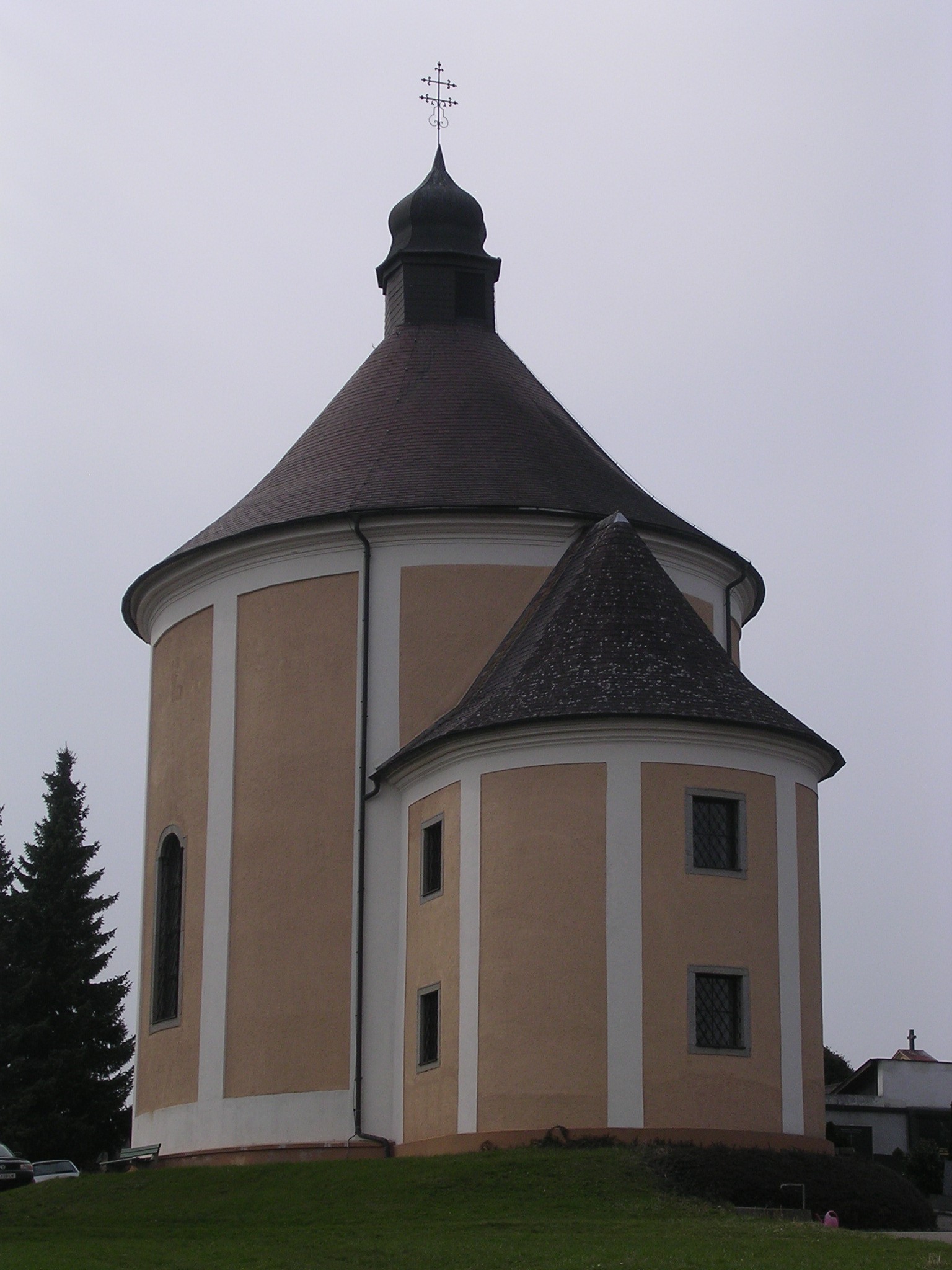
Perg is a town in the Perg District of Upper Austria, Austria, sitting on the Naarn river at an elevation of 250 metres, about 35 km east of Linz and approximately 7 km north of the Danube. With a preliminary figure of 9,483 inhabitants as of 1 January 2025 (Statistik Austria), it is the most populous municipality in the Mühlviertel region. Perg covers an area of 26 km² and has been the administrative seat of its district since 1868. For centuries its economy was built almost entirely on millstone quarrying, an industry that connected the town to grain mills across Central Europe.
Key facts
- Country: Austria
- Type: municipality of Austria; place with town rights and privileges
- Located in: Perg District
- Coordinates: 48.2503, 14.6336
- Population: 9,459
- Area: 26 km²
- Elevation: 250 m
Geography and setting
Perg lies at 48.2503° N, 14.6336° E in the lower Mühlviertel, a hilly granite landscape between the Danube valley and the Bohemian highlands. The Naarn river runs through the municipality from north to south: in its upper reaches it cuts through a narrow, deeply incised valley before spreading into a regulated channel across the flat Machland plain further south.
The town is surrounded entirely by seven municipalities, all of which belong to the same Perg District. The Danube flows only a few kilometres to the southwest, passing through the neighboring communes of Naarn and Mitterkirchen im Machland rather than through Perg itself.
History
The area around Perg has been inhabited since approximately 5000 BC, when Neolithic cultures first settled the region. Celtic tribes followed, and from around 14 BC the Romans dominated the area, declaring the left bank of the Danube a buffer zone.
During the Napoleonic Wars the town saw French troops under General Édouard Adolphe Mortier establish a camp in Perg in 1805. In 1809 soldiers from Württemberg marched through the Mühlviertel, bringing billeting and plundering with them.
Perg held the status of a market town (Marktgemeinde) for many centuries. On 21 April 1969 the Upper Austrian state government elevated it to a city (Stadt), simultaneously issuing formal confirmation of its coat of arms and municipal colors.
Perg has functioned as the Bezirkshauptstadt, the administrative capital of the Perg District, since 1868. The Perg District comprises 26 municipalities and recorded a total population of 70,979 as of 1 January 2025 (Statistik Austria preliminary figures).
The millstone trade
Millstone quarrying was the central economic activity in Perg from the Middle Ages onward. The first written mention of the “Perger Stainprecher” (millstone cutters) appears in a Freistadt council record dated 1391. At its height the guild numbered between 30 and 40 master craftsmen, and it persisted until 1860.
The stones were cut from a locally occurring crystalline, quartz-bearing sandstone and distributed throughout Central Europe for use in grain mills. The industry shaped not only the local economy but also the physical landscape.
The Steinbrecherhaus, a quarry worker’s dwelling built in 1802 and preserved with its original furnishings, stands on the grounds of the Scherer quarry. It forms part of the Mühlsteinmuseum Steinbrecherhaus and is one of the sites passed by the Kugelmanderlweg hiking loop.
Architecture and landmarks
The parish church of Perg, dedicated to Saint James the Elder, occupies a prominent position on the Hauptplatz. First documented in 1363, it is a three-aisled Gothic hall church that was rebuilt in the Late Gothic style toward the end of the 15th century and elevated to a full parish in 1542.
Among the town’s oldest surviving secular buildings is the Seifensiederhaus (soap boiler’s house) at Herrenstraße 1. An inscription chiseled into its granite door frame dates the building to 1563. Records show the soap-boiling trade operating in Perg between 1671 and 1879.
The Kugelmanderlweg, a circular Donausteig loop of approximately 9 km, begins and ends at the Karbrunnen fountain on the Hauptplatz. The trail connects the town center with cultural sites including the Steinbrecherhaus and the Scherer quarry.
Administration and public services
As the Bezirkshauptstadt of the Perg District, the town houses all major district administrative bodies. These include the Bezirkshauptmannschaft (district authority), the district court, the tax office, the Upper Austrian health insurance office (ÖGK), the labor market service (AMS), and the chambers of commerce and labor.
Did you know
- On 30 November 1582, Emperor Rudolf II confirmed the trade ordinance of the Perg millstone cutters, granting them exclusive rights to operate any millstone quarry discovered in the land above the Enns river. The monopoly was later reconfirmed by Leopold I, Karl VI, and Empress Maria Theresia. (perg.at)
- The Kugelmanderlweg trail takes its name from the “Kugelmanderln,” gnome-like figures from local legend who are said to guide lost wanderers. The legend is inscribed at the rest area in the hamlet of Weinzierl along the route. (gasthof-lettner.at)
Data sources
- Wikidata
- austria-forum.org
- tourmycountry.com
- www2.land-oberoesterreich.gv.at
- meinbezirk.at
- perg.at
- steinbrecherhaus.at
- donauregion.at
- stadtmarketing-perg.at
Data updated: 2026-10-31