A Gallery Full of Someone Else’s Entire Life
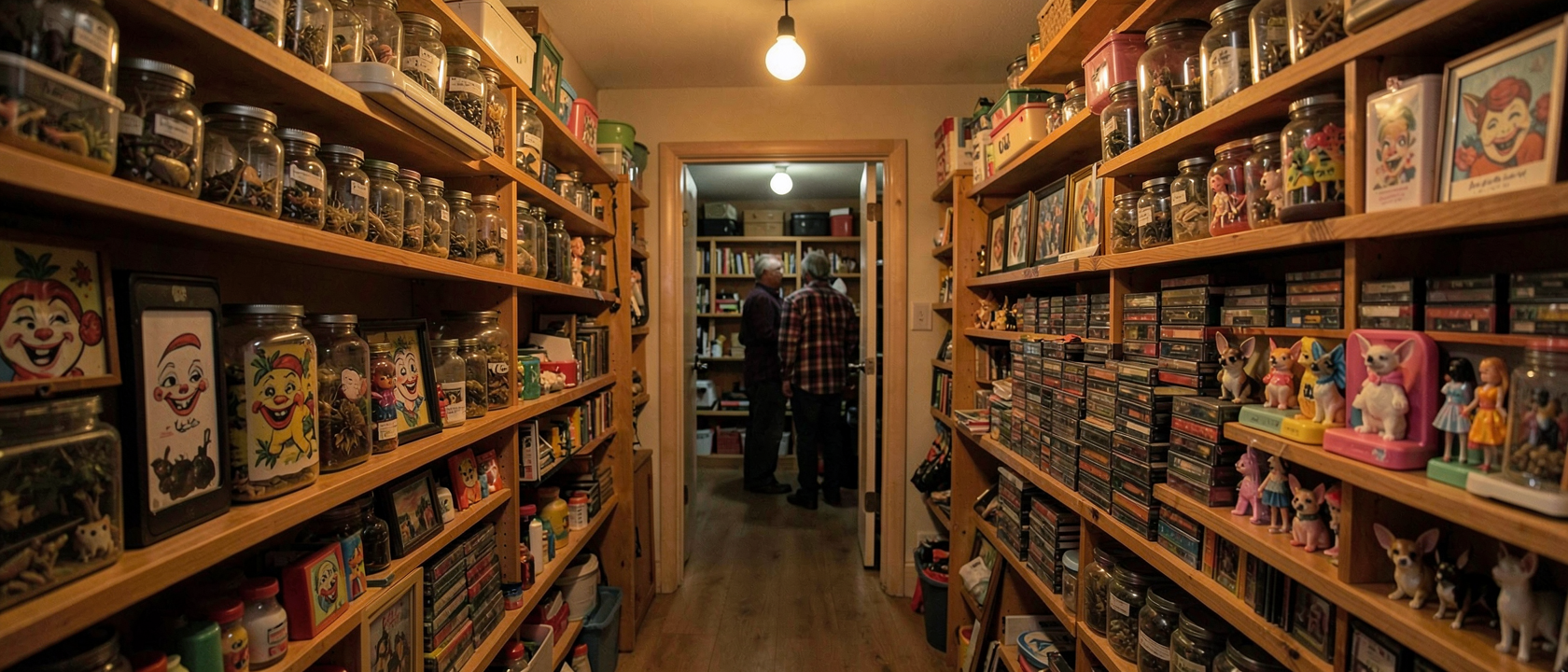
In early 2009, a Denver gallery called the Lab at Belmar mounted a show built entirely from one person’s house: cassette tapes of calls with telemarketers, amateur clown paintings, items tied to teeth and braces, sleeping bags, lunch boxes, jars of dead animals, watches, every concert ticket the owner had kept since high school, old trash cans, Dukes of Hazzard memorabilia, and a box of hair saved from college.
Nothing on the walls shared a theme, a decade, or a medium. The only thread was that one man had decided, object by object, that each thing was worth keeping. The curators named the show plainly: The Astounding Problem of Andrew Novick. A fair question follows: who collects like this, and why does it end up on a gallery wall?
Meet the Man Behind the Hundred-Plus
Novick isn’t a professional artist, and he says so himself. His day job is electrical engineer at the National Institute of Standards and Technology in Boulder, Colorado, in the Time and Frequency Division, where he’s worked since 1987 helping keep the nation’s atomic clocks accurate. He likes pointing out that the cesium atoms inside those clocks resonate at 9,192,631,770 hertz, precise enough to define a second, but insists he doesn’t personally watch the clock, that job belongs, in his words, to “a team of super smart physicists.”
In the late 1980s he sang in the Denver band Warlock Pinchers, and later co-owned an Asian pop culture shop, Gimme Gimme Pillow Toast, with his wife, Janene. None of that explains how he also ended up with what he estimates at more than one hundred separate collections, his own count, not an audited inventory. Even as an estimate, it raises a real question: how does one ordinary person end up with a hundred different collections instead of one very large one?
Not One Obsession. Dozens of Them.
The answer lies in how that hundred-plus breaks apart. Novick doesn’t keep one catch-all pile of odd objects; he keeps Barbie dolls of seemingly every variety made, Chihuahua figurines, clown paintings, and a separate collection of anything connected to teeth or braces, each filed under its own name.
That filing is the real trick. Someone who piles up random objects with no order gets called a pack rat. Michelle Baldwin, who co-curated his 2009 show, described him instead as “less of a hoarder and more of a collector.” Volume isn’t the difference; the sorting system is. Adam Lerner, director of the Museum of Contemporary Art Denver and the show’s other co-curator, compared Novick’s attention to ordinary objects to Andy Warhol’s, both men turning a habit of noticing the overlooked into something organized enough to display.
Where the Filing System Breaks
Even a hundred named collections eventually hit a wall. Beyond the labeled shelves, Novick keeps a rented storage unit and parts of his home packed with things that fit no category he’s bothered to name: cassette tapes of incoming answering-machine messages, a separate pile of tapes recording nearly every call he’s had with telemarketers, jars of dead animals preserved without formaldehyde, and a rotating stock of unusual foods.
None of that is curated the way the Barbie dolls or clown paintings are. It’s just kept, in bulk, past the point where naming each piece would help, roughly where any dedicated collector eventually lands: a scale past which cataloging stops being possible, and keeping becomes the whole point by itself.
The Question No One Has Answered
Here’s the detail worth noticing: nothing on record, not the 2009 exhibit, not the newspaper profile that first covered him, explains why Novick collects these specific things. No psychologist is quoted. No tidy theory ties it to childhood, trauma, or meaning. He’s been documented at length, but never diagnosed.
That’s not a gap in the reporting; it’s the actual shape of the story. Most people walk past small, rigid patterns every day without naming them: the friend who alphabetizes a spice rack, the coworker who remembers every concert in order, the relative who sorts mail by color before opening any of it. Novick just did it louder, at a scale that eventually needed a gallery wall and a rented storage unit to hold it. The explanation was never the interesting part, noticing that the pattern was there to name is the part worth keeping.