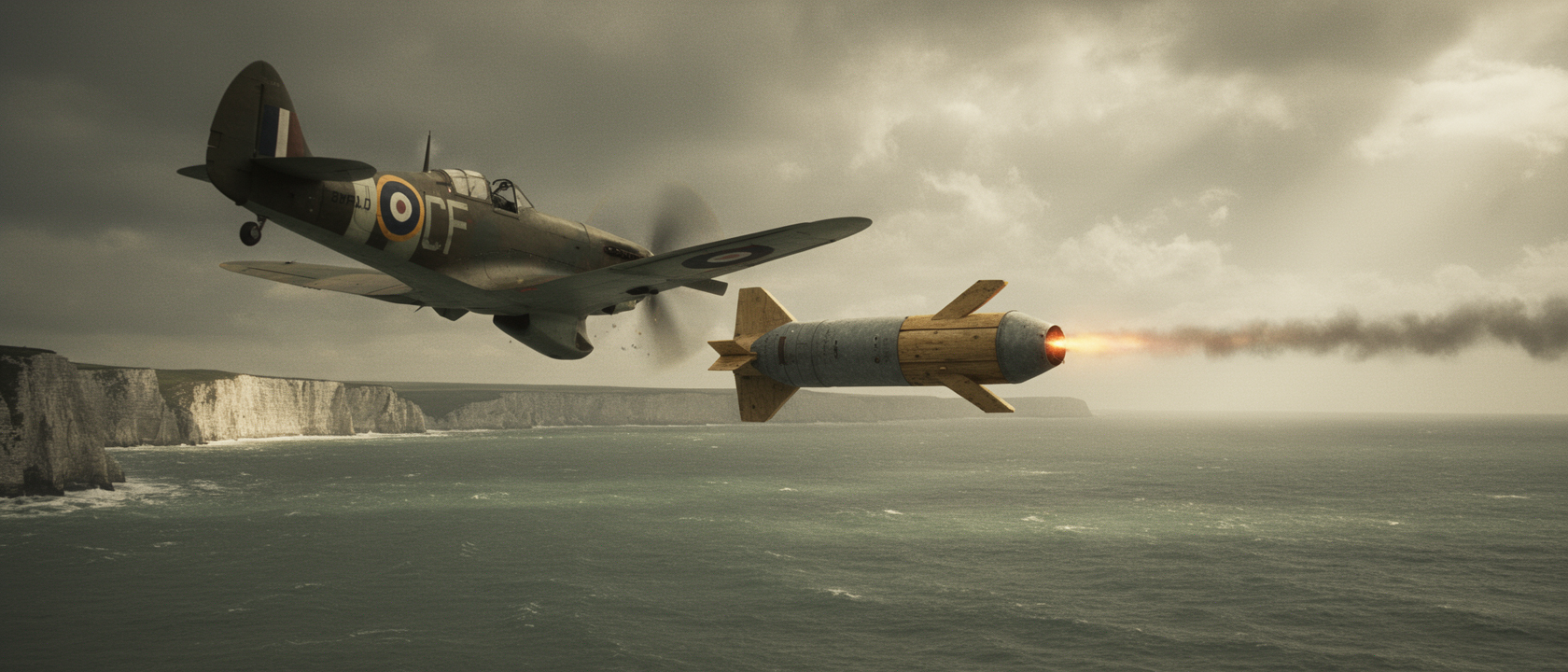
The Buzzing That Meant Danger
Londoners who survived the summer of 1944 described it consistently: a mechanical drone overhead, like an enormous angry insect, audible long before anything appeared in the sky. That sound came from one of the strangest weapons of the Second World War, the V-1 flying bomb, officially the Vergeltungswaffe-1, or Vengeance Weapon One. Allied troops called it the buzz bomb or the doodlebug. Both names capture something real.
What nobody wanted to hear was the silence.
When the engine cut out, the bomb was seconds from impact. Somewhere between five and fifteen seconds. Long enough to know it was coming, not long enough to do much about it. That silence was its own psychological weapon, separate from the explosion that followed.
Built Like a Farm Tool, Flew Like a Fighter
The V-1 reached speeds of roughly 400 miles per hour, carrying an 850-kilogram high-explosive warhead. Its fuselage was welded rolled sheet steel; its wings were plywood. Developed by Fritz Gosslau at Argus Motoren and Dr. Robert Lusser at Fieseler, it measured about 7.5 meters long with roughly a 5-meter wingspan. Nothing about those materials suggests 400 mph. The answer is in the engine.
Fire, Forty-Five Times a Second
The Argus As 109-014 was a pulse-jet, the simplest form of jet propulsion imaginable. Fuel enters a tube and ignites. The pressure spike slams shut spring-loaded shutter valves at the front and blasts exhaust out the back, creating a partial vacuum that pulls the valves open and draws in fresh air. The cycle repeats about 45 times per second, nearly 2,700 combustion events per minute. That mechanical hammering produced the characteristic buzzing and earned the weapon its nickname. Crude compared to a turbine jet, but not ineffective.
A Compass, Two Gyroscopes, and a Mallet
Guidance was minimal. A magnetic compass set the heading; two gyroscopes kept the missile level; a barometric sensor controlled altitude. A propeller-driven counter in the nose measured distance traveled, and once it reached a preset count, the system locked the elevators into a dive, which also starved the pulse-jet of fuel. That is precisely why silence preceded impact.
Before launch, ground crews struck the steel skin repeatedly with wooden mallets to reorient its residual magnetic field and correct compass interference. That combination of precision engineering and blunt-force calibration captures the V-1’s contradictory nature in miniature.
Zero to 200 Miles Per Hour in One Second
The V-1 could not take off under its own power. It needed a 49-meter inclined catapult ramp, powered by steam from mixing hydrogen peroxide with potassium permanganate, accelerating the missile to around 320 km/h in approximately one second. Gosslau had been pursuing pilotless aircraft since 1939, and in early 1942 he proposed the collaboration with Lusser that produced the final design. The first attacks on London began on June 13, 1944, with ten missiles launched, most failed to reach the city. One did.
Operation Diver: Building the Wall
Britain’s answer was Operation Diver, a layered defense that grew steadily more effective as it adapted. The Hawker Tempest V, the fastest single-engine propeller aircraft at low altitude during the war, was credited with 638 V-1 kills between June and September 1944, more than any other type. The de Havilland Mosquito added around 428 more.
Anti-aircraft guns became dramatically more effective once paired with the SCR-584 radar and the proximity fuze. In the first week of coastal gun deployment, 17 percent of incoming V-1s were destroyed. By August 23, 1944, that figure reached 60 percent, and by late August hit 74 percent, with one day reaching 82 percent. Shell consumption fell from roughly 2,500 rounds per kill to around 100.
Barrage balloons accounted for approximately 200 more. Despite all of it, around 6,100 people in Britain were killed by V-1s and roughly 17,000 wounded. By the end, the more pressing danger for an attacking pilot was staying close enough to fire without being caught in the detonation of an 850-kilogram warhead.