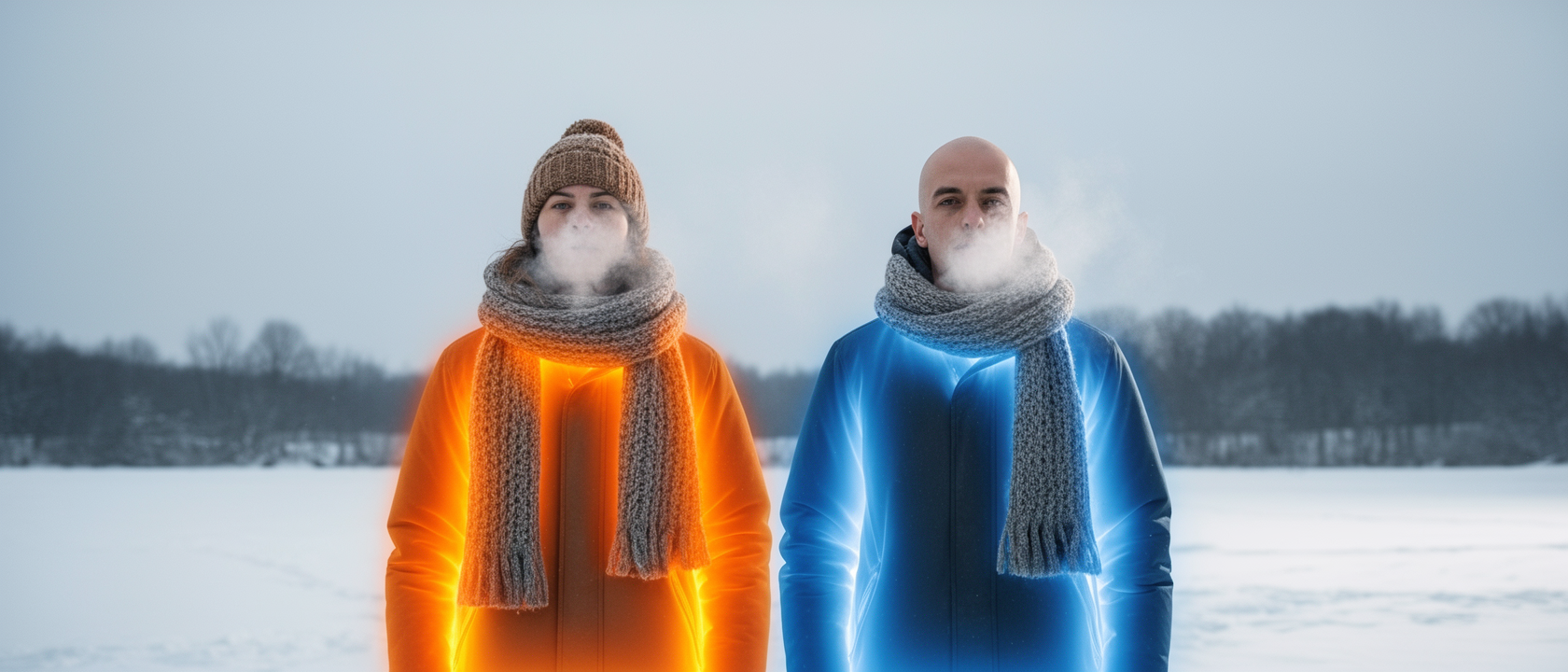
The Hat That Keeps You Warm, Or Does It?
At some point in childhood, most of us got the same lecture: put your hat on, you’ll lose most of your body heat through your head. The advice travels through generations like a household law. It has the ring of established science.
It isn’t.
Where the 40 Percent Figure Came From
The U.S. Army Field Manual once stated that a person could lose between 40 and 45 percent of body heat through an unprotected head. That figure traveled into parenting advice, survival guides, and sports coaching. The trouble is that the Army experiments behind it, conducted in the 1950s, contained a flaw nobody caught for decades.
The test subjects wore Arctic survival suits covering the entire body from the neck down. Their heads were left bare. With every other surface sealed off, heat poured out through the skull, because the skull was the only uncovered area. Measuring that and concluding “the head loses most heat” is roughly like taping over every vent in a room except one, then declaring that vent is abnormally leaky.
In December 2008, physicians Rachel C. Vreeman and Aaron E. Carroll at the Indiana University School of Medicine published a paper in the British Medical Journal formally debunking this and other persistent medical myths (BMJ, doi:10.1136/bmj.a2769). The flaw in the Army reasoning had gone unexamined for roughly fifty years.
The Geometry of Heat
Heat escapes through skin in proportion to exposed surface area. The adult head accounts for about 7 to 9 percent of total body surface area, close to the medical “Rule of Nines” used in burn assessment. Standing outside in a swimsuit, your head would account for roughly 7 to 10 percent of total heat loss. Nowhere near half.
Researcher Thea Pretorius and colleagues at the University of Manitoba tested this in a 2006 study, immersing subjects in cold water both with and without wetsuits, and with heads submerged or above the surface. Results tracked closely with what exposed surface area alone would predict. Richard Ingebretsen, MD, PhD, at the University of Utah School of Medicine stated the logic plainly: when the rest of the body is clothed, the head loses a disproportionate share simply because it is the only part left uncovered. There is nothing biologically special about the head that makes it radiate heat faster than a knee or forearm of the same surface area.
A simple thought experiment makes this concrete: if the myth were true, going hatless in winter would feel about as bad as going without insulated trousers. Anyone who has ever forgotten a hat but kept their legs warm knows that is not how cold works.
Why Your Face Files a Complaint
So why does the hat feel so effective? The face, scalp, and neck carry a much higher density of thermoreceptors than the back or thighs, roughly two to three times more sensitive to temperature shifts. Step into cold air and these regions report the change loudly and fast. The rest of your body feels it too; it simply lacks the nerve coverage to broadcast it at the same volume.
The dramatic warmth you feel when you pull on a hat is largely the silencing of a very loud alarm, not the plugging of a very large hole.
What the Body Actually Does in the Cold
When temperatures drop, the body’s first response is vasoconstriction: blood vessels in the limbs narrow, keeping warm blood near the brain and vital organs, though at the cost of raising frostbite risk in fingers and toes. When that is not enough, shivering starts, muscle contractions that produce heat as a byproduct. Goosebumps raise body hair, which insulates animals with dense fur well; in humans, the effect is minimal.
None of those mechanisms are concentrated in the head. A hat on a cold day is a perfectly sensible choice, but a pair of well-insulated leggings covering far more surface area does more thermal work than any beanie ever will.