Your Mouth Is Not Tasting the Heat. It’s Registering an Alarm.
When you bite into a hot pepper, your tongue doesn’t taste heat the way it tastes sweetness or salt. It feels heat, the same way it would feel a lit match held too close. That means something is genuinely going wrong in your nervous system every time you reach for the hot sauce.
A Receptor That Can Be Fooled
The compound responsible is capsaicin, formally known as 8-methyl-N-vanillyl-6-nonenamide. It binds to a nerve receptor called TRPV1 (Transient Receptor Potential Vanilloid 1), which normally warns your body when something is dangerously hot. Capsaicin simply opens that channel without any thermal event to justify it. Calcium ions flood into sensory neurons, an emergency signal races to your brain, and the brain interprets it as fire. Because the experience travels through pain pathways rather than taste pathways, spiciness varies wildly between people, age, prior exposure, and pain-receptor density all affect perception. Two people eating from the same jar can have completely different experiences, and neither is wrong.
Who the Heat Is Actually Meant For
Capsicum plants didn’t arrive at capsaicin by accident. Mammals are destructive eaters, rodents crush seeds when chewing, ending the plant’s reproductive ambitions. Birds swallow seeds whole and deposit them elsewhere unharmed. Avian TRPV1 receptors are structurally different: a single amino acid substitution at position A578 makes the bird receptor insensitive to capsaicin. A bird can eat the hottest pepper available and feel nothing. The pepper has built a biological filter that repels the wrong visitors while leaving the right ones unaffected.
The Five Humans With the Difficult Job
For much of the 20th century, the only way to measure pepper heat was to taste it. In 1912, pharmacist Wilbur Scoville, working at Parke-Davis in Detroit, dissolved ground pepper samples in alcohol and sugar water and offered them to a panel of five tasters. If any detected heat, the solution was diluted and offered again, until no taster felt any burn. The number of dilutions required became the pepper’s Scoville Heat Unit (SHU) rating. The weaknesses were obvious: repeated sampling caused sensory fatigue, personal tolerance varied too much, and the same pepper submitted to two labs could return ratings 50% apart.
Replacing Human Judgment With Chemistry
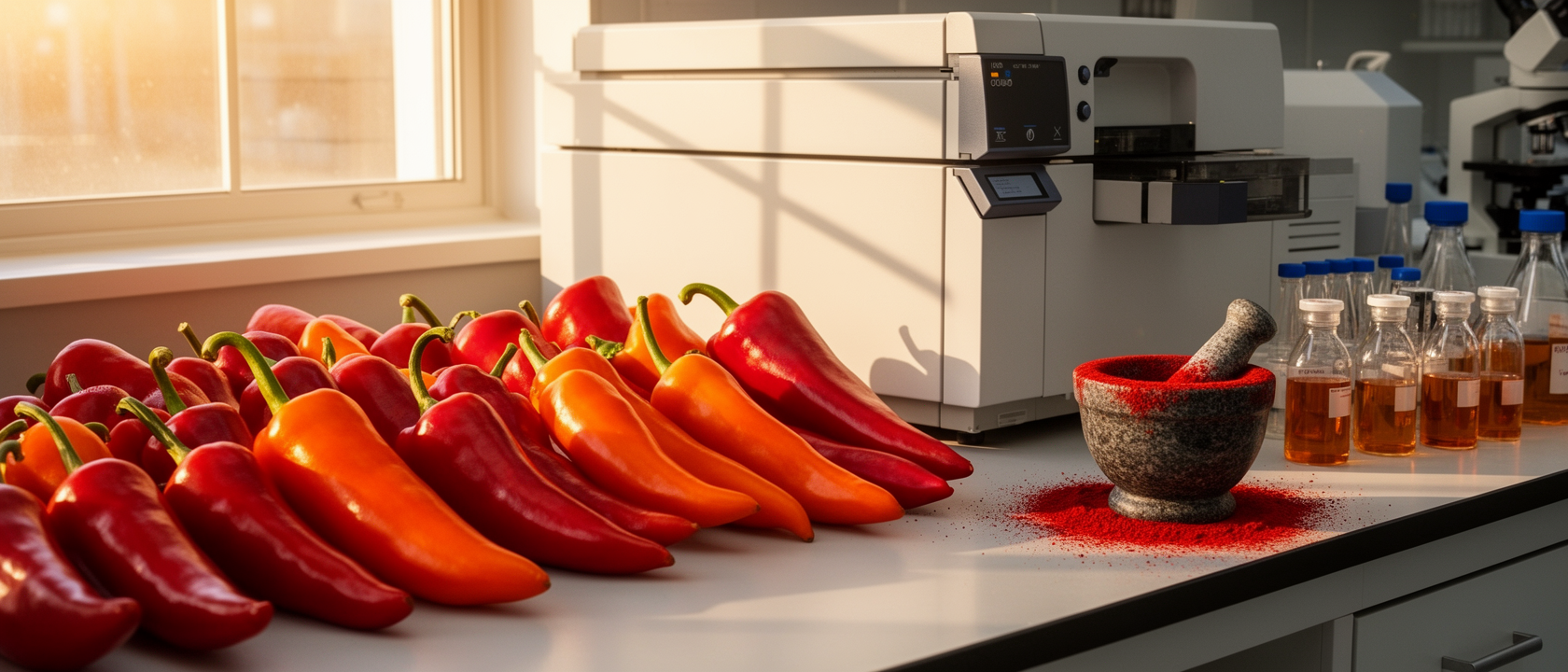
Starting in the 1980s, laboratories switched to high-performance liquid chromatography (HPLC). A pepper sample is dissolved and pushed through a column of porous material; different compounds migrate at different rates, and a detector measures exactly how much of each arrives. Results are reported as parts capsaicin per million parts dry pepper mass, then multiplied by 16 to convert to SHU, keeping modern figures comparable to historical ones while grounding them in chemistry rather than committee consensus.
What the Numbers Actually Look Like
A bell pepper registers 0 SHU. A jalapeño falls between 2,500 and 8,000 SHU. Police-grade pepper spray runs roughly 1.5 to 2 million SHU. Pure capsaicin reaches 16 million SHU. The Carolina Reaper, bred by Ed Currie of PuckerButt Pepper Company in Fort Mill, South Carolina, was Guinness-certified in November 2013 and recertified in August 2017 at an average of 1,641,183 SHU. On August 23, 2023, that record passed to another Currie creation, Pepper X, certified at an average of 2,693,000 SHU by Winthrop University in South Carolina, though independent third-party verification has not been conducted.
The Scale Has a Much More Distant Ceiling
Pure capsaicin at 16 million SHU sits nowhere near the top of what chemistry can produce. Resiniferatoxin (RTX), found in Euphorbia resinifera on Morocco’s Atlas Mountains and Euphorbia poissonii from Nigeria, also binds to TRPV1, but with such force that it causes a sustained calcium influx capable of destroying pain-sensing neurons outright. Its rating is approximately 16 billion SHU, some 500 to 1,000 times the potency of pure capsaicin. That precision in targeting pain receptors while leaving surrounding cells intact is why researchers are studying RTX as a potential chronic-pain treatment. What makes a hot pepper feel dangerous is, in the chemistry of pain, barely the opening act.