When the British Army Tried Rocket Wheels and an Ice Aircraft Carrier
Most people picture WWII weapons as tanks, bombers, and submarines. But tucked inside the British war machine was a unit called the Directorate of Miscellaneous Weapons Development, nicknamed by its own staff “the Wheezers and Dodgers.” Their job was to solve problems nobody else could figure out. Some solutions were brilliant; others went spectacularly sideways.
Two Problems, Two Improbable Answers
By 1943, the Allies were preparing for the D-Day landings on June 6, 1944. The German Atlantic Wall included reinforced concrete up to 10 feet high and 7 feet thick. At the same time, German U-boats were savaging Allied shipping in the mid-Atlantic, beyond the range of land-based aircraft, and building more carriers required steel and aluminum the war was consuming faster than factories could produce.
The Great Panjandrum
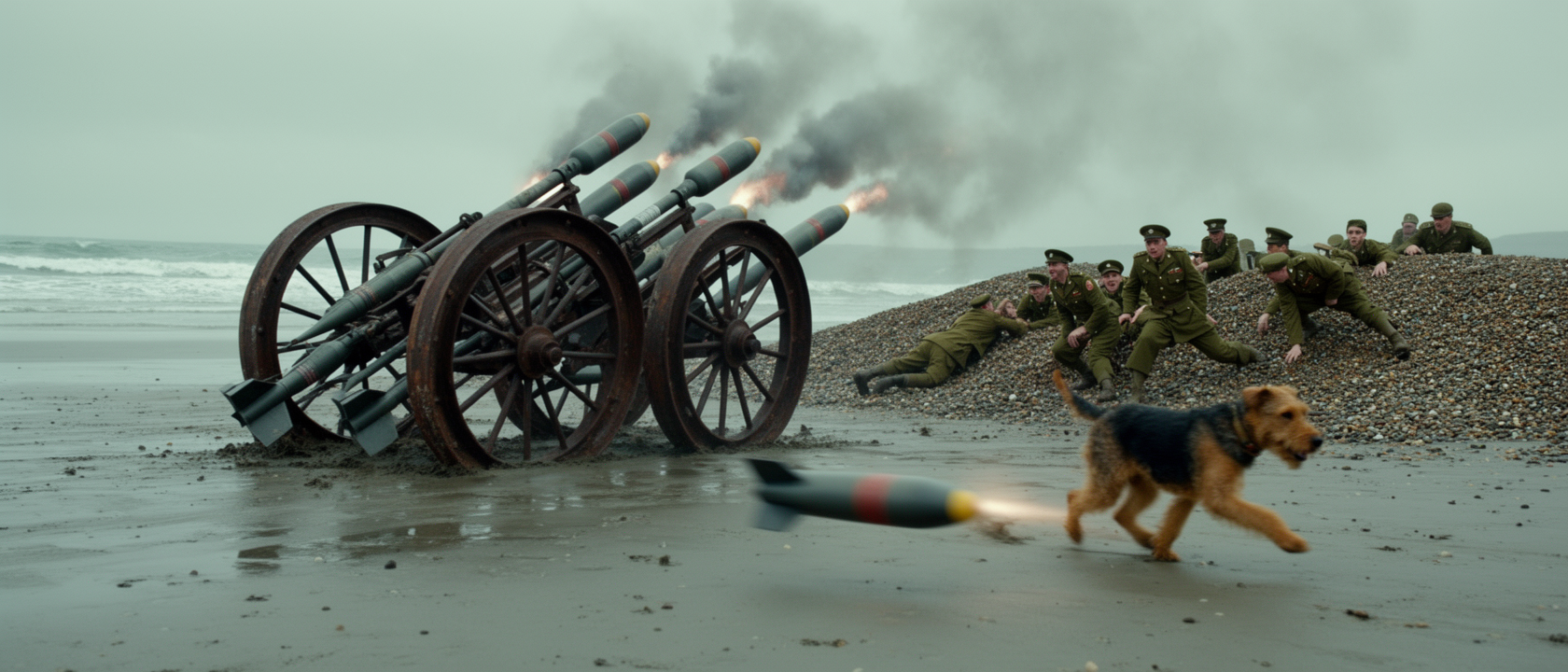
The Wheezers and Dodgers’ answer to the concrete wall problem was the Great Panjandrum, a name borrowed from 18th-century comic nonsense by playwright Samuel Foote, which turned out to be grimly appropriate. Two steel wheels, each 10 feet across, were connected by a central drum packed with 4,000 pounds of high explosive. Cordite rockets mounted around both rims would propel the device across a beach at roughly 60 mph. The problem was the rockets: if one side fired unevenly, the device veered.
The first test on September 7, 1943, at Westward Ho! in Devon played out before curious vacationers who had no idea what they were watching. Subsequent tests doubled the rockets, added a third wheel for stability, and reached near-design speed, before shedding rockets into the sea and overturning.
The Final Test, January 1944
The definitive run came in January 1944, with admirals, generals, and cinematographer Louis Klemantaski watching from the beach. The rockets ignited and shed in every direction. The device veered, generals dove behind a pebble ridge into barbed wire, and an Airedale named Ammonal chased a stray rocket across the sand. The project was scrapped shortly after. Klemantaski’s footage survived and remains one of the more startling documents of wartime engineering.
Some historians have argued the program was deliberate deception, meant to convince German intelligence that exotic beach-assault weapons were aimed at Pas-de-Calais rather than Normandy. DMWD head Charles Goodeve disputed this. Whether the chaos was genuine or calculated, the footage speaks for itself.
Pykrete: The Material That Made an Ice Carrier Almost Possible
Geoffrey Pyke, a British inventor working for Combined Operations Headquarters, proposed building a mid-Atlantic carrier out of ice. Pure ice is brittle, tensile strength around 1.1 MPa, breakable with a small hammer, so useless for a hull absorbing torpedo hits. The fix was adding wood pulp before freezing. The resulting composite, named Pykrete after Pyke, was roughly 86% water and 14% sawdust. That small addition pushed tensile strength to approximately 4.8 MPa, stronger than concrete at 1.7 MPa, while also slowing melting and allowing the material to be machined like wood.
The proposed ship was 2,000 feet long and 300 feet wide, displacing 2.2 million tons, with room for 150 aircraft and 40 gun turrets. The catch: Pykrete creeps under its own weight over time. Preventing the hull from sagging would have required refrigeration keeping the entire structure at around 3°F, and construction would have demanded 300,000 tons of wood pulp. The project was cancelled in December 1943.
A 1,000-ton, 60-foot prototype was built on Patricia Lake in Alberta, kept frozen through summer by a single one-horsepower motor. It took three summers to fully melt after cancellation, and the metal components still rest at the bottom of the lake.
The 2009 Postscript
In 2009, a team built a three-quarter-scale replica of the Great Panjandrum in Devon using modern solid-fuel rockets. It traveled 50 meters in a straight line, which suggests the underlying concept was not inherently broken, just that 1940s cordite rockets were too unreliable to fire evenly. For the Wheezers and Dodgers, that is probably cold comfort.