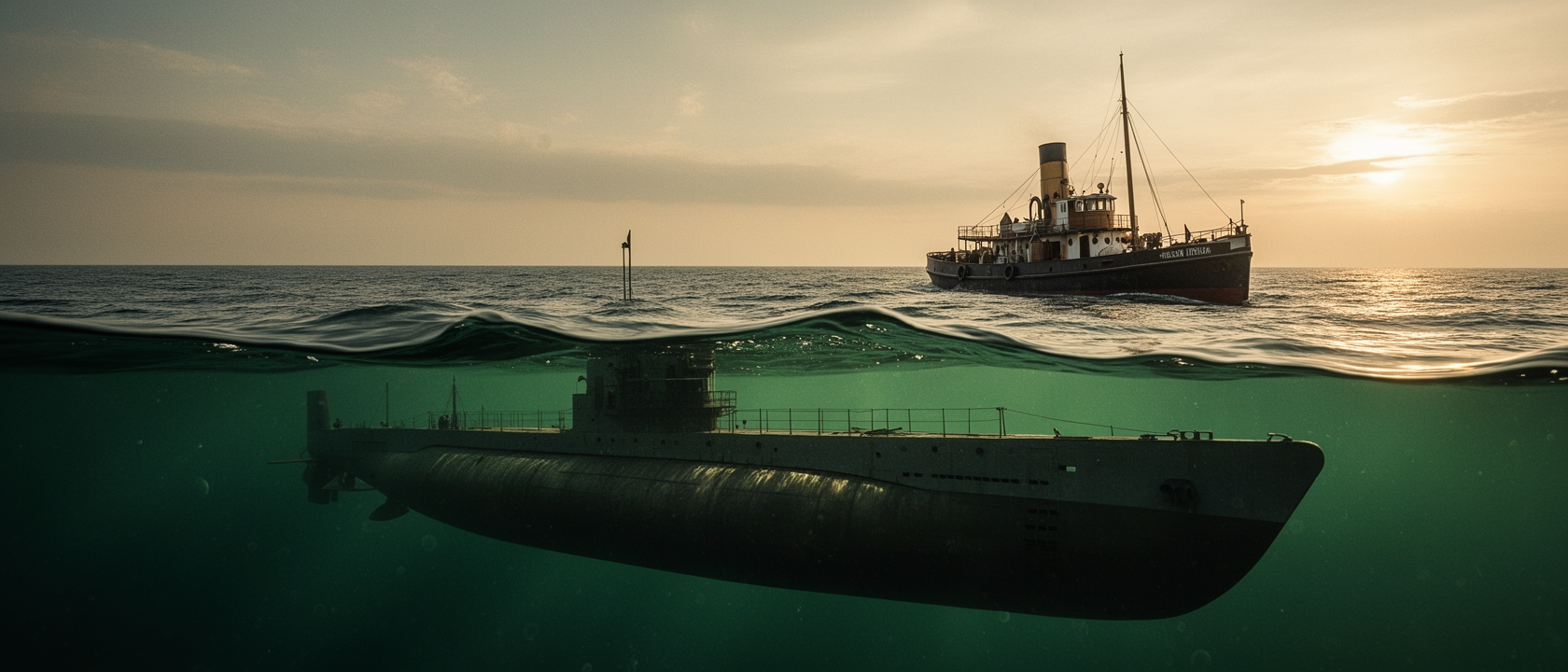
The U-Boat That Delivered Medicine to Baltimore
On July 9, 1916, a German submarine glided into the waters off the Virginia coast and made contact with a waiting tugboat. No alarm was raised. No shots were fired. The submarine had come to do business.
The crew was feted at banquets, American textile merchants clamored for synthetic dyes, and an unarmed U-boat sat anchored in a neutral harbor while British diplomats fumed, it remains one of the stranger episodes of the First World War.
A Wall Across the Atlantic
When war broke out in August 1914, the British Royal Navy moved quickly to seal off German ports, cutting Germany off from overseas raw materials its industries depended on: rubber, nickel, and tin. Any surface ship attempting to trade with the neutral United States ran directly into British patrols.
A consortium organized under the name Deutsche Ozean-Reederei, a subsidiary formed by Deutsche Bank and the North German Lloyd shipping company, came up with an answer. Not around the blockade. Under it.
The Loophole With a Hull
The vessel they built was the Deutschland: 213 feet (65 m) long, displacing roughly 2,505 short tons (2,272 tonnes), with a cargo hold rated for 772 short tons (700 tonnes). She carried no weapons, no torpedoes, no deck guns. Under U.S. neutrality law, an unarmed vessel was classified as a merchant ship regardless of its shape, the moment she reached Baltimore, she was legally just a freighter that happened to travel underwater.
British and French diplomats protested immediately. The U.S. government ruled in Germany’s favor. Her commander, Captain Paul König, was treated less like an enemy officer than a visiting dignitary, attending dinners while his crew toured the city.
What Was Worth the Trip
Everything in the cargo hold had to justify its place in dollars per cubic foot. The Deutschland‘s outbound cargo, worth approximately $1.5 million in 1916, consisted of 138 short tons (125 tonnes) of synthetic dyes coveted by the American textile industry, along with the drug Salvarsan, gemstones, and mail, compact, valuable, and urgently wanted.
The return cargo made plain what Germany actually needed. The Deutschland left Baltimore on August 2, 1916, carrying 384 short tons (348 tonnes) of crude rubber, 376 short tons (341 tonnes) of nickel, and 103 short tons (93 tonnes) of tin, worth roughly $17.5 million, more than eleven times what the ship had brought over.
Underwater, Rarely
Of the full 9,726-mile (15,650 km) round trip, the Deutschland was submerged for only about 218 miles (350 km), roughly 2 percent of the total distance. On the surface she could manage around 12.4 knots; submerged on batteries, that dropped to about 5.2 knots and could not be sustained for long. Diving was something she did when she had to.
After the Trade Routes Closed
The Deutschland made two voyages in all. The second, in November 1916, ended in New London, Connecticut, and was marked by a grim accident: on November 17, 1916, the submarine rammed and sank the tugboat T.A. Scott Jr. in Long Island Sound, killing five crew members.
A third voyage was planned and then cancelled. On February 19, 1917, the Deutschland was formally converted into an armed cruiser submarine redesignated U-155, fitted with torpedo tubes and deck guns. The United States declared war on Germany on April 6, 1917. Between 1917 and the Armistice, U-155 sank 43 ships totaling 120,434 gross register tons (a standard measure of a vessel’s cargo-carrying capacity), surrendering to the British at Harwich on November 24, 1918.
For two voyages in 1916, the same vessel had delivered medicine and synthetic dye to American ports without firing a shot. Nothing like it has happened before or since.