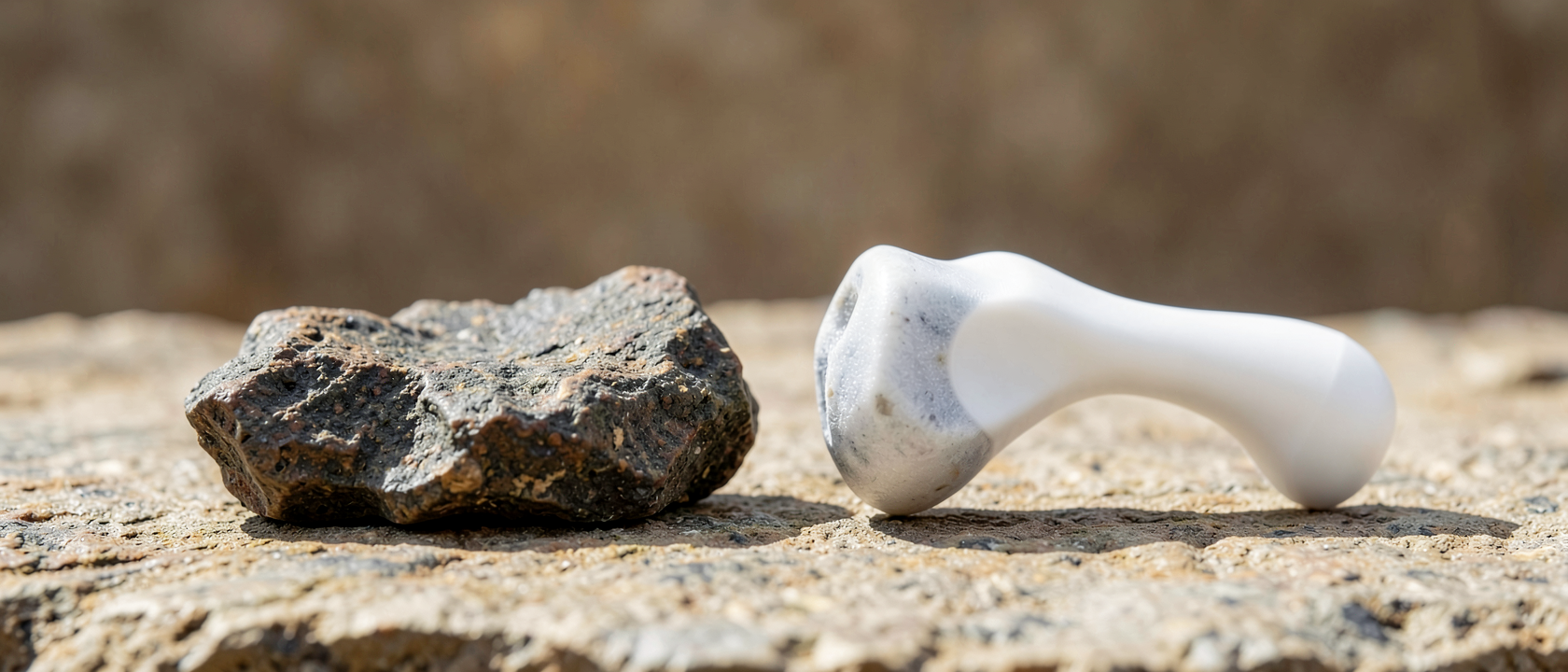
They Had to Bleed First
Before any scan was taken or any polymer printed, Dov Ganchrow sat down with raw flint from the Negev desert and started hitting it with a rock. That is knapping: the technique humans used to shape stone tools for most of our species’ existence. You strike flint at a precise angle and a flake breaks away cleanly. Do it right, hundreds of times, and you get a sharp-edged hand-axe. The edges ancient flintknappers produced were surgically sharp, and they still are.
The cuts Ganchrow sustained helped produce “Man Made,” a 2014 series of nine hybrid objects created with his late studio partner Ami Drach. The two designers had founded their Tel Aviv studio in 1996 after graduating from Jerusalem’s Bezalel Academy of Arts and Design. Drach died in September 2012, and “Man Made” was completed and published posthumously two years later.
A Tool Frozen Mid-Thought
The Acheulean hand-axe, the tool type at the heart of “Man Made,” is one of the oldest designed objects we know of. Associated with Homo erectus and early Homo sapiens, these teardrop-shaped flint pieces were knapped symmetrically from both sides and used for cutting meat, scraping hides, chopping wood, and digging. The Acheulean period stretched roughly from 1.6 million years ago to about 100,000 years ago, with examples found across Africa, Europe, and Asia.
The standard museum view treats a hand-axe as a complete artifact. Ganchrow and Drach proposed the opposite: the stone edge is only half the object. Without an ergonomic grip, a hand-axe is awkward to hold for precise tasks. In their framing, a prehistoric maker would have kept reshaping the tool as its use evolved. The 3D-printed handle represents one specialized form that continuous reshaping never reached, now produced by a different technology entirely.
What a Scanner Sees That We Don’t
Each knapped flint piece was taken to Dr. Leore Grosman’s digital lab at the Hebrew University of Jerusalem’s Institute of Archaeology and three-dimensionally scanned. Every ridge and hollow was captured as precise geometric data, which went to Stratasys, whose PolyJet technology printed handles in VeroGray polymer. The finished pieces are white against the grey-brown flint. No two handles are identical because no two flint pieces are identical: each printed form maps directly to the contours of the individual stone it fits. Layer surface finish reached 16 microns, fine enough to follow the flint’s topography with real precision.
The Physics the Ancients Ran on Instinct
When you strike flint at the right spot and angle, a cone of pressure radiates inward from the impact point and causes a flake to shear away along a curved surface, conchoidal fracture. Think of the curved chip a pebble leaves in a car windshield, but controlled. Skilled flintknappers read the stone’s internal grain before striking, directing that energy deliberately. The knappers who produced Acheulean tools developed that skill across generations, without diagrams. It is one of the oldest purposeful technologies on record, predating pottery and agriculture by orders of magnitude.
Science, Design, or Art? The Series Won’t Say
“Man Made” occupies ambiguous territory. The available documentation does not confirm whether the handle forms were derived from archaeological evidence about how such tools were actually gripped, from ergonomic modeling, or from aesthetic decisions, a distinction that matters, since a handle shaped by gut feeling is a different claim about the past than one shaped by biomechanical research. As functional tools the objects are debatable; as design, they raise real questions about authorship across deep time. What they do clearly is expose a gap that is otherwise invisible: the distance between a hand that shaped stone in the Negev hundreds of thousands of years ago and a printer laying down VeroGray in 16-micron layers in 2014. That gap does not close just because the two materials are now physically attached.