The Least Likely Volunteer
If you were trying to cut Hollywood’s carbon footprint, the last show you’d pick as your test case is one that blows up cars for a living. Yet that is exactly what Fox chose when Dana Walden, chair of Fox Television, decided that 24, the counter-terrorism thriller built around Jack Bauer’s relentlessly violent world, would become the company’s flagship experiment in carbon-neutral production. Executive producer Howard Gordon was on board; so was Mike Posey, associate director of production at Twentieth Century Fox Television, who coordinated the environmental effort on set. The goal was to make Season 7 the first television series ever certified completely carbon neutral.
A Show That Never Sits Still
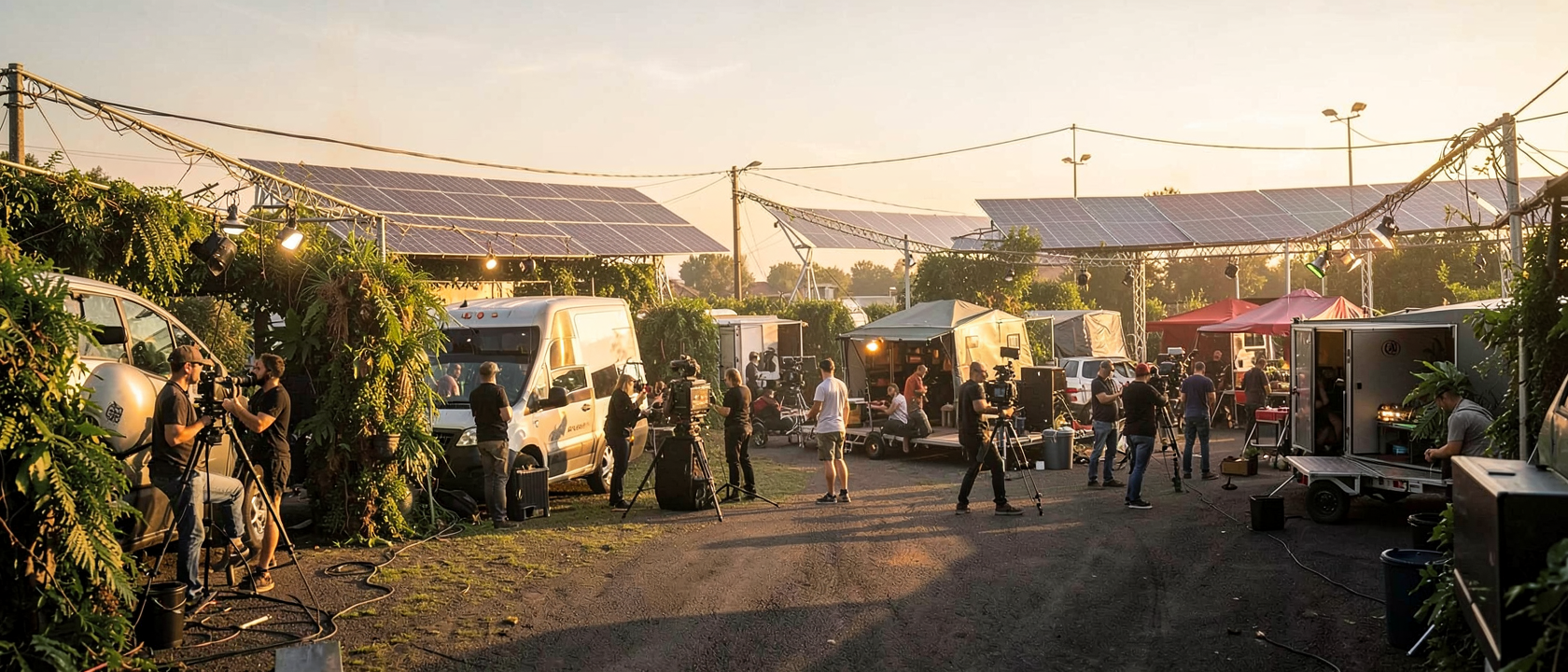
Most television is physically static. A hospital drama films the same corridors week after week; a sitcom might never leave its standing sets. 24 operates nothing like that. About half of all its scenes were filmed on location, far above the industry norm. Each new location is a logistical reset: the full crew travels, heavy equipment is transported, and because most outdoor sites have no mains power, the production erects its own generator-powered lighting rigs every time. Do that dozens of times across a season, and fuel consumption adds up fast before you’ve lit a single fuse. Then there are the action sequences: car chases, controlled explosions, pyrotechnics, costs a quieter drama simply never incurs.
1,684 Metric Tonnes, What That Actually Means
In 2006, the measured baseline carbon footprint for 24 came to 1,684 metric tonnes of CO₂ equivalent, roughly the annual emissions of 364 cars, or the yearly energy use of 89 households. Roughly 96 percent came from mobile fuel and electricity: generators, vehicles, and the machinery needed to build and dismantle temporary sets.
When production teams planned Season 7 with carbon neutrality as the target, third-party consultants at ClearCarbon Consulting estimated that season’s footprint, before reductions, at 2,179 metric tonnes. Production changes followed: around 200 old fluorescent fixtures were replaced with compact fluorescent bulbs, generators switched to biodiesel, hybrid vehicles replaced conventional ones, scripts went digital, and some physical special effects were handled digitally instead. Purchasing renewable electricity knocked more than 940 metric tonnes off the total, reducing the overall footprint by 43 percent. The remaining 1,239 metric tonnes were covered by carbon offsets, purchases of credits representing emissions reductions made elsewhere, used to balance out what the production could not eliminate directly. ClearCarbon Consulting independently verified the outcome, and in 2009 24 Season 7 was declared the first television series to achieve complete carbon neutrality.
Why Hardest Means Most Persuasive
Mike Posey’s reasoning for choosing 24 was direct: the more demanding the production you demonstrate this on, the stronger the proof. A single-stage sitcom going carbon neutral shows it can work for sitcoms. An explosion-heavy, half-location, effects-driven production doing the same shows it can work for the industry as a whole. There was also institutional weight behind the decision: in May 2007, News Corp. chairman Rupert Murdoch announced the company would reach carbon neutrality across all global operations by 2010, a commitment reportedly catalyzed by a presentation Al Gore gave at the company’s annual meeting. Fox formally announced the carbon-neutral plan for 24 on March 2 of that same year.
The difficulty was the argument. If Jack Bauer’s crew could get there, the industry’s next objection, our show is too complicated, too location-heavy, too effects-driven, would have considerably less ground to stand on.