The Gap Between Public and Scholar
A 2015 poll of roughly 4,000 people in Britain found that around 40% of respondents didn’t believe Jesus ever existed. That figure puts most of the public at odds with professional historians, who maintain a near-universal consensus that a Jewish preacher named Jesus of Nazareth was a real historical person, among Christian scholars, yes, but also among atheists and agnostics. Bart Ehrman, an agnostic New Testament scholar, put it plainly: “He certainly existed, as virtually every competent scholar of antiquity, Christian or non-Christian, agrees.” The debate is active in comment sections and documentaries. It barely features at academic conferences.
The Problem With “Show Me the Proof”
No letter or diary written by Jesus survives. No inscription bears his name, no coin his face. That’s a legitimate observation, but apply the same standard consistently and it causes problems. Socrates left no writings of his own. Julius Caesar left no contemporaneous biography written by someone who knew him. Historians don’t require a direct artifact to conclude someone existed; they build a case from what others wrote and test how reliable those writings are.
The Criterion of Embarrassment
One tool historians use is the criterion of embarrassment. Early Jewish followers of Jesus expected a triumphant, powerful messiah. A savior arrested, publicly humiliated, and executed as a criminal by Rome was almost the opposite of that ideal. The fact that this detail sits at the center of the New Testament, rather than being quietly dropped, is taken by many historians as a mark of authenticity. Stories people invent tend to edit out the awkward parts.
The Paper Trail
Historians count at least 14 independent sources mentioning Jesus within a century of his death. The earliest are Paul’s letters, written between roughly 50 and 60 AD, approximately 20 to 30 years after the crucifixion. Paul records meetings with people who knew Jesus personally, including Peter and James, Jesus’s brother. These aren’t secondhand summaries of old rumors.
Tacitus, the Roman historian and senator, in his Annals written around 116 AD, states that “Christus” was executed by Pontius Pilate during the reign of Tiberius. Tacitus sat on a priestly council monitoring foreign religious cults, giving him access to official records. Scholars broadly accept this passage as genuine and independent of Christian sources. Flavius Josephus, a Jewish historian born in Jerusalem in AD 37, adds another strand; his reference to “the brother of Jesus, who was called Christ, whose name was James” is widely accepted as authentic.
What Pontius Pilate Can Teach Us
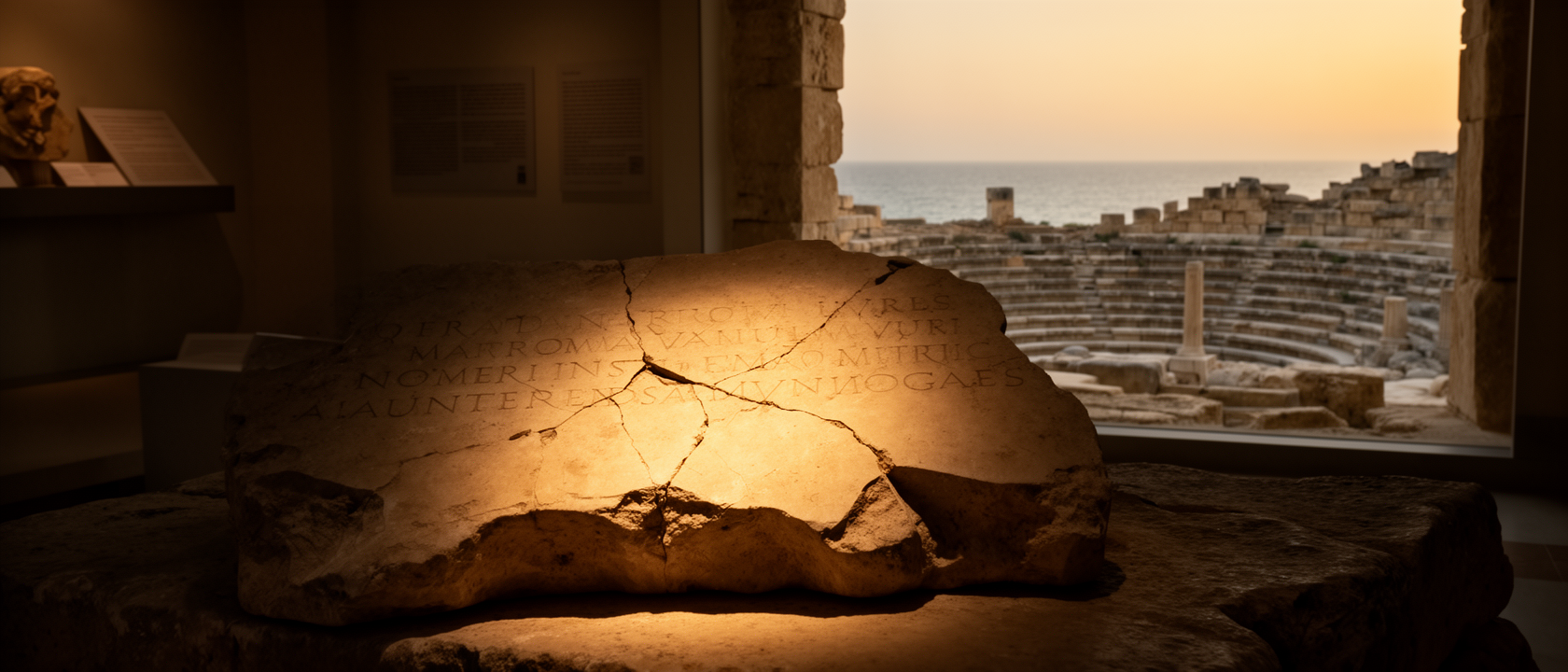
For a long time, Pontius Pilate was known almost exclusively through religious texts, and some scholars questioned whether he was a literary device. In June 1961, Italian archaeologists excavating a theatre complex at Caesarea Maritima uncovered a carved limestone block bearing a Latin inscription identifying Pontius Pilate as prefect of Judaea. Before that discovery, his absence from the archaeological record wasn’t proof he didn’t exist, it was silence. The same logic applies to Jesus. A low-status Jewish preacher from a Roman province left no buildings, no administrative files, no minted coins. Neither did almost anyone else of that time and social position.
The Pilate Stone is now held at the Israel Museum in Jerusalem, a carved limestone block that illustrates how randomly the ancient world preserves its records, and how long some silences last before they end.