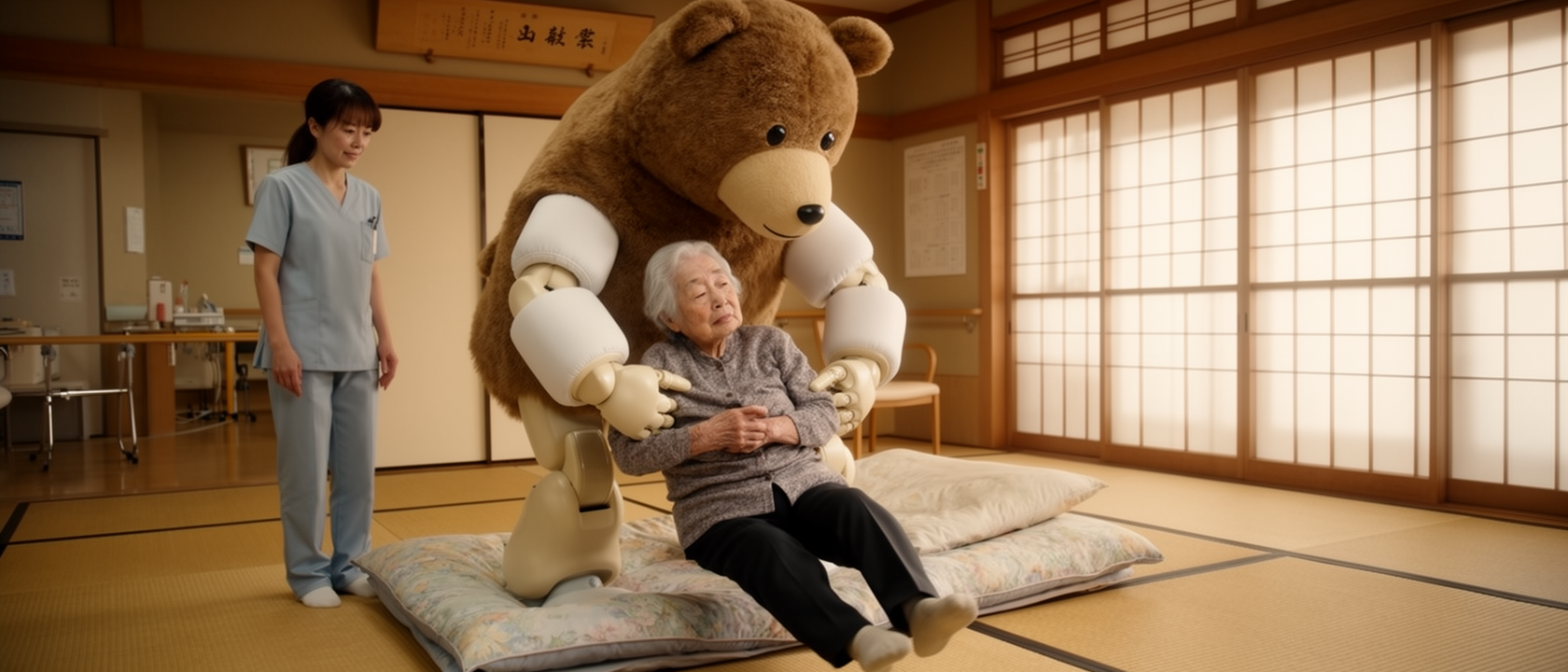
The Powerhouse Plush
Picture a care worker’s busiest shift, and you might imagine medication rounds or paperwork, not a giant teddy bear. At 4 feet 6 inches (137 cm) tall and weighing roughly 507 pounds (230 kg), RIBA-II is exactly that: a robot with a soft, bear-like face and the strength to lift a person weighing up to 176 pounds (80 kg). It was developed by RIKEN, one of Japan’s leading research institutes, in collaboration with Tokai Rubber Industries (later renamed Sumitomo Riko Company Limited), through their joint project center established in 2007 at Nagoya Science Park in central Japan.
The bear aesthetic isn’t decoration. Researcher Mukai Toshiharu and the team designed the friendly exterior specifically to help care recipients feel at ease with a machine about to wrap its arms around them. A robot that looks like heavy industrial equipment is a harder sell in a bedroom than one with a soft face.
The Tatami Factor
In many Japanese homes, the bedroom floor is the bed. Tatami mats and futons placed directly on the floor are a long-standing part of domestic life, and that tradition doesn’t vanish when someone needs nursing care. This creates a physical problem that most Western care equipment never had to solve: how do you transfer a person from floor level to a wheelchair safely?
RIBA-II was designed specifically for this. Its predecessor, RIBA I, could lift patients already at a raised height but lacked the joints to crouch low enough for a floor-level pickup. The second generation added new articulation in its base and lower back, giving it the ability to bend down, slip its arms under a person lying on a futon, and bring them up.
The arms and chest add another layer of precision through an unusual sensor system. Called Smart Rubber sensors, sheets of rubber with capacitance-type tactile sensing built in, they were the first sensors of their kind made entirely from rubber. They let the robot gauge the distribution of a person’s weight from touch alone, which matters enormously when the machine doing the lifting weighs 507 pounds.
The Physics of Caregiving
Lifting a person from the floor to wheelchair height is genuinely one of the most physically demanding moves a care worker performs. The load is uneven, the posture puts intense strain on the lower back, and it can’t be skipped: RIKEN’s own figures put the average frequency at 40 times per day for caregivers working in homes with floor-level bedding. That cumulative strain leads to musculoskeletal injuries, and when caregivers are injured, the care they provide suffers too.
Japan had particular reason to address this urgently. At the time RIBA-II was announced on August 2, 2011, projections put the number of elderly people requiring nursing care in Japan at 5.69 million by 2015.
Boosting the Lift
RIBA I, unveiled in August 2009, could handle up to 134 pounds (61 kg), real capability, but one that excluded a significant portion of potential patients. The engineering team pushed that ceiling to 176 pounds by the time RIBA-II arrived. The design gives each arm seven degrees of freedom, while the waist, neck, and rolling base each contribute additional axes of movement, allowing the robot to crouch without locking into a rigid posture.
As of the August 2011 announcement, RIKEN and Tokai Rubber Industries were planning to test RIBA-II in partner nursing care facilities, with rehabilitation as a possible future direction. RIBA I’s limitations had previously blocked the path to a commercial product. With a robot that could finally reach the floor, at least that particular obstacle was gone.