Beyond the Mustard Bottle
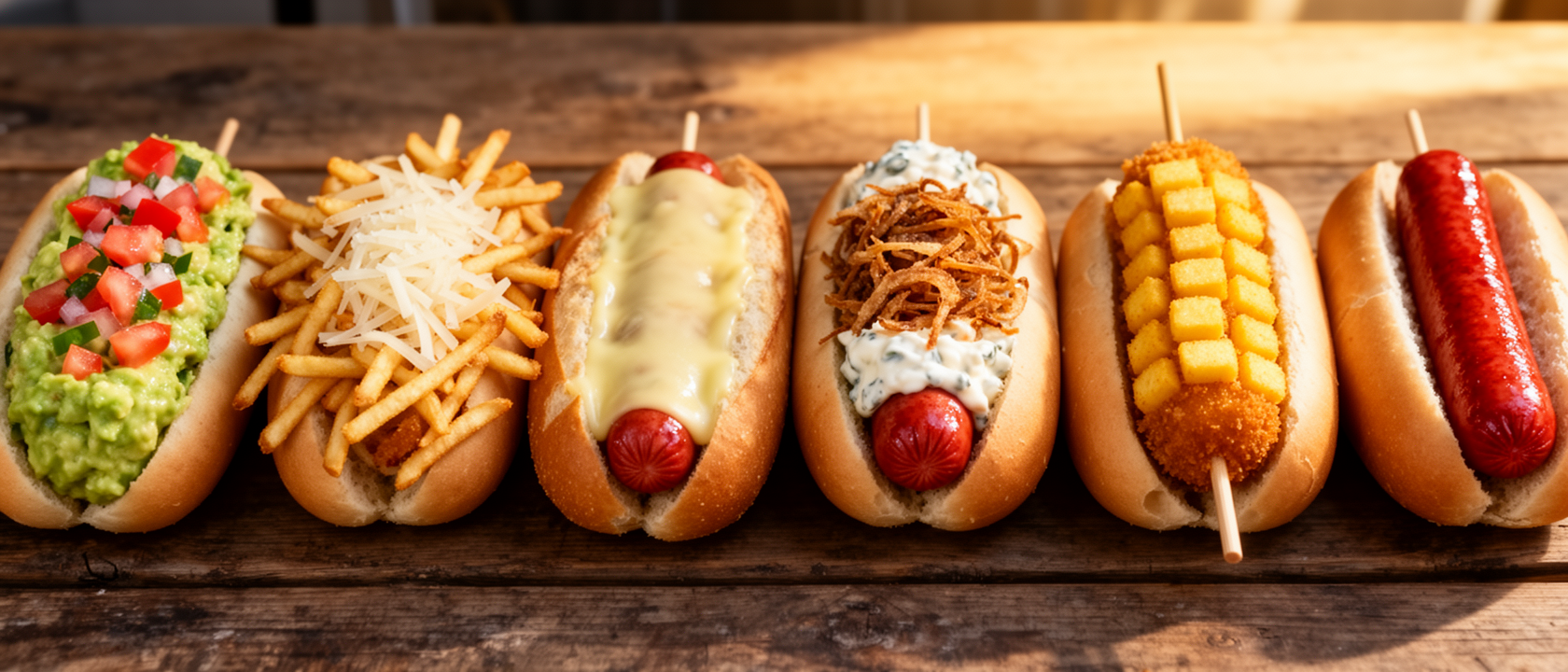
Picture a hot dog: sausage, bun, mustard, maybe ketchup. Now picture the same concept in Brazil. The sausage is simmered in tomato sauce with onions and seasoning, then topped with shredded Parmesan and crunchy potato sticks. Depending on the region, you might also get corn, peas, mashed potatoes, shredded carrots, a quail egg, olives, or tomato vinaigrette. Order a “completo” and you get the whole lot.
The Brazilian version is called cachorro quente, Portuguese for “hot dog.” Same name, a plate that looks nothing like what a North American expects. That gap is a clue that the hot dog is far more flexible than the stadium snack version suggests.
The Great Tube Steak Identity Crisis
“Hot dog,” “frank,” “wiener,” “dachshund sausage,” “tube steak”, these names pile up around what looks like the same cylindrical object, but they don’t all describe the same thing. A frankfurter and a wiener each carry the name of a city, Frankfurt and Vienna, and their supporters insist these are distinct products. Each sausage style has its own seasoning tradition.
The name “hot dog” has a different origin entirely. It appeared in print by 1884 and was in wide use by 1892, believed to have started as a sarcastic joke about the meat’s contents. By fall 1894 the term was already circulating at Yale University, where vendors sold sausages from “dog wagons” outside dormitories. Before that name stuck, the sausages were commonly called “dachshund sausages,” after the breed they resembled.
A 19th-Century German Blueprint
Exactly where the hot dog came from is genuinely contested. Frankfurt claims the frankfurter was developed there in 1487 and threw itself a 500th anniversary celebration in 1987. Vienna counters that the “wiener” originated on Austrian soil. A third version credits butcher Johann Georghehner of Coburg, said to have created a “dachshund sausage” in the 1690s before traveling to Frankfurt to sell it.
Pork sausages resembling the modern hot dog were reportedly distributed at imperial coronations in Frankfurt going back to the reign of Maximilian II, Holy Roman Emperor, placing the product centuries before any specific origin claim. Johann Georg Lahner, a butcher said to have relocated from Coburg to Vienna in the 18th or early 19th century, reportedly added beef to the Frankfurter recipe and sold the result under the “Frankfurter” name in his adopted city.
What is clear is that German immigrants carried these sausages to America during the 1800s. By the 1860s, vendors in New York were selling them on the street. Charles Feltman opened a dedicated hot dog stand on Coney Island in 1871.
The Engineering of Convenience
The bun changed everything. Nobody knows with certainty who first tucked a sausage into a roll, food historians consider the origin unclear, though probably German, yet the practical effect was immediate: a portable, self-contained meal requiring no plate, no fork, no table. A sausage on a plate is a finished dish. A sausage in a bun is a structure waiting to be filled, and once the format traveled, each place that adopted it treated the bun as a starting point rather than an endpoint.
Brazil layered it with potato sticks and Parmesan. Chile piles on mashed avocado, diced tomatoes, and mayonnaise. Iceland uses lamb sausage with two kinds of onion and a caper-mustard-anchovy remoulade. South Korea coats the whole thing in batter, deep-fries it on a stick, and sometimes rolls it in crushed ramen noodles. France bakes the sausage inside a baguette with Gruyère.
Americans alone eat approximately 20 billion hot dogs per year, roughly 70 per person annually, and most are dressed with nothing more adventurous than ketchup and mustard. The cachorro quente crowd in Brazil would find that a missed opportunity.