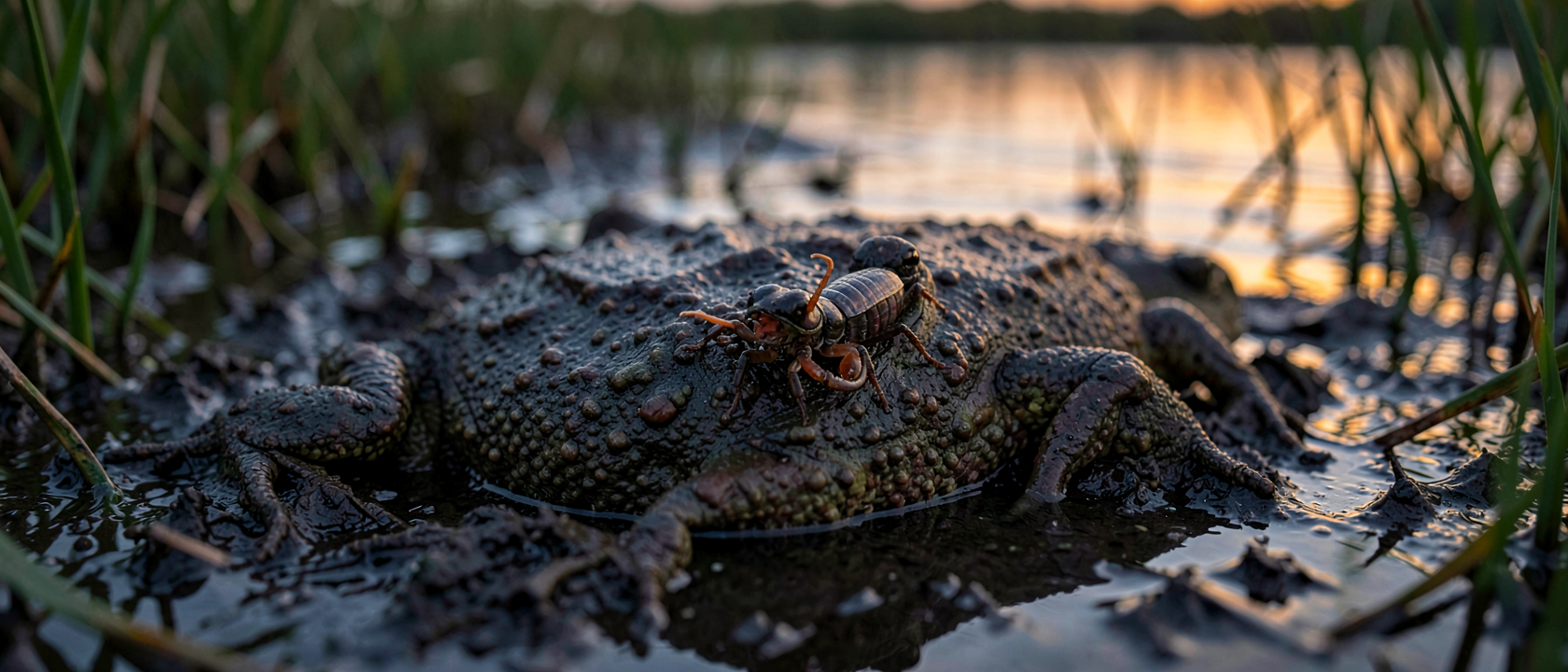
The Meal That Bites Back
A toad spots something small moving nearby. The larva waves its antennae slowly, irregularly, in a way that reads to the toad’s brain as: food. The tongue fires in roughly one-tenth of a second. The larva disappears. The toad settles back into stillness, apparently satisfied.
What follows is not digestion. The toad has not caught a meal. It has just delivered itself to a specialist predator that feeds exclusively on amphibians.
The Lure and the Hook
The larva belongs to Epomis, a subgenus of ground beetle studied by entomologists Gil Wizen and Avital Gasith at Tel Aviv University in Israel. Their findings, published in PLoS ONE in September 2011, documented what had gone almost entirely unnoticed: a beetle larva that actively hunts frogs and salamanders, vertebrates many times its size.
The hunt begins with a performance. The Epomis larva waves its antennae up, down, and side to side, mandibles moving in sync, imitating the erratic movement of something small and vulnerable. Amphibians follow simple hunting rules: attend to moving objects, attack small ones, and avoid large ones. The larva exploits all three steps, it presents as a tiny, twitching target, well inside the size that triggers a strike and far below the size that triggers retreat.
Across 382 documented experimental trials, the outcome was nearly always the same: the larva won. In roughly 70% of encounters, it dodged the amphibian’s tongue and attached itself to the animal’s body. Of the cases where it was actually swallowed, almost every larva was eventually spat back out, unharmed.
Two Phases, One Strategy
Scanning electron microscope images from the paper show why the larva is so hard to shake off. Its mandibles carry a double-hook structure, built to grip and not release. Once attached, the larva begins phase one: extracting bodily fluids while the amphibian remains alive.
How it subdues its host remains an open question. Epomis larvae carry no documented venom, yet amphibians stop resisting while being consumed. Wizen has reported that within roughly two days the amphibian becomes too weak to move, a reported observation rather than a formally published figure. The larva then shifts from fluid extraction to direct tissue consumption. Popular accounts have described the larva releasing enzymes to digest its host from the inside, but that mechanism is not supported by the peer-reviewed literature. The verified process is physical: specialized mandibles, followed by tissue consumption.
A Few Hours, and Very Little Left
The feeding phase is fast. Within a few hours of that transition, what was a living frog or salamander is reduced to bones and a small remnant of skin. The larva’s head at its first developmental stage measures around 500 micrometers across, roughly half a millimeter, making the completeness of what it leaves behind one of the more striking proportions in invertebrate predation.
One documented case sharpens the picture further. A larva was swallowed whole and survived inside a frog’s stomach for two hours before the frog vomited it back up. The larva was uninjured. It immediately attached to the frog and consumed it.
Not a Fluke: a Food Chain Rewritten
Epomis larvae are obligate predators of amphibians, they refuse other food and cannot complete development without amphibian prey. Each larva passes through three developmental stages, dropping off its host after each one to molt, then seeking a new amphibian. Wizen and Gasith studied two species in particular, Epomis circumscriptus and Epomis dejeani, found in the swamps and temporary ponds of Israel’s central coastal plain. The broader subgenus spans the Old World, with most of its roughly 30 species concentrated in Africa.
Researchers have proposed that this behavior began as defense, a larva fighting back rather than being digested, and became active predation over time. Amphibians likely never evolved recognition of Epomis larvae as a threat because the beetles are rare compared to the hundreds of harmless insects amphibians safely eat every day. The tongue fires long before experience gets a chance to intervene, and by then the outcome is decided.