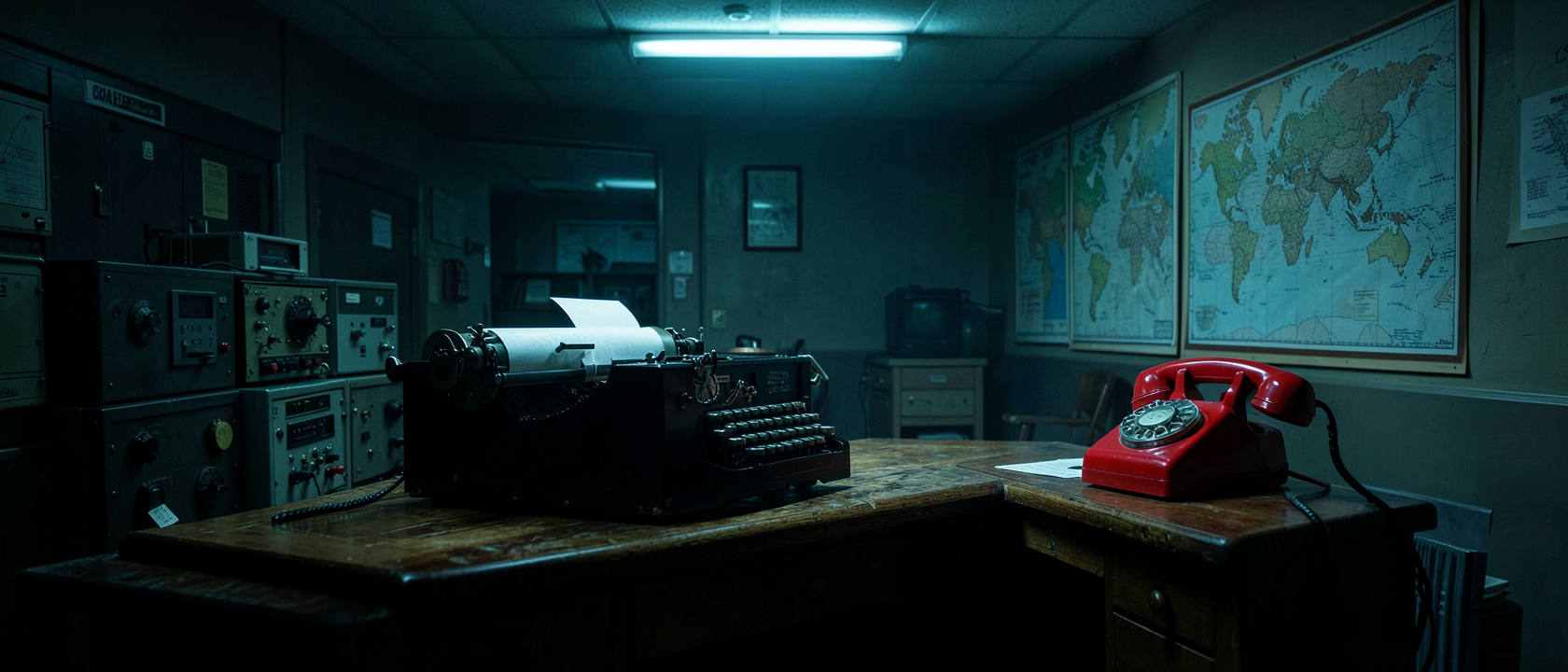
The Most Famous Phone That Never Existed
The image is fixed in most people’s minds: a red telephone on the President’s desk, a direct line to the Kremlin, two leaders within a single dial tone of averting catastrophe. Movies have used it. Political ads have used it. None of it is real. The hotline was never a telephone, never red, never in the Oval Office. The two leaders have never spoken through it, the system was built specifically to prevent that from happening.
Why Diplomacy by Bicycle Was a Problem
The Cuban Missile Crisis of October 1962 made the need obvious. For thirteen days, the United States and the Soviet Union stood at the edge of nuclear war, communicating through commercial telegram channels where a single message could take up to twelve hours to transmit, decode, and answer. Soviet Ambassador Anatoly Dobrynin dispatched a bicycle courier to a Western Union office to pass urgent messages. On October 27, 1962, Premier Khrushchev abandoned official channels entirely and broadcast a reply over Radio Moscow, because broadcasting was faster. The most consequential standoff of the Cold War was being managed, in part, by a man on a bicycle and a radio announcer.
What the Real System Actually Was
The agreement creating the Washington-Moscow Direct Communications Link was signed on June 20, 1963, in Geneva. The system went operational on August 30, 1963, with a test message from Washington: “The quick brown fox jumped over the lazy dog’s back 1234567890”, a pangram confirming every key on the teleprinter worked.
The hardware was four Teletype machines at the Pentagon, not the White House. Messages traveled through the TAT-1 transatlantic cable, routed under the Atlantic through London, Copenhagen, Stockholm, and Helsinki before reaching Moscow. A backup radio relay ran through Tangier, Morocco. Encryption used a one-time pad cipher via a machine called the ETCRRM II, built by a Norwegian company, chosen because neither government wanted to hand the other its own encryption technology. There was nothing cinematic about it: a room at the Pentagon, four clattering machines, a cable under the ocean.
Why Two Leaders Were Deliberately Kept Apart
Text was chosen over voice deliberately. Phone calls were harder to encrypt reliably and easier to misinterpret, a tone of voice under pressure, a poorly chosen word, a pause read the wrong way. A written message could be composed, checked, and translated carefully. Each message was written in the sender’s own language and translated at the receiving end, passing through layers of duty officers, translators, and situation-room staff before reaching either leader. The human chain created a deliberate pause between impulse and action. The fiction of two leaders speaking directly describes the scenario the engineers were working to rule out.
Even a Presidential Museum Got It Wrong
The myth ran deep enough that the Jimmy Carter Presidential Library displayed a mislabeled red telephone as part of its hotline exhibit until March 2016, when visitors pointed out the error. If a presidential archive could get this wrong in a permanent exhibit for years, it explains why the myth has been so resistant to correction everywhere else.
From Teletype to Inbox: Six Decades of Upgrades
On September 30, 1971, the original cable was replaced by satellite links. Fax capability followed after the two governments formally agreed on July 17, 1984, with terminals operational by 1986 and the Teletype machines fully switched off by 1988. On January 1, 2008, the system was upgraded to a secure fiber-optic email connection. The “hotline” is, in functional terms, a heavily secured inbox.
A Symbol That Does Work by Simply Existing
Security analysts have long argued that the hotline does something beyond transmitting messages: its existence signals that de-escalation is the preferred outcome. Choosing to use it rather than more confrontational channels is itself a statement about how the sender wants the conversation to go. The red-phone fiction got one thing accidentally right, the hotline has always been less about hardware and more about what both governments agreed to by building it. Two adversaries, each capable of destroying the other, choosing to keep a line open.