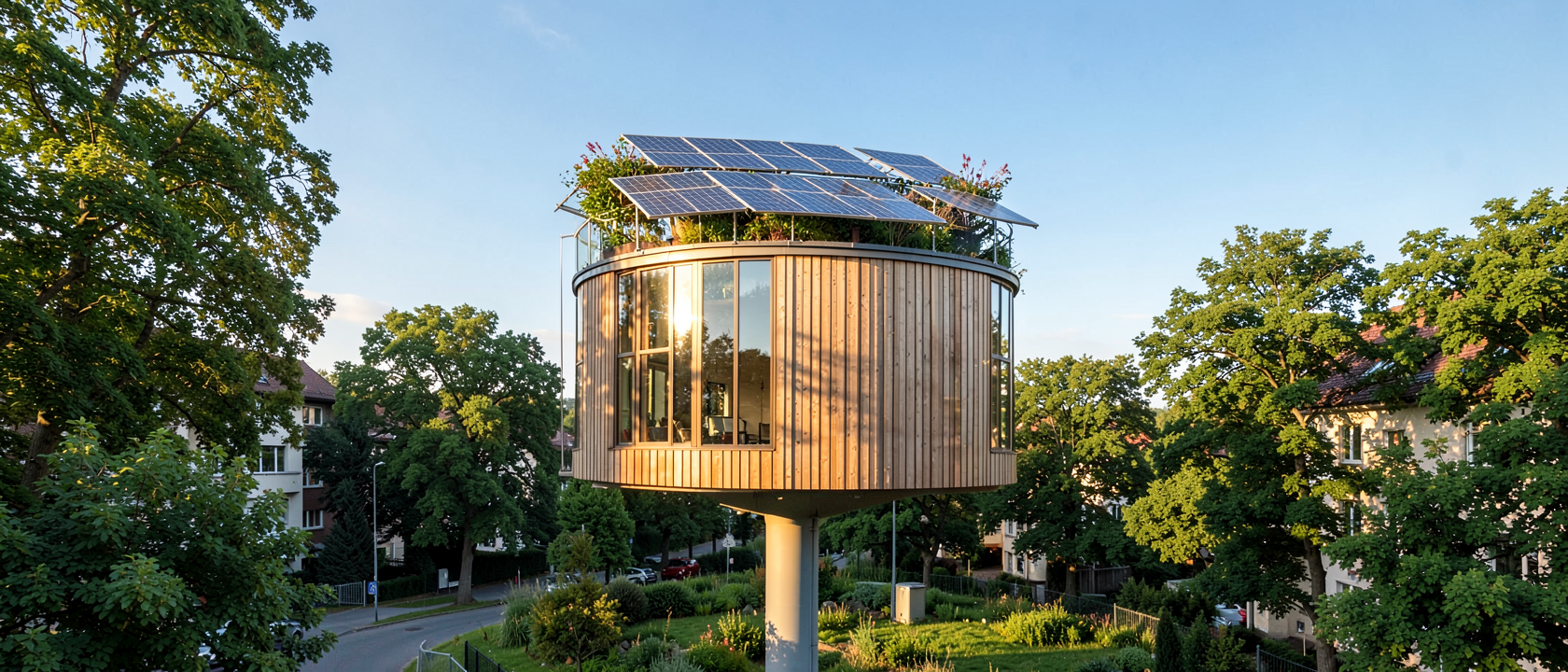
The House That Won’t Stand Still
Picture a house sitting not on a foundation but on a pivot. As morning light arrives from the east, it faces east. By midday, it has swung south. By late afternoon, it has turned again. Nobody is steering it. The whole thing just follows the sun.
This is the Heliotrope, completed in 1994 in the Vauban quarter of Freiburg im Breisgau, Germany. Architect Rolf Disch built it as his own home; the name comes from the Greek for “turned towards the sun.” That is not a metaphor: the building physically rotates at 15 degrees per hour, keeping pace with the sun as it crosses the sky.
Isn’t That What Solar Panels Are For?
Solar-tracking technology is well established. Large panel arrays at commercial installations sit on motorized mounts that swing through the day, keeping cells face-on to the sun. Disch understood this, but he noticed that the structure underneath always stays fixed. The panels chase the sun; the windows face whatever direction the architect chose at construction. Rotating only the panels is a partial answer to a problem that runs through the whole building.
The Whole Building Is the Tracker
Disch’s solution was to stop treating the building as a fixed object with moveable attachments. The Heliotrope rotates as one unit: the roof-mounted photovoltaic array, the solar thermal system integrated into the balcony handrails, and the triple-pane glazed facade all turn together.
The structure is cylindrical, built primarily from glue-laminated spruce beams. A central supporting column roughly 46 feet (about 14 meters) tall carries all plumbing and electrical connections through the core. The upper floors provide about 1,938 square feet (180 m²) of living space, plus a roof deck and garden terrace. The glazed facade faces the sun; directly opposite sits a heavily insulated wall rated at U = 0.12 W/m²K, compared to U = 0.5 W/m²K for the triple-pane windows, both figures considerably better than what you would find in standard residential construction.
There is also a summer mode: the building can swing its insulated back toward the sun rather than its glass side, cutting heat gain instead of chasing it.
Two Kinds of Solar Energy, Caught at Once
The roof carries roughly 580 square feet (approximately 54–56 square meters) of monocrystalline silicon photovoltaic cells rated at 6.6 kilowatts, converting sunlight directly into electricity. Separately, the balcony handrails double as solar thermal tubing, warming the home and supplying hot water. A fixed building can only find a compromise angle for both systems. The Heliotrope does not compromise: both track the sun together, all day. The building’s specifications put dual-axis solar tracking at between 30 and 40 percent higher energy gain than a fixed installation. The photovoltaic array also carries its own independent dual-axis tracking hardware for fine-tuning beyond what building rotation alone provides.
What the Record Shows
The Heliotrope produces between four and six times the energy it consumes over a year, selling the surplus back to the national grid. Rolf Disch coined the term “PlusEnergy” (Plusenergie in German) to describe buildings that generate more than they use; the Heliotrope was the first home anywhere to reach that standard. Two further Heliotrope buildings were later constructed in Germany, one in Offenburg, one in Hilpoltstein, Bavaria, though their individual energy figures are not publicly available.
What the record does not confirm is the mechanical detail: the motor type, the bearing system, and how the central column’s plumbing connections are managed as the building turns are not documented in sources available for verification. But the broad picture is solid. A 6.6-kilowatt solar home that heats its floors to a maximum of 113°F (45°C), collects rainwater, and feeds surplus electricity to the grid is not a theoretical exercise. Disch built it in 1994, lived in it, and the building has been turning slowly eastward every morning since.