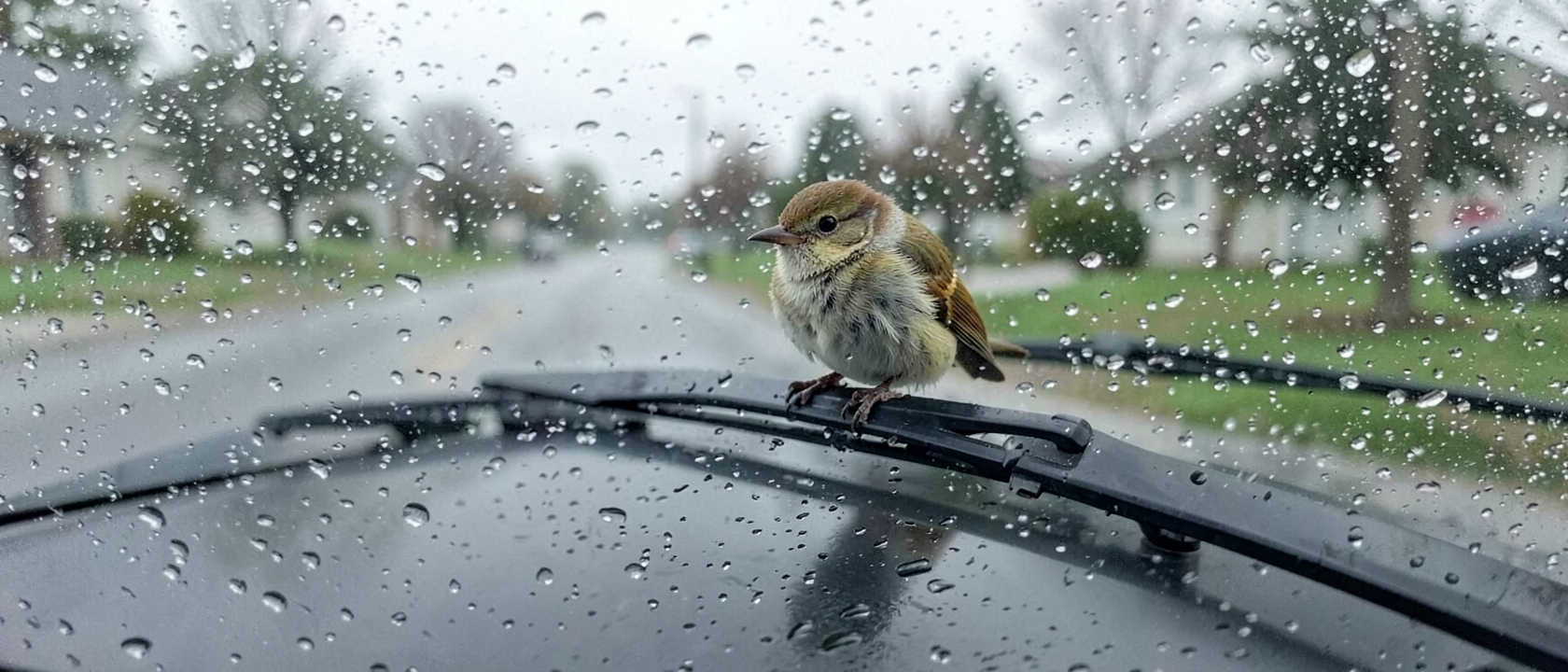
The Bird on the Wiper
A small bird lands on a car’s windshield wiper. The driver, presumably hoping to reclaim the view, switches the wipers on. The blade swings. The bird rides the arc. Back comes the blade. The bird is still there, feet locked around the rubber, going nowhere.
A video of exactly this circulated online in late July 2011, picked up by HuffPost on July 31 of that year and featured on Neatorama on August 2, 2011. The bird’s species was never confirmed. Its location was never identified. What everybody noticed, though, was the grip. The wiper moved, and the bird didn’t let go. And somehow that looked almost personal, like the bird had made a decision.
It hadn’t.
Why Doesn’t It Just Leave?
Most animals respond to unexpected motion by retreating from it. A frog on a vibrating surface jumps. Plenty of birds, startled by sudden movement, scatter immediately. So what keeps this one planted? The wiper is not subtle about what it’s doing. The bird is clearly awake. And yet it sits through sweep after sweep, apparently unbothered.
The tempting explanation is personality: stubborn little thing, good for it. But personality has nothing to do with it. The answer is structural, and it lives in the bird’s feet.
The Lock That Runs Itself
Passerine birds, the group technically called Passeriformes and commonly known as perching birds or songbirds, have a passive gripping system built into their legs. When the ankle bends upon landing, two flexor tendons are automatically pulled taut. The flexor digitorum longus controls the three front toes; the flexor hallucis longus controls the rear toe, called the hallux. Both tendons run over the back of the ankle joint, so any time that joint bends, they tighten, and the toes curl closed around the perch.
No muscle contraction required. The bird’s own body weight pressing down on bent legs keeps the tension going. The grip is mechanical, closer to a self-tightening clamp than a conscious squeeze, and it costs almost nothing in energy because no muscles are actively holding it.
When the wiper swings and jostles the bird, the leg bends slightly in response. That bend tightens the tendon. The grip gets firmer. The bird doesn’t “hold on harder” in any intentional sense; the anatomy handles it. Releasing the grip actually takes a deliberate action: extending the legs, which eases the tendon tension and lets the toes open. That extension is the same motion as launching into flight, which is why birds fly off when they choose to leave and why they don’t drift off a branch while sleeping.
Built for Branches, Not Bumpers
This mechanism didn’t develop for parking lots. It evolved across a long evolutionary history of perching on tree branches. A bird asleep on a bough during a storm doesn’t need to wake up and consciously grip when a gust shakes the wood. The sway itself bends the ankle, the bending tightens the tendons, and the sleeping bird stays put.
Staying elevated matters for survival. Many ground-based predators can’t reach a bird on a branch, and the tendon-lock means a perched bird doesn’t have to burn energy maintaining its position through the night. The grip holds without effort.
From the bird’s biological point of view, a windshield wiper swinging back and forth reads something like a branch in a breeze. The oscillation isn’t registered as a threat; it’s registered as a perch doing what perches sometimes do. The locking system responds accordingly: hold.
The picture for sleeping birds may be more nuanced than the standard model assumes, a 2012 study on sleeping European Starlings found their legs weren’t fully bent during sleep, suggesting the locking mechanism wasn’t completely engaged in the way the general model predicts. The wiper-riding bird, though, is clearly awake, and the passive-grip principle still applies to its situation.
Not Stubborn. Not Brave. Just Built That Way.
The bird on the wiper isn’t making a choice. Its musculoskeletal anatomy is doing what it does, and what it does when the leg bends is grip. The motion of the wiper doesn’t give the bird a physiological reason to let go; it gives the bird a reason to hold tighter. Interestingly, research on other perching birds has shown they use visual cues and precise timing to optimize landing on moving objects, so the capacity to handle an unsteady perch goes deeper than the tendon lock alone. The bird isn’t defying the wiper. Its feet simply haven’t received any instruction to open.