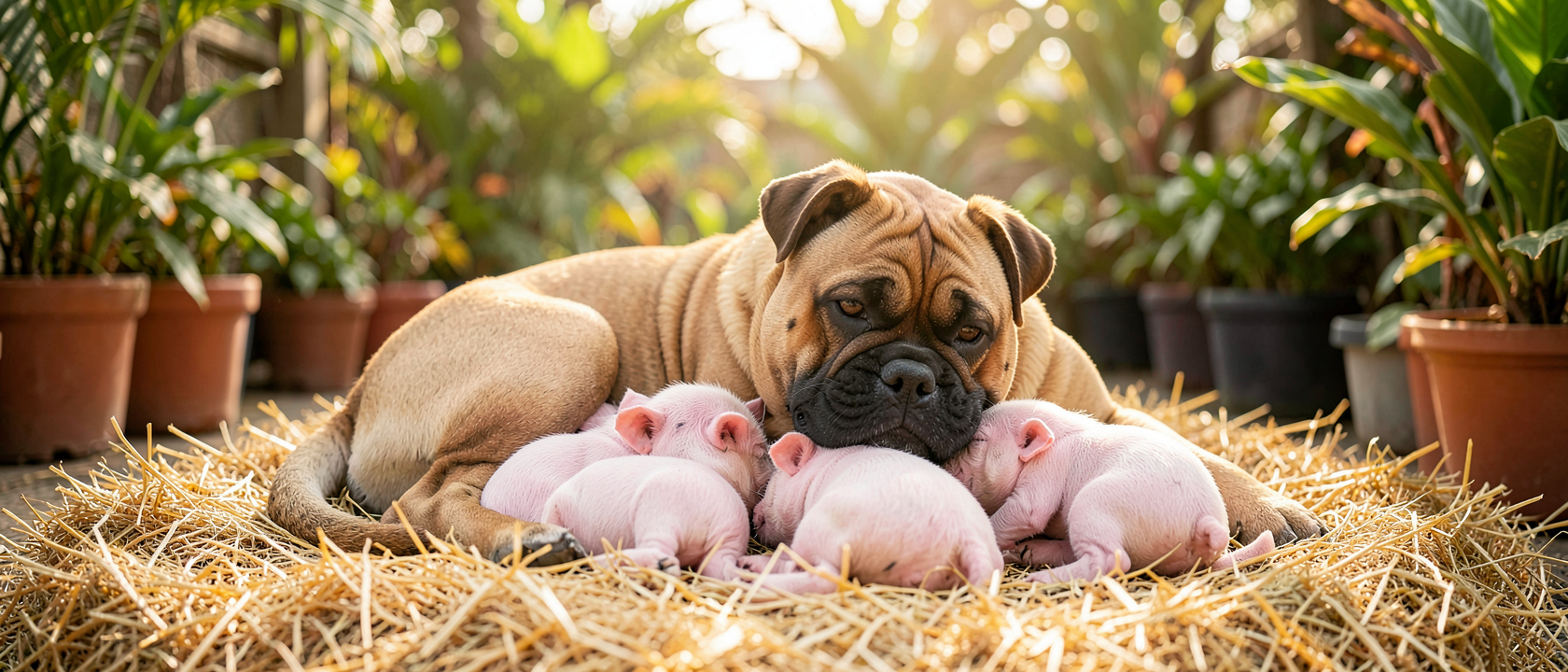
Eight Piglets, One Dog, Zero Precedent
Treasure had already beaten the odds once. She came off the streets as a stray before landing at Spectrum Plants Gold Coast, a plant nursery on the Gold Coast in Queensland, Australia, run by Wes Trevor. What she did next was harder to explain.
Eight piglets arrived at the nursery in poor shape. Trevor fed them a specialist diet until they were strong enough to move around on their own. At that point, Treasure took over: she cleaned them, stayed close, and let them nurse. The nursing worked because Treasure, a Boxer with no recent pregnancy, was producing milk. Trevor consulted a vet, who confirmed the arrangement was fine as long as the piglets received supplemental nutrition and didn’t injure the dog. The story circulated through Bored Panda on September 25, 2017.
How Does a Dog Start Making Milk With No Pregnancy?
Most people’s rough mental model goes: pregnancy, birth, milk. In that order, as a package. No birth, no milk. Treasure apparently skipped two of the three steps, so either the model has a gap, or something more unusual was going on.
Two well-documented mechanisms, probably working together, explain it.
The first is pseudopregnancy, or false pregnancy. In unspayed female dogs, hormonal shifts after a heat cycle can mimic the post-birth state closely enough that the body produces milk, builds a nest, and kicks in nurturing behaviors, all without an actual pregnancy. The milk is real and can feed young.
The second is stimulus-induced lactation. When young animals suckle persistently, they stimulate pressure-sensitive receptors in the nursing female’s teats. That physical signal triggers a feedback loop: the brain releases oxytocin, which drives milk letdown, and the anterior pituitary releases prolactin, which sustains ongoing production. Apply the stimulus consistently enough, and prolactin levels can rise even without prior pregnancy or birth. Eight animals nursing persistently is exactly the kind of sustained input that system needs.
Both pathways can run simultaneously. That said, no veterinary report specifically documents which mechanism drove Treasure’s individual case, the science explains the how, but the exact route for her remains unconfirmed.
The Biological Half Is Where It Gets Interesting
Dogs adopting young of another species behaviorally, grooming, guarding, sleeping alongside them, is well-documented. A Rhodesian Ridgeback named Katjinga acted as surrogate mother to a Vietnamese pot-bellied piglet. A dog in Cuba nursed 14 piglets alongside her own puppies in 2011. A dog in northeastern China fed an orphaned piglet for around 40 days in 2007.
What Treasure added was the biological half: sustained milk production for a different species, enough that a vet could evaluate and approve it. The behavioral side of cross-species adoption shows up regularly. Lactation across species lines, without a recent pregnancy, is considerably rarer.
What the System Is Actually Built Around
Mammalian lactation is more responsive than the pregnancy-first model suggests. The body doesn’t strictly require a recent birth, it requires the right hormonal conditions, or in some cases a physical stimulus repeated consistently enough to trigger the hormonal cascade on its own. The oxytocin-prolactin loop doesn’t check the species of the animal doing the suckling. It responds to the signal.
Treasure’s nervous system received a repeated physical cue from eight piglets, ran it through hormonal pathways common to most mammals, and produced milk. A former stray dog, no puppies, no recent pregnancy, and eight piglets that needed feeding. Biology, it turns out, is less rigid about the paperwork than we tend to assume.