The Photo That Started the Questions
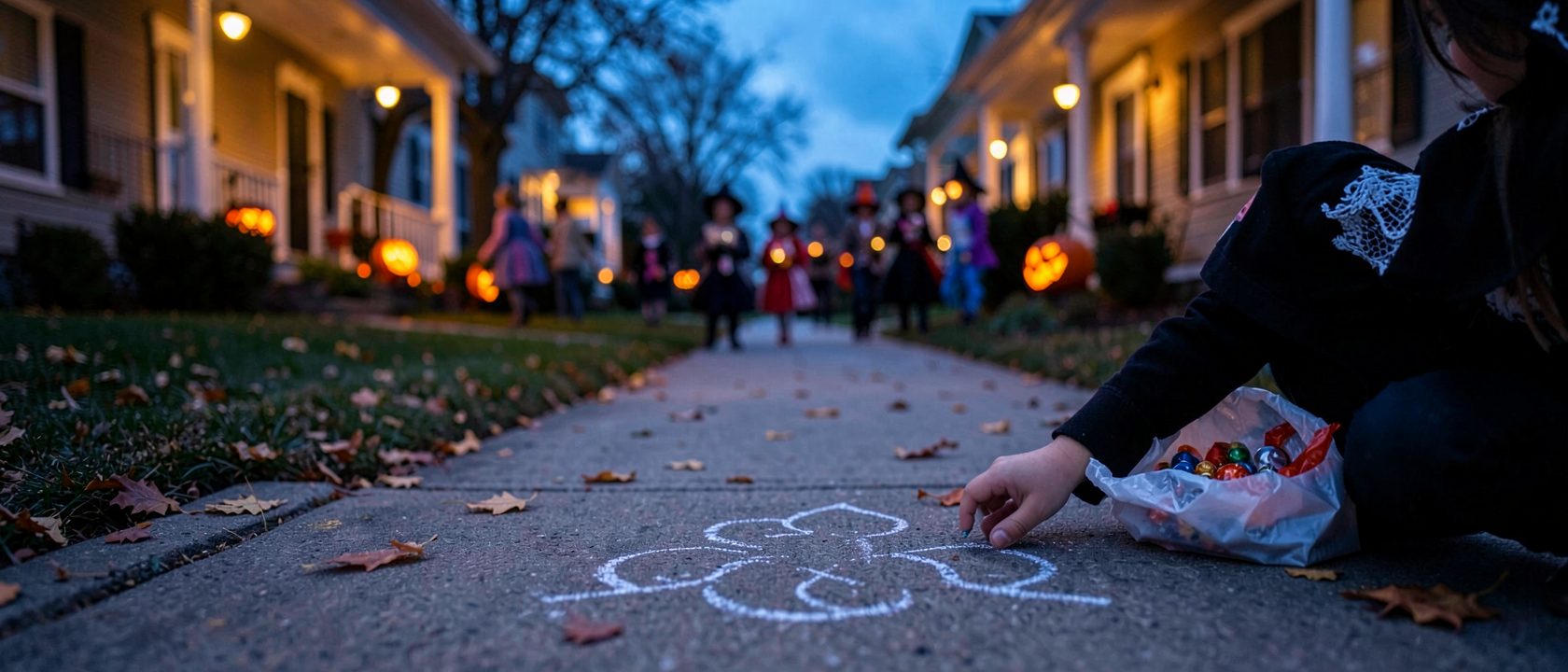
A hand-drawn symbol at the bottom of a driveway does not look like much: a faded scribble in chalk, sitting right where the sidewalk meets a front path. But according to a story that has circulated online since Halloween 2008, that scribble once carried a message. It was left by one trick-or-treater for the next, a quick signal about what was waiting at the door, so nobody had to ring the bell and find out the hard way.
Why Candy Would Ever Need a Code
Candy is candy, unless you are a kid working a neighborhood on a curfew. Halloween night runs on a clock, and pillowcase space is limited. Not every house hands out the same tier of treat, and the kid who already knocked on a disappointing one knows something the next kid doesn’t. The problem is simple: how do you pass that along without knocking first yourself and losing the surprise?
How the Symbols Reportedly Worked
The idea traces back to a post by Rob Cockerham on his site, cockeyed.com, published October 30, 2008. Cockerham described growing up in the Bowling Green neighborhood of Sacramento, where he learned to read and leave chalk marks at the bottom of driveways, a trick especially useful for kids who had to be home by a set hour. Once a house was “tagged,” later trick-or-treaters could use the marks to head straight for houses giving out full-size chocolate bars and skip the ones handing out Chex mix or dried apricots. When Neatorama picked up the story the next day, on October 31, 2008, its version added three specific symbols: one said to mean “Dentist” (toothbrushes or floss instead of anything sweet), one for “Werther’s Originals” (the old-fashioned hard caramels beloved by grandparents everywhere), and one for “Reese’s Pieces,” treated as the jackpot worth doubling back for.
Where This Story Actually Comes From
Here is the catch: those three specific symbols only appear in Neatorama’s retelling, which says it was passed along through a comment on a site called YesButNoButYes. They cannot be confirmed against Cockerham’s original post. Cockerham himself credited the spark for his article to a tweet by Cabel Sasser, and Laughing Squid covered the same story that same day, describing it more loosely as a “Hobo-style” code for marking houses. None of these versions offers a complete list of symbols, a named inventor beyond Cockerham’s own childhood memory, or proof that kids outside one Sacramento neighborhood ever actually used it.
A Myth Worth Keeping Anyway
Strip it down and you have one named, dated post, one same-day repost that tacked on details nobody can trace back to the source, and one more outlet vaguely nodding along without adding anything new. It is a thin trail for a story that feels like it should be decades old and citywide. The printable “trick-or-treat chalk code” sheets you find on parenting sites now are a separate, later invention, built to match the legend rather than proof the legend came first.
People keep decorating the story anyway. A modern version jokes about warning kids away from a house handing out hot sauce packets instead of real candy, a wink at how treat standards have supposedly fallen since the days of Werther’s Originals. That instinct to keep adding to it might be the actual explanation for why it survives: not because anyone has ever matched the same three symbols across two different neighborhoods, but because the shape of the story is so satisfying that verifying it almost feels beside the point. Noticing that gap, between how good the story sounds and how little of it actually checks out, is its own small reward, and it is exactly the kind of thing you clock while everyone else just laughs and passes the candy bowl.