The Most Profitable Joke You Never Heard Of
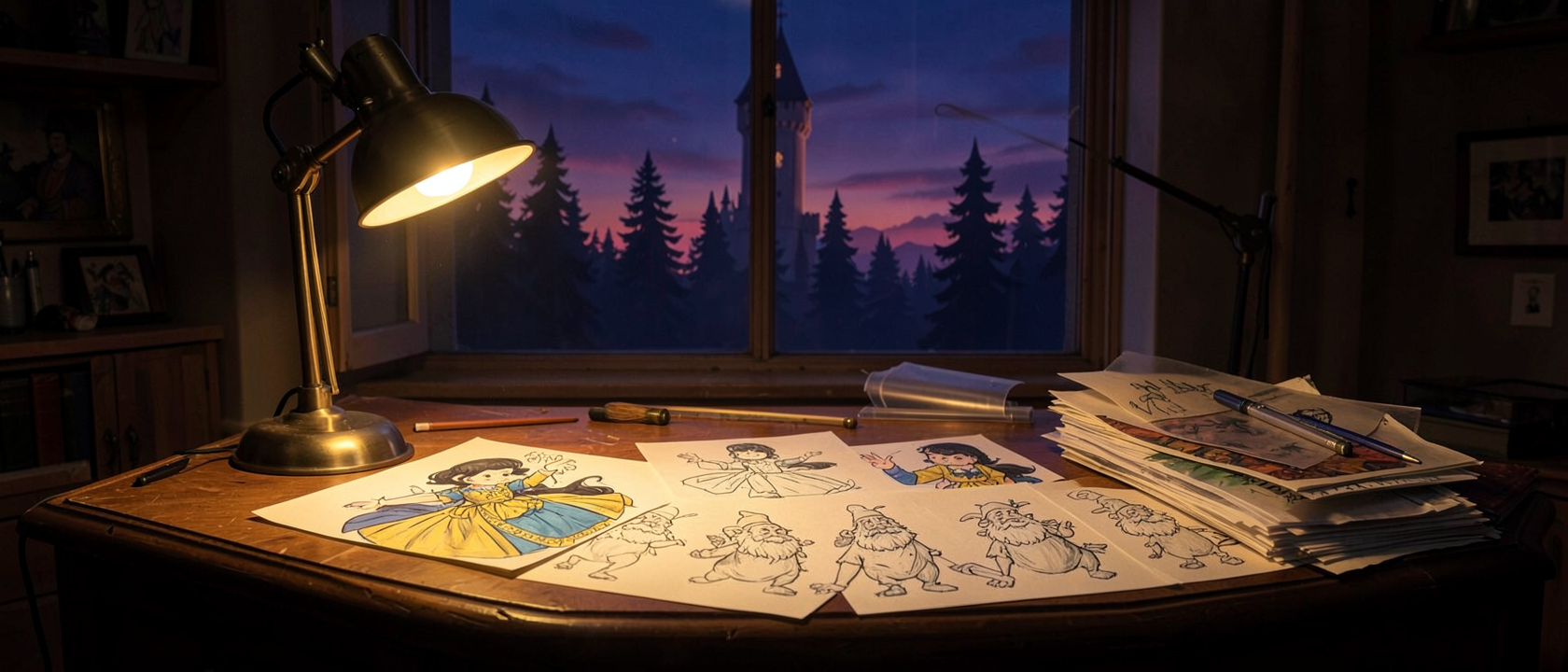
During the making of Snow White and the Seven Dwarfs, Walt Disney ran a program with a simple premise: if you came up with a comedic gag that made it into the film, you got paid five dollars, not as a bonus, but as a direct purchase of the idea itself, line-itemed like a box of pencils.
In the mid-1930s, five dollars covered a decent meal or two. It was enough to make any animator think twice before keeping a funny idea to themselves. The result is that many of the film’s best-remembered comic moments, the pratfalls, the physical timing, the visual punchlines, were literally bought.
Nobody Had a Map for This
Why would a major studio need a cash bounty to generate jokes for a cartoon? The answer is the scale of what Disney was attempting. Snow White and the Seven Dwarfs, which premiered on December 21, 1937, was the first full-length cel-animated feature ever made, not just for Disney, but for anyone. There was no comparable production to learn from, no handbook for how to fill 83 minutes with comedy, emotion, and visual storytelling drawn entirely by hand.
Story work began around 1934. By the time animation was fully underway, more than 750 people were employed on the film. Sustaining creative output across that many people for that long, with no precedent for what the final product should look like, was a logistical challenge as much as an artistic one. The $5 system kept good ideas moving through the pipeline.
The Noses That Earned Their Keep
The clearest example of the system working is one of the film’s smallest moments. Animator Ward Kimball submitted a gag in which the seven dwarfs, peering over the footboard of Snow White’s bed while she sleeps, let their noses pop into view one by one along the top edge. It lasts only a second or two, but it works precisely because it treats seven separate characters as a single comic mechanism for just that moment. Kimball submitted the idea, collected his five dollars, and the gag made the final cut.
The Youngest Princess
Snow White is canonically 14 years old, making her the youngest of all the Disney princesses by a notable margin. In 1937, this was not a point of friction. The Brothers Grimm tale draws from a European literary tradition in which fairy tale heroines are frequently young adolescents; attaching significance to a character’s age was not part of the storytelling grammar of the period. The gap between how the story plays and this biographical fact comes directly from the source material Disney was adapting.
Hiding in Plain Sight, on Purpose
Snow White also contains deliberate “hidden Mickeys”, the iconic three-circle silhouette embedded into the film’s backgrounds. One confirmed instance appears on the wall behind the Evil Queen when she rushes into her laboratory. The practice became systematic enough across Disney’s films and theme parks that dedicated communities now catalog every confirmed sighting, going frame by frame through a 1937 film. The fact that people do this, and that the artists apparently expected they might, says something specific about the culture inside that studio.
What Got Built Along the Way
Every meaningful decision made during Snow White‘s production was an experiment in one form or another. How do you pace a feature-length animated story? How do you make audiences genuinely care about drawn characters across 83 minutes rather than the eight or ten of a short? The $5 gag program, the hidden visual jokes, the careful character work, none of it had a template. The film’s budget ballooned from an initial $250,000 to $1.5 million, with Disney borrowing heavily and mortgaging his home to finish it. The skeptics called it “Disney’s Folly.” When it premiered on December 21, 1937, to an audience that included Charlie Chaplin, Judy Garland, and Clark Gable, it received a standing ovation. What the production figured out became the foundation for animated storytelling as a form.