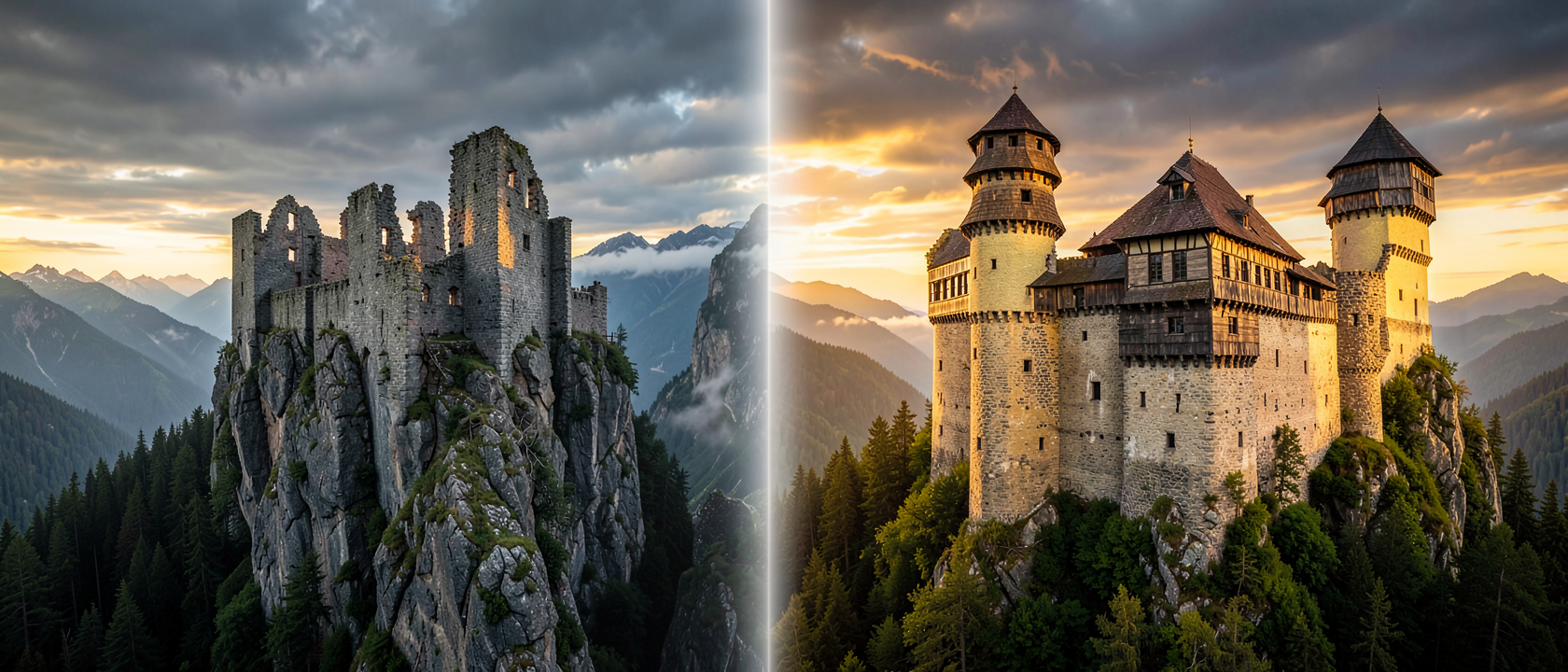
1,480 Steps to a Ruin
The climb to Poenari Castle starts at the bottom of a gorge in Argeș County, Romania, and it does not let up. All 1,480 concrete steps are cut into a cliff above the Argeș River, near the Transfăgărășan road in the Făgăraș Mountains. By the top, your legs are done and the view is a straight drop rather than a comfort.
What’s waiting at the top is no postcard castle, just a scatter of broken walls and stubs of towers open to the sky. A team of digital artists has rebuilt Poenari on screen, showing roughly how it looked at full strength, with its roof, towers, and walls intact. Something guarded this hard, this far above everything else, was clearly meant to keep someone out. Or in.
Why Ruins, Why Legend?
A position this defensible should have lasted. Instead, most of Poenari is gone, down to foundations and a few standing walls. Ask anyone what they know about the place and the answer is usually one word: Dracula. Not the man who lived there, not the mountains that protected him, not the disaster that tore the fortress apart. Just the vampire.
The myth got the address right and invented most of the rest. What actually happened here is real medieval politics layered over real geology, and it’s stranger, in its own way, than the folklore built on top of it.
Vlad’s Real Stronghold
Poenari’s foundations date to the early 1200s, laid by the Basarab dynasty, Wallachia’s first rulers. Its most famous occupant was Vlad III, Voivode (ruling duke) of Wallachia, the historical figure Bram Stoker drew on for Count Dracula. In 1459, Vlad reportedly had arrested Wallachian nobles, known as boyars, forced into labor rebuilding the old fortress, adding new towers and turning a natural chokepoint in the rock into serious military architecture. It held that shape for decades after his death in 1476, before being abandoned by the early 1500s.
What finally brought most of it down was a landslide strong enough to drag entire towers 1,312 feet (400 meters) into the river valley below. That’s the real reason so little of Poenari survives: gravity and unstable ground, not vampire hunters.
The Escape Route Written Into the Mountains
The cliffs that make Poenari hard to reach also made it hard to conquer and, according to most accounts of Vlad’s life, hard to trap him inside. During one attack on the fortress, Vlad reportedly escaped through a secret passage leading straight into the Carpathian Mountains, using the terrain itself as his exit route. A ruler who builds his stronghold into a mountain range gets that mountain range as a backup plan. Here, geography wasn’t scenery. It was strategy.
Building Into the Rock, Then Rebuilding in Pixels
The fortress wasn’t simply placed on its cliff; it was built directly into it, using the exposed rock as foundation and structure, then reinforced with earth or lime mortar rather than concrete. Its walls stood only about 10 feet (3 meters) high in places, though the drop beneath them made the fortress look far taller from the valley floor. At full strength, it had four watchtowers along an elongated layout, three round and one prismatic.
That surviving footprint, plus what’s known of Wallachian building methods from the period, is what the digital artists worked from. Rather than invent a fantasy castle, they extended a real, partly standing structure using the same logic its original builders used, the way you’d piece together a broken pot from the fragments still in your hand.
Bears, Stairs, and a Tram That Doesn’t Exist Yet
According to a 2020 report describing this reconstruction project, Poenari was closed to visitors, not for politics or paperwork, but because of bears active in the surrounding forest. It’s a sign this is still a wild mountainside, not a fenced museum. The same report floated a possible future addition: a rack-and-pinion tram, or crémaillère, to carry visitors up from the valley and spare them all 1,480 steps. That’s a proposal, not a confirmed project, and nothing here suggests it was ever built.
One of Seven Ruins Waiting to Be Seen Again
Poenari isn’t a one-off. It’s one of seven European castle ruins the same group of designers, architects, and digital artists reimagined in full, each a real structure that time, war, or geology reduced to fragments. The other six go unnamed here, which almost proves the point: ruins across the continent used to be extraordinary, and most people scroll past their photos without a second look. Poenari just happens to come with a famous name attached. The other six are still waiting for someone to notice.