The Video That Isn’t Actually About the Band
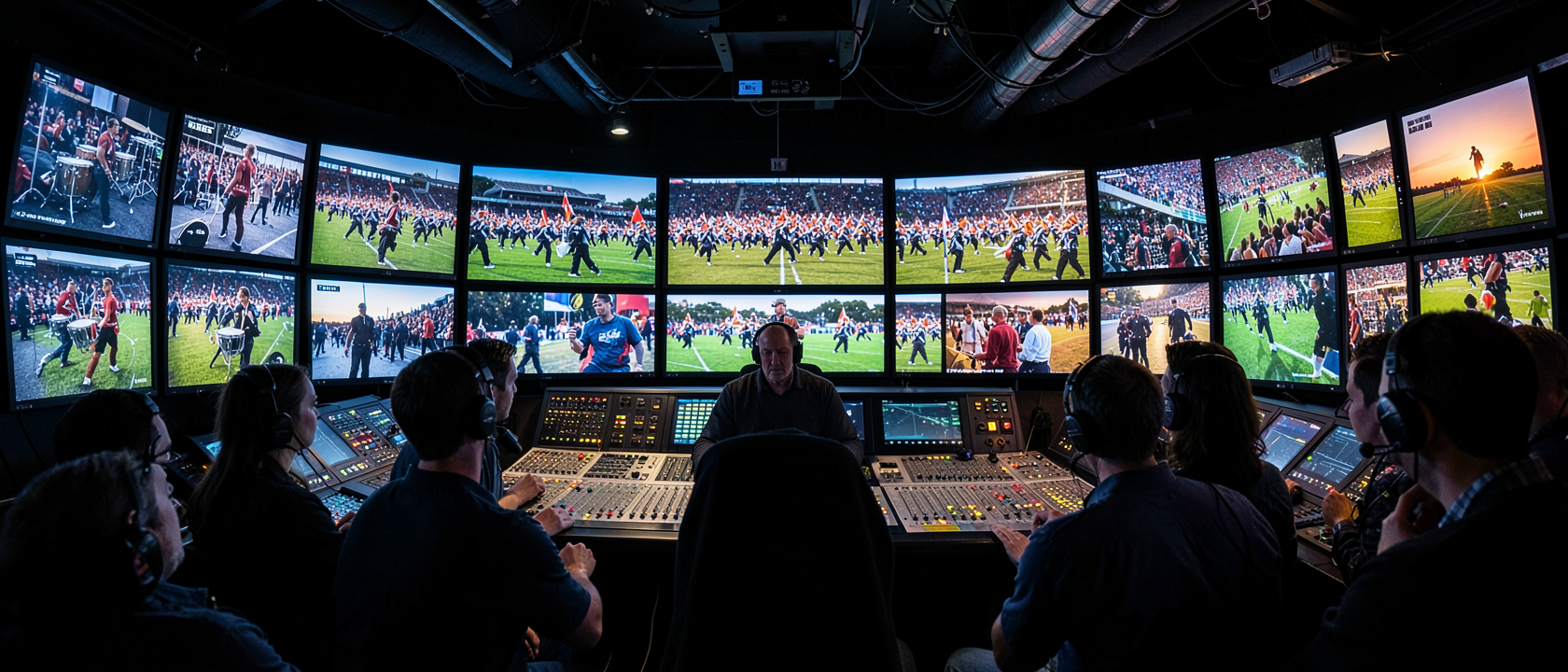
A clip from the 2004 Drum Corps International (DCI) World Championship looks at first like ordinary marching band footage: the Cavaliers performing “007,” their James Bond-themed program, built on tight drill lines and brass that hits like a wall of sound. But the real subject isn’t on the field at all. It’s a person you never see: a producer calling every camera shot, second by second, deciding what viewers at home get to look at.
How Do You Direct a Show That Won’t Wait for You?
A drum corps field show fills an entire stadium: dozens of performers hitting different formations at once, brass surging on one side while a color guard peaks on the other. None of it pauses for a camera operator to catch up. There’s no second take, no reshoot, no fixing a bad cut later. Pick the wrong camera at the wrong instant, and the audience misses the moment the performance was building toward, permanently.
So how does anyone watch that much happening across a field and choose, correctly, which single feed tells the story of that second? The answer is more physically demanding than it sounds.
Meet the Person Calling the Shots
The producer behind this footage is Tom Blair, a longtime broadcast producer for DCI World Championship telecasts (some versions of the clip spelled the name “Tim Blair,” but DCI’s own production materials and the video’s official description confirm it’s Tom). Calling cameras means sitting before a wall of more than 100 live monitors, headset on, watching every angle simultaneously and feeding a constant stream of commands, “cut to two,” “ready three,” “take one,” to a technical director who executes each one instantly.
None of it is scripted. Every call is made in a fraction of a second, timed to movement that can’t be predicted precisely and can’t be redone. Doing it well takes anticipation: sensing where a formation is headed half a second before it arrives, so the right camera is already live when the moment lands.
That wall of monitors doesn’t appear out of nowhere. Behind it sits months of preparation, because every stadium is a new problem: a broadcast truck parked outside, cables pulled through conduits, and 11 cameras positioned around the field, each needing a clean line on a movement that might last only seconds.
Why Live Beats Scripted, Every Time
Having once worked as a TV switcher, I can say a nightly newscast, chaotic as it feels, is still a script: you know the segment order, rehearse transitions, and cut around flubbed lines. A drum corps final has none of that. Whatever happens on the field is the only script there is, and it shifts by fractions of a second every run.
That’s the real distinction. Producing something predictable and repeatable is a skill. Calling cameras for something live, physical, and unrepeatable, a marching band championship, a parade, a football game, is rarer, because there’s no version of the job where you fix it after the fact.
How a Broadcast-Booth Clip Reaches You Anyway
This footage didn’t start on some major network’s page. It first circulated through a smaller outlet called Viral Viral Videos before being passed along more widely, eventually landing wherever you first ran into it. It’s a small case study in how far niche professional footage can travel: content made for people inside broadcast production ends up in front of someone who’s never watched a drum corps competition or touched a camera switcher.
Most people watch live television and never wonder who’s making the cuts. Noticing that somebody is, and wanting to know how, is exactly the instinct that gets things passed along by people who like spotting what everyone else scrolls past.
What the Clip Leaves Out, and Why That’s Fine
The video doesn’t give Blair’s full career history, nor every technical detail of the broadcast, though DCI’s own materials confirm 11 cameras were positioned for the taping and that each new venue meant months of setup. It doesn’t dwell much on the 2004 championship itself, beyond the fact that the Cavaliers won it, their sixth DCI title, edging the second-place Blue Devils by just 0.175 of a point.
None of that is really the point. The point is a mechanic that shows up in every live broadcast you’ve ever watched, from a championship halftime to a cousin’s graduation livestream. Someone, somewhere, is watching a wall of screens and calling every cut in real time. Next time you’re watching something live, count the cuts. Somebody just made every single one, on purpose, with no way to take it back.