The Object That Won’t Stay Down
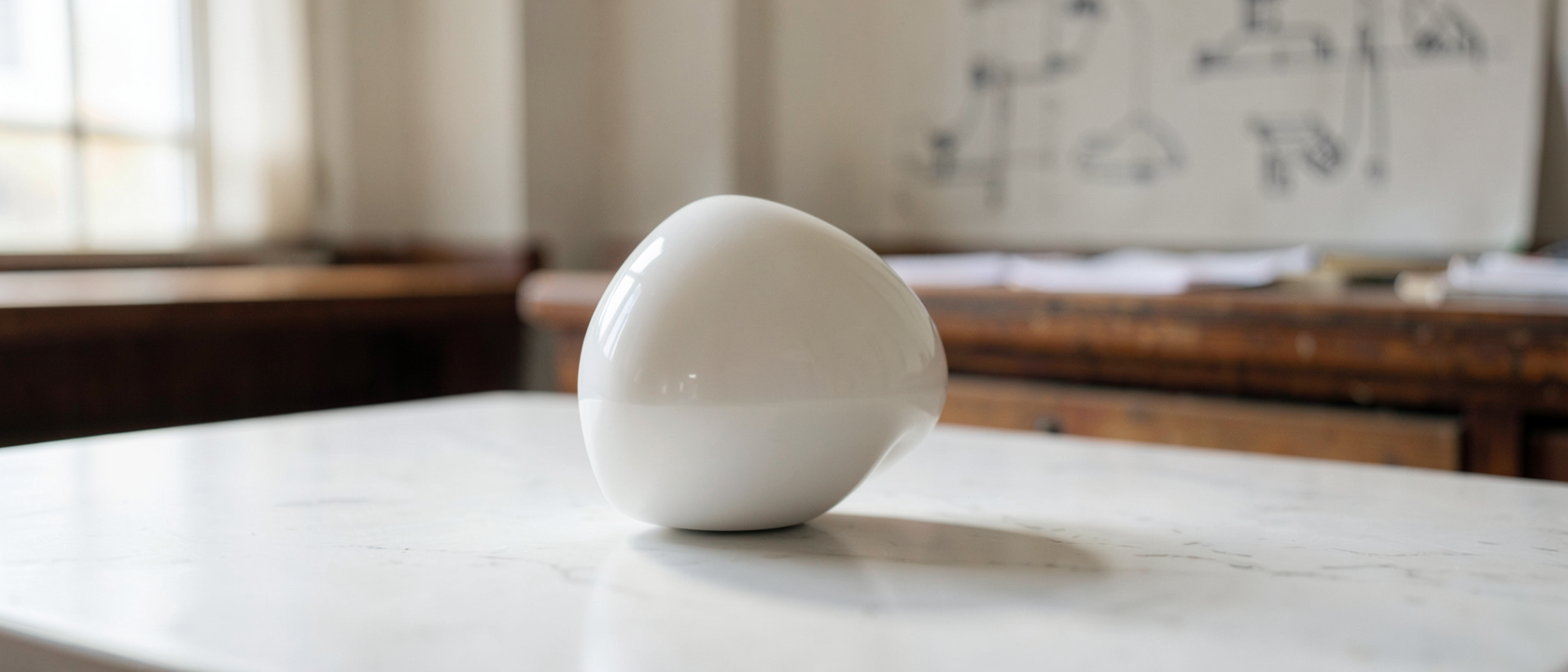
Picture a smooth, glassy, rounded object with no seams, no paint, and no visible mechanism. Its name, Gömböc, comes from the Hungarian word for sphere, “gömb.” Push it onto its side and let go.
It rocks, wobbles, seems to hunt for something, then rolls itself upright and settles, untouched. Try it from a different angle. Same result, every time.
You might think of a Weeble, or an inflatable punching bag that always bounces back up. Those toys work because a hidden weight in the base shifts the center of mass, and gravity pulls them upright. The Gömböc has no such trick. It’s made of a single uniform material, weight spread perfectly evenly. There’s nothing hidden to find.
If There’s No Weight Trick, What Is Doing the Work?
So here’s the puzzle: if the mass is distributed evenly, how does the object “know” which way is up? The only thing left that could do the job is the surface’s exact curve.
In 1995, at a conference in Hamburg, Russian mathematician Vladimir Arnold proposed that a convex, homogeneous solid, same density throughout, no dents or hollows, could in theory have just two points of balance: one stable resting position it always falls back into, and one unstable position it could only balance on for an instant. Mathematicians call this “mono-monostatic.” Arnold had no proof such a shape existed; nobody had built or found one in nature. For roughly a decade, the idea lived only on paper.
Two Engineers Build the Impossible Shape
The challenge fell to Gábor Domokos, then head of Mechanics, Materials and Structures at the Budapest University of Technology and Economics, and his student Péter Várkonyi, an engineer and architect who had won a silver medal at the 1997 International Physics Olympiad. They set out to actually design the shape Arnold had only imagined.
The requirement is brutal to hit: exactly one stable point, exactly one unstable one, nothing in between. The tolerance is about one part in a thousand, nudge the curve slightly and the object gains extra resting positions and stops working. Using computer modeling, Domokos and Várkonyi searched for a surface precise enough to thread that needle.
Once found, the mechanism was almost poetic: gravity pulls the center of mass toward the single stable point, while the surface’s curvature steers every roll, like a marble finding the bottom of a bowl sculpted into the object itself. No convex homogeneous solid can have fewer than two equilibrium points at all, so the Gömböc sits at the mathematical floor, the simplest such shape possible. Early versions looked like a pinched sphere, steep-backed with a flattened underside, and it’s considered the most sphere-like shape there is, short of an actual sphere.
2,000 Pebbles That Didn’t Make the Cut
Before building anything, Domokos wondered whether nature had already beaten them to it, wind and waves tumbling smooth rocks into rounded forms, so maybe a mono-monostatic pebble was already sitting on some beach.
He and collaborators tested about 2,000 pebbles from beaches on the Greek island of Rhodes. Not one qualified: “roundish” and “mathematically precise” are very different things, and random erosion never lands on the exact curve required. The shape wasn’t something you could stumble across, it had to be calculated.
Years of computer-based refinement followed, adjusting the model until the geometry held, before anyone attempted to machine a physical version. By 2006, that object existed and behaved exactly as predicted: self-righting, every time.
Holding Proof in Your Hands
Várkonyi later described what made the problem so satisfying: you could hold the proof of a mathematical idea in your own hands, elegant and beautiful, in his words.
On August 20, 2007, the first functioning Gömböc, serial number 001, was presented to Arnold in Moscow on his 70th birthday. He died less than three years later, on June 3, 2010, in Paris.
The idea didn’t stop at one object on a table. Domokos and Várkonyi later used the same shape analysis to study tortoises, publishing a 2008 paper connecting shell geometry to how some species flip themselves back over after landing on their backs. The Indian star tortoise, with its domed, ridged shell, has since been compared to the Gömböc’s self-righting logic, even though a living tortoise is nowhere near as uniformly weighted as a lab-made solid. A theoretical shape, dreamed up with no use in mind, ended up explaining something about how a shell survives being upside down.