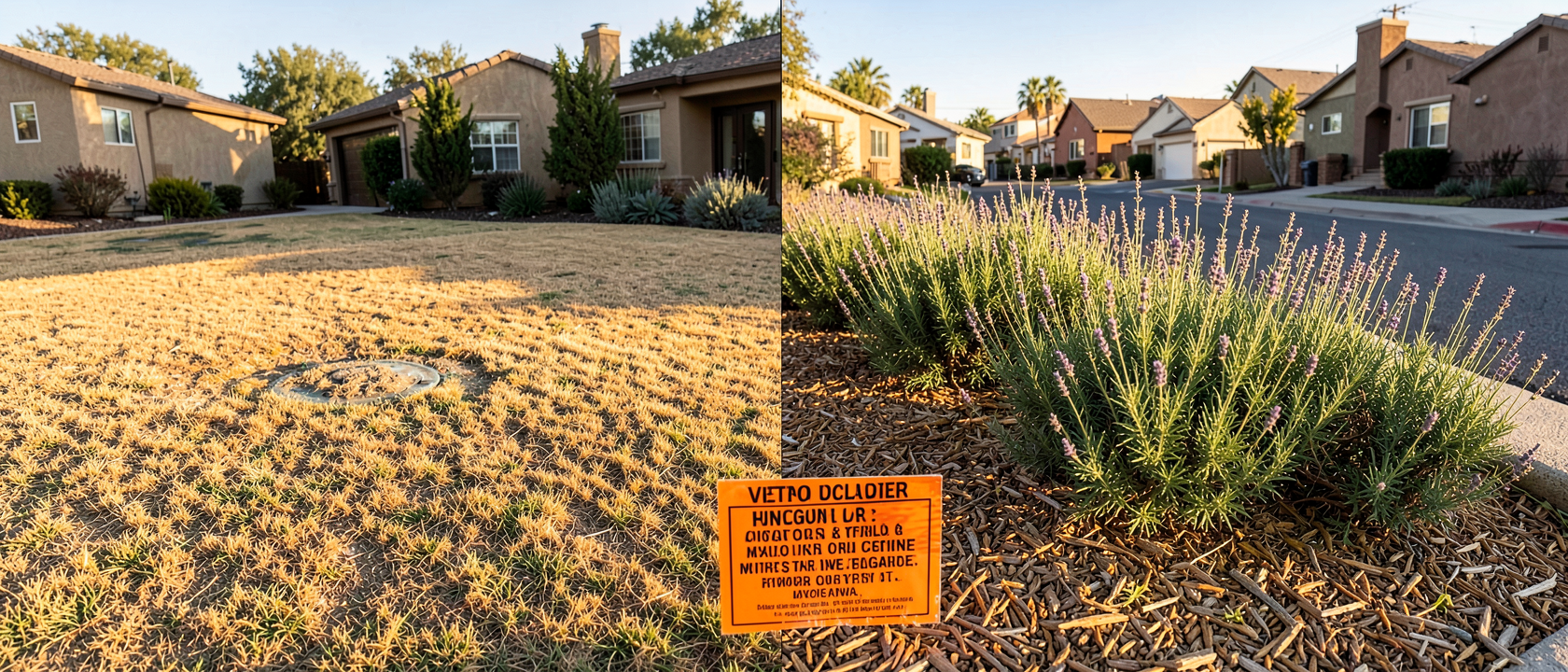
A Lawsuit for Doing the Right Thing
Around 2008, as best as the record allows it to be pinned down, Quan Ha and Angelina Ha looked at the lawn in front of their home in Orange, California, and did the thing water agencies, news anchors, and the state government kept begging people to do. California was deep into a drought, so they tore the grass out.
No more sprinklers running at dawn. No more water bill creeping higher every summer. What the Has got in return wasn’t a thank-you note. It was a lawsuit, filed by their own city.
Wait, How Is This Illegal?
Ripping out a lawn is one of the most common water-saving moves a homeowner can make. Cities across California have literally paid people to do it. So how does a family end up facing misdemeanor charges for having less grass, not more?
If the state, the city, and the local water district all want you to use less water, what rule could possibly turn bare dirt into a crime? It sounds like a contradiction, because it is one. But it’s also something stranger: a rule that was never really about water in the first place.
The Rule Nobody Updated
The city of Orange’s municipal code required front yards to be substantially covered with “living ground cover,” language written long before water scarcity became a civic emergency. Under that wording, dirt didn’t count, no matter how responsibly it got there.
It didn’t matter that removing the grass was, by any measure, the more sustainable choice. The code wasn’t written with conservation in mind. It was written to keep front yards looking a certain way, from an era when a lush lawn was simply what a well-kept home looked like. The Has weren’t breaking the spirit of any environmental law. They were breaking an aesthetic one that had quietly outlived the reason it existed.
Wood Chips Weren’t Good Enough
Trying to smooth things over, the Has covered the bare dirt with wood chips, a low-water fix used in drought-tolerant yards everywhere, with help from a neighbor. City officials rejected it anyway.
The code, it turned out, was more specific than “no dirt.” It demanded that at least 40 percent of a yard be landscaped predominantly with live plants, not inert material like mulch or wood chips. Mulch could stop the dust and keep the ground from washing away, but it couldn’t grow, and growing was apparently the whole point. The rule wasn’t built to reward a reasonable substitute. It was locked onto one narrow picture of what a yard should look like.
A State Says Save Water. A City Says Keep It Green.
Pull back from the Has’ front yard and you can see a real tension playing out in drought-prone places. Their own water bill told the story: in 2007 the property used about 299,221 gallons (roughly 1,132,700 liters) of water a year. By 2009, with the lawn gone, that number had fallen to 58,348 gallons (about 220,900 liters), a drop of more than 80 percent.
That’s the kind of number state and local agencies point to when they urge people to conserve. But those campaigns sit on top of decades of local ordinances built for a different priority entirely: curb appeal. One level of government asks you to use less water. Another level, sometimes inside the same city hall, still enforces rules written when water felt like it would never run out.
Not Everyone Wanted the Old Rules Kept
Not everyone in the neighborhood sided with the city. Dennis Cleek, who lived nearby and had replaced his own lawn with fruit trees, helped the Has lay down the wood chips and publicly defended their choice. He argued their yard wasn’t an eyesore and that homeowners deserved more room to landscape responsibly.
It’s a small detail, but it says something. This wasn’t a story about neighbors upset over appearances. It was neighbors starting to wonder whether the appearance rules themselves were the actual problem.
Did Anyone Ever Fix This?
The dispute reached Orange County Superior Court, where Quan Ha pleaded not guilty to three misdemeanor counts tied to the city’s municipal code. Commissioner Vickie Hix set a hearing for March 16, 2010, and the couple said they intended to challenge the ordinance itself, not just the charges against them.
What happened at that hearing isn’t part of the record available here, and that gap is, in its own way, the most interesting part of the story. It leaves a question worth carrying around: how many cities still have a “pretty lawn” clause sitting untouched in their code books, written long before saving water became the point, and never revisited since. Next time you pass an HOA notice or a city ordinance, it might be worth asking who wrote it, and when.