You Don’t Even Have to Touch It
In 1866, a Queensland surveyor named A.C. Macmillan wrote that his packhorse brushed against a plant in the rainforest, went wild with pain, and died within two hours. That plant still grows across the wet forests of Queensland and New South Wales, and still carries the name people gave it back then: the suicide plant.
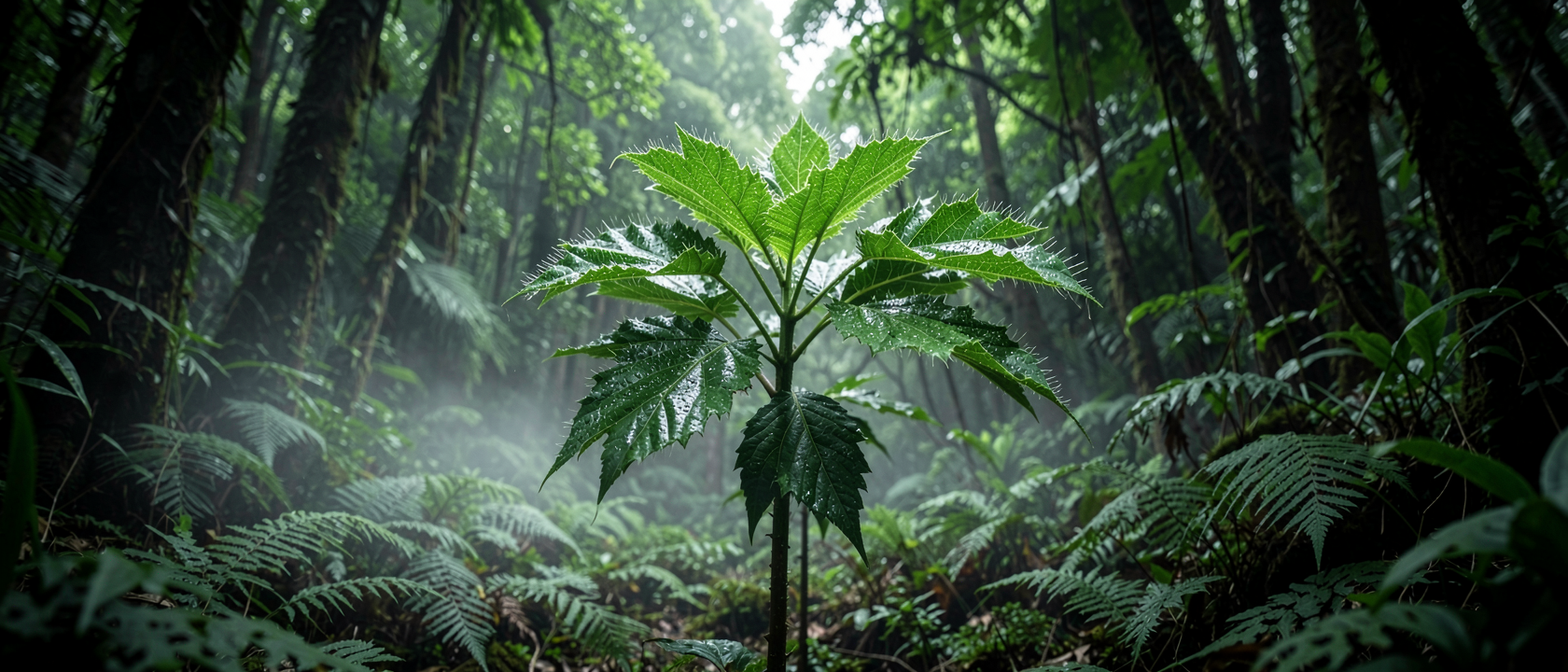
Its scientific name is Dendrocnide moroides, though almost everyone calls it gympie-gympie, a name borrowed from the language of the Gubbi Gubbi people and shared with the old Queensland gold-mining town of Gympie, settled in the 1860s. It has soft, heart-shaped, serrated leaves that could pass for something on a garden center shelf, growing on a shrub usually under 10 feet (3 meters) tall.
The danger isn’t in the leaf you can see. It’s in something almost invisible, and in some cases, you don’t even need to touch the plant to meet it.
Why This Sting Is So Different
Everyone has brushed a stinging nettle at some point: a few red bumps, an itch, gone within the hour. Gympie-gympie sits under a completely different heading. Bushwalkers and researchers rank its sting among the most painful things a person can experience from a plant, intense enough to make grown adults vomit or scream.
Oddly enough, a nettle hair and a gympie-gympie hair work on roughly the same principle: a fine hollow spike that snaps off in the skin. So why does one wear off in an hour while the other has, according to some accounts, bothered people for months? The difference isn’t how sharp the hair is. It’s what keeps happening after it breaks off.
The Needles That Keep Firing
Every above-ground part of the plant, stem, branches, leaf stalks, leaves, even the fruit, is covered in hairs so fine they’re hard to spot with the naked eye. Only the root is bare. Each hair works like a miniature syringe: a bulb at the base holding toxin, a needle-sharp tip that snaps off on contact and lodges in skin.
In 2020, researchers at the University of Queensland’s Institute for Molecular Bioscience, including Irina Vetter and Thomas Durek, identified the toxin as a brand-new class of miniproteins they named gympietides. Structurally, these molecules resemble toxins from spiders and cone snails, part of why scientists have studied the plant seriously rather than dismissing it as exaggeration.
For a long time, the assumption was that each touch on an old sting sent a fresh dose of venom into the skin. Newer research suggests something stranger: gympietides are unusually stable proteins that lock onto the sodium channels nerve cells use to send pain signals, jamming the switch in the “on” position. That instability may be why pressure, water, or a change in temperature on the same spot can reignite the burning days later, without a single new drop of venom.
The hairs don’t even need you to grab anything. Broken ones drift and settle on nearby soil and leaf litter, so a plant disturbed by an animal or a hiker can scatter its weapon around itself. Even a dead, dried specimen can still sting, since the toxin sits sealed inside each hair like a tiny vial that doesn’t seem to expire.
Why the Pain Spreads Far From the Wound
A gympie-gympie sting rarely stays where it started. The toxin overloads the lymphatic system, the network of vessels that normally drains extra fluid out of tissue and helps the immune system do its job. Overstimulated, that network swells in places nowhere near the original contact, the throat, the armpits, the groin. A scratch on one forearm can end up aching at the other end of the body.
This is what separates the plant from an ordinary irritant. A nettle sting stays local; this one pulls the body’s own plumbing into the reaction, which helps explain why case records describe animals and, in rare instances, people dying from a sting that never even punctures deep tissue.
The Feared Plant Nobody Wants to Save
You may have read that gympie-gympie is endangered. Current IUCN assessments actually list Dendrocnide moroides as a species of least concern, so that claim doesn’t hold up.
What is genuinely strange is how ordinary its ecology turns out to be for something with such a fearsome reputation. Red-legged pademelons, certain insects, and some birds eat its leaves without any trouble, using the same rainforest canopy people avoid. A weapon built to stop generalist predators still has gaps that local wildlife has already found.
Here’s the part that flips the story on its head. The same gympietides that make this plant a nightmare to brush past are being studied for the opposite purpose: because they bind so precisely to the receptors that cause pain, researchers see potential in them for building new painkillers. A plant famous for inflicting agony may end up teaching us how to switch it off, which is exactly the kind of detail that turns “have you heard of this plant” into a story worth passing along.