A Spade Hits Something That Isn’t a Pipe
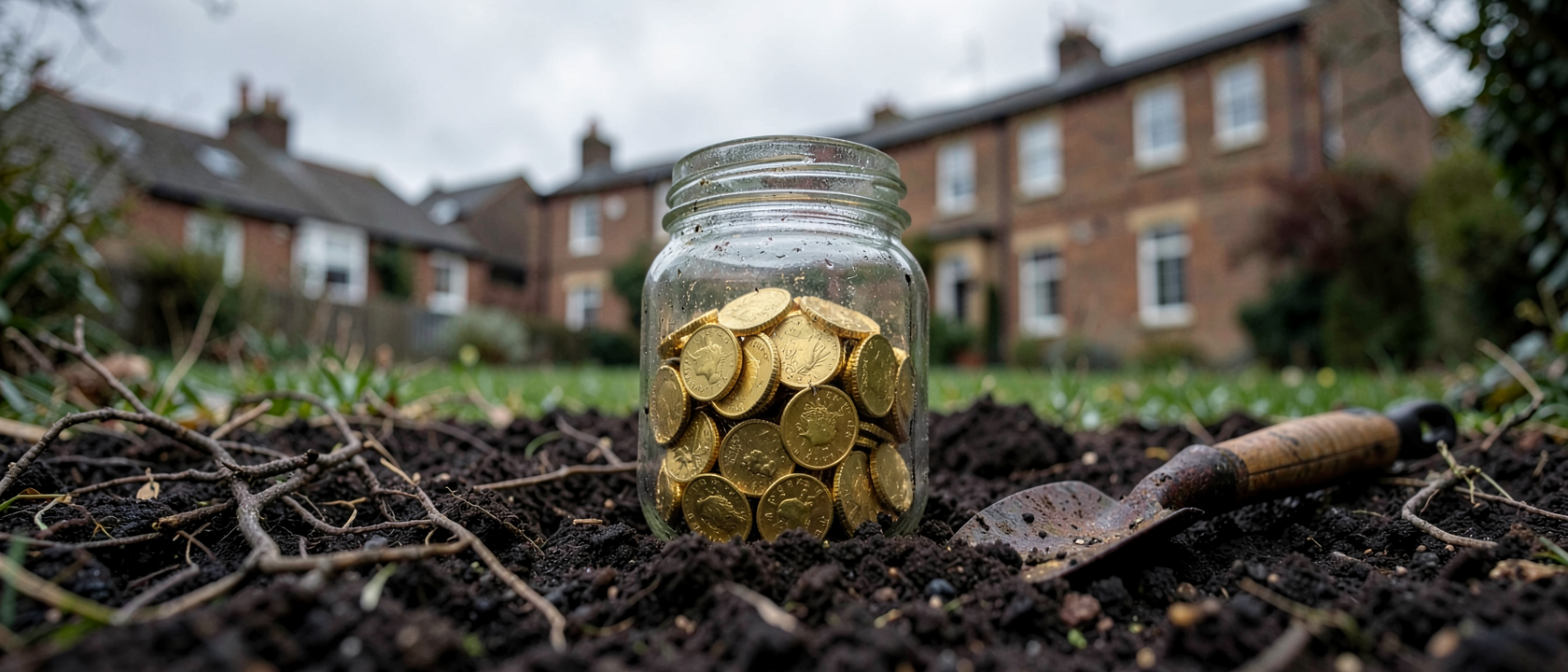
In 2007, Terence Castle was digging a pond in his back garden in Stamford Hill, Hackney, with three others helping him. Partway down, a spade struck something that wasn’t a pipe, brick, or scrap metal. It was gold.
By the time digging stopped, 80 coins lay stacked in the dirt, all American $20 gold pieces known as Double Eagles, dated between 1854 and 1913, packed into a glass jar that had sat under a London lawn for decades. Nothing like it had ever turned up in the UK before.
Why Buried Gold Rarely Means What You’d Guess
“Buried treasure” conjures pirates and smugglers, but people usually bury valuables for plainer reasons: an unsafe bank, a closing border, a sudden danger. American coins under a London garden only sharpened the puzzle. The answer had nothing to do with crime, and everything to do with a war that made simply owning gold a risk.
A Banker Who Escaped One Danger and Walked Into Another
The coins belonged to Martin Sulzbacher, who had moved to Hackney with his extended family from Germany in the late 1930s. For a Jewish family fleeing the Nazis, gold made sense in a way paper money didn’t: it crosses borders and keeps its value regardless of government. Sulzbacher deposited the coins in a London bank vault, the obvious choice.
Then came a twist nobody could have planned for. Wartime Britain classified German-born residents, Jewish refugees included, as “enemy alien refugees.” Sulzbacher was interned and sent to Australia; his wife and children were interned separately on the Isle of Man. A vault tied to his name had become a liability.
The Brother Who Dug and Never Told
In early 1940, Sulzbacher’s brother Fritz, a British citizen who had stayed in the Hackney house, withdrew the 80 coins from the bank and buried them in the garden instead, presumably meant to be temporary.
It never got the chance to be temporary. On September 24, 1940, the house was bombed, and Fritz died, leaving his four children orphaned. He was the only person who knew where the coins were, and he took that detail with him.
Coming Home to an Empty Lot
Once released and reunited with his wife, his own four children, and his brother’s orphaned children, Sulzbacher returned to London to find the house destroyed. He searched the site thoroughly for the coins. He found nothing.
Strangely, in 1952, workers preparing the site for a new building unearthed a different jar: 82 American gold coins dating to 1890. A coroner ruled those coins weren’t legally “treasure” since the owner was known, meaning Sulzbacher couldn’t simply have them back, though he was compensated. Meanwhile, the first jar, the 80 coins from 1854 to 1913, stayed exactly where Fritz had left it, for decades more.
An Honest Report Reopens a Sixty-Year-Old Mystery
When Castle struck gold in 2007, he reported it rather than keeping quiet, sending the find through the Portable Antiquities Scheme at the Museum of London, then the British Museum, then the coroner’s office for St. Pancras, as UK law requires for a possible “treasure” find.
That process cracked the case open. A member of the public pointed investigators to a March 13, 1952, article in The Times describing an earlier, strikingly similar gold hoard found on the same property, already tied by name to Martin Sulzbacher. One overlooked clipping connected a six-decade-old mystery to a living family.
Eighty-One Years Old, Claiming What His Father Never Could
Martin Sulzbacher had died in 1981, after running a bookshop in Stoke Newington. On April 18, 2011, an inquest ruled that the 80 coins, valued at roughly £100,000, didn’t legally qualify as treasure and should pass to his descendants. His son Max Sulzbacher, 81 and living in Jerusalem, came forward to claim them.
The coins went to auction on November 29, 2011, expected to fetch up to £80,000; 77 of the 80 sold, with one donated to Hackney Museum. As museum manager Niti Acharya put it, the story carries a human weight most archaeological finds don’t, tying together the Second World War, Jewish immigration, and the history of one London borough. A war, a lost brother, a sixty-year gap, and one honest report is a long chain to trace from a backyard pond project, but it’s exactly that chain that brought the gold home. One coin now sits in Hackney Museum, a few miles from the garden where it spent nearly seventy years underground.