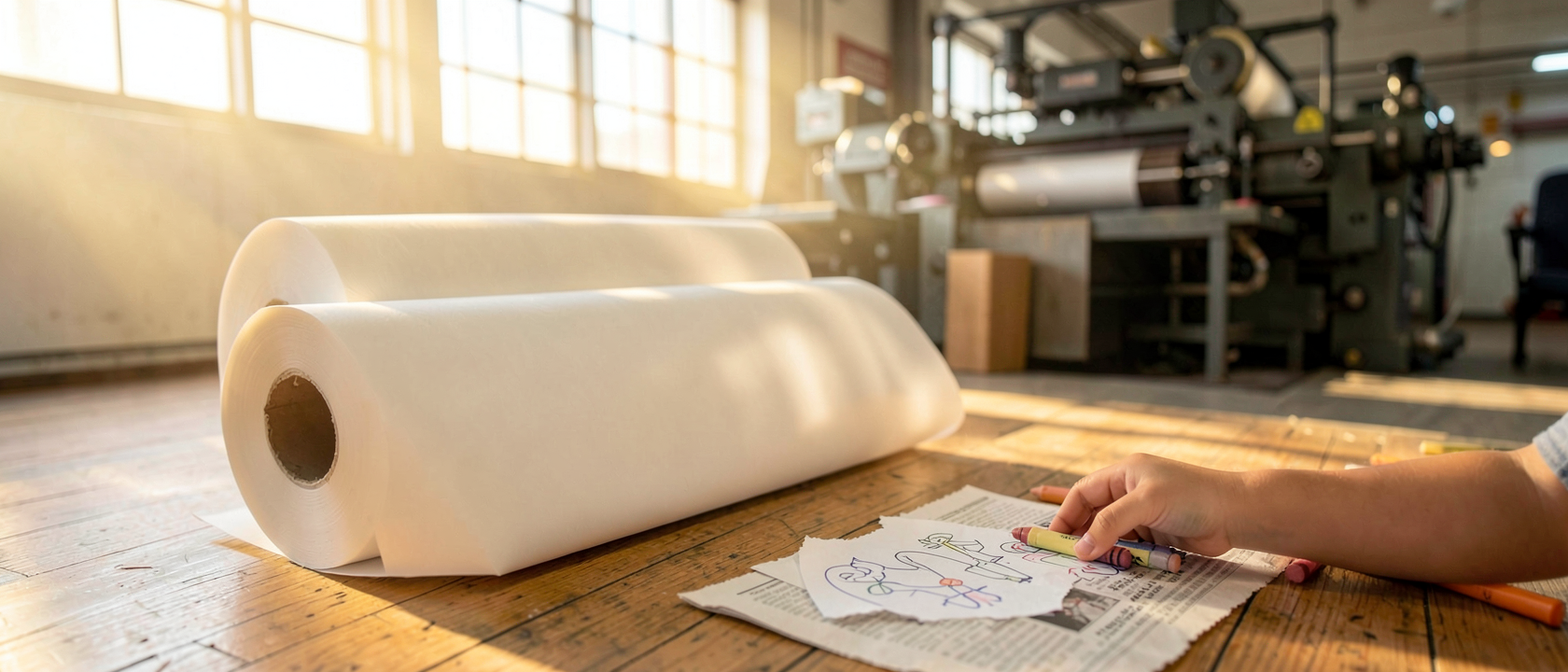
A Giant Roll of Paper for the Price of a Coffee
Walk into the front office of a local newspaper, hand over a dollar or two, and walk out with a roll of blank paper so big it’s taller than a toddler. No printing on it, no ink smudges, just clean, blank newsprint, unspooled from the same giant reels that print the news every day.
It sounds like a one-time deal or an inside favor, but it isn’t. These rolls, known in the industry as “end rolls,” sometimes still hold hundreds of square feet of usable paper when a printing press sets them aside. Many newspapers sell them routinely, right there at the business counter. Most people never ask, so most people never know.
Why Not Just Use It All?
Here’s the part that doesn’t add up at first. Newsprint costs money. Newspapers run on tight margins. So why would any press operator deliberately stop using a roll while it still has plenty of paper left on it?
If you were running a factory line, you’d expect every manager to squeeze every last inch out of the raw material. Paper that’s still usable is still worth something. Tossing it, or selling it off for pocket change, seems like leaving money on the table. There has to be a reason a press would walk away from paper it hasn’t finished using.
Why Presses Retire Rolls Early
The answer comes down to how a printing press actually runs. These machines move paper at speed, continuously, for an entire print run. Stopping that run to swap in a fresh roll mid-stream is called a splice, and it’s a delicate operation. Do it wrong and you risk tearing the web of paper or throwing off the alignment, which can ruin a run of pages.
So instead of risking a splice failure by chasing every last foot of paper, press operators pull a roll once it’s running low and load a full one in its place before the next print job starts. It’s a simple trade-off: a little bit of “wasted” paper is cheaper than a jam that stops the whole press. Multiply that small, sensible decision across every run, every day, at papers everywhere, and you get a steady supply of rolls that are retired early, not because they’re empty, but because finishing them isn’t worth the risk.
The Afterlife of an “Empty” Roll
Those retired rolls don’t get thrown in a dumpster. Pressroom staff hand them over to the newspaper’s front office, where they sit until someone decides what to do with them.
Rather than paying to have the paper hauled away or recycled, many papers just sell it. It costs them almost nothing to let the rolls go for a dollar or two apiece, and it turns a leftover from an efficiency decision into a small, steady bit of side income. It’s the kind of detail that never makes it into the paper itself, even though it happens in the same building every single day.
What People Actually Do With It
On September 11, 2008, personal finance writer Trent Hamm published a piece on his blog, The Simple Dollar, built entirely around this cheap source of blank paper. He laid out fifteen ways parents and kids could put a one-dollar end roll to use: giant sheets for drawing and painting, homemade wrapping paper, padding for a move, a disposable cover for a messy craft table, even makeshift gift wrap for something too oddly shaped for a store-bought roll.
His list didn’t stop at fifteen. Readers added their own ideas in the comments, and the post, later picked up by Neatorama’s Miss Cellania on September 24, 2010, turned into a small running tradition of frugal, hands-on creativity built on something most people assumed was only good for recycling.
How to Actually Get One (and the Fine Print)
If this sounds worth trying, the method is almost comically simple: call or stop by your local newspaper’s office and ask whether they sell end rolls. Many do, quietly, because it’s a minor sideline nobody bothers advertising.
Just don’t expect a fixed national price. Readers and local buyers report real variation: some papers charge about a dollar per roll, some price by weight at around fifty cents per pound, and others sell for a few dollars depending on size. Some give the rolls away for free, and a few have stopped the practice altogether, sending end rolls straight to recycling instead. As print runs shrink across the industry, availability isn’t guaranteed everywhere.
None of that makes it a bad question to ask. It just makes it the kind of thing you’d only think to try if somebody happened to mention it first, and now somebody has.