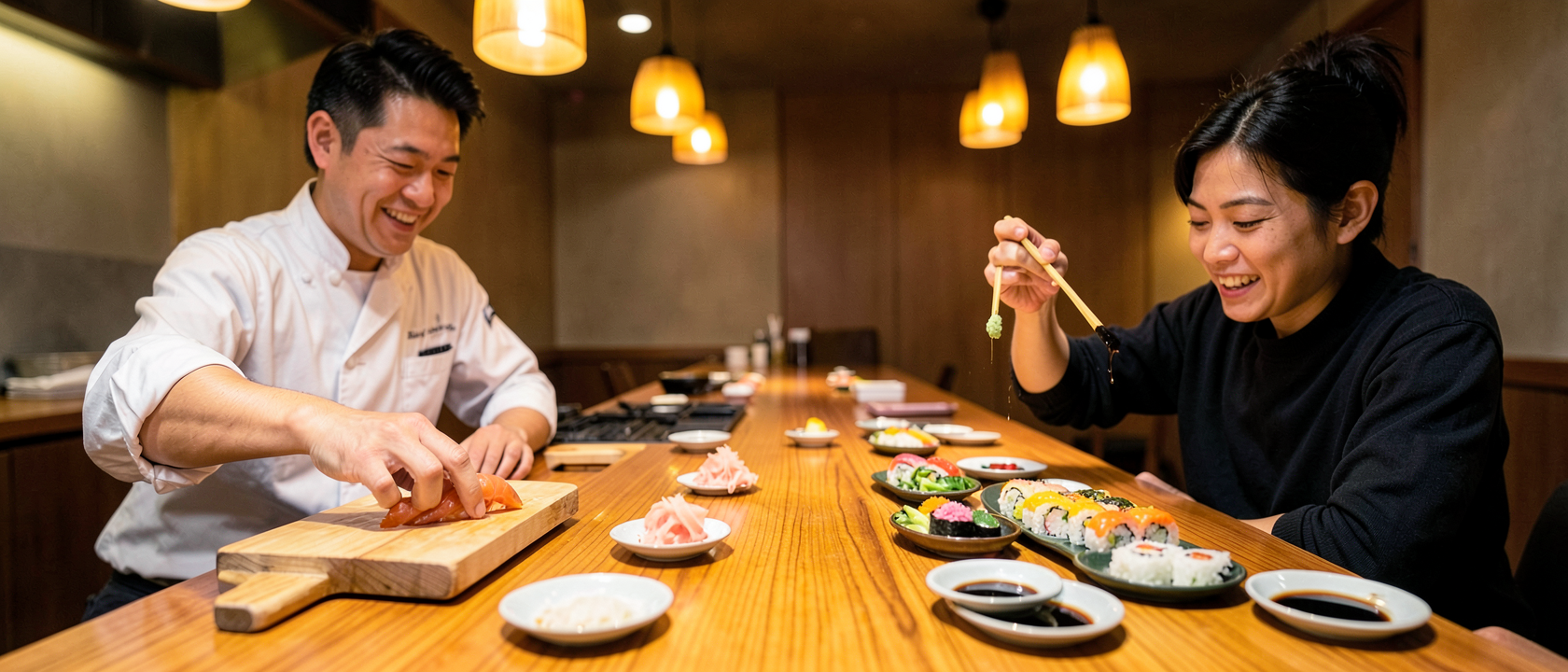
The Chef Notices Everything
Picture a Friday evening at a well-regarded sushi counter. A table of four settles in confidently, they know their nigiri from their maki, one has ordered omakase, and within minutes the itamae behind the bar has quietly registered three or four etiquette violations. Nobody at the table has any idea. This happens at sushi restaurants across the Western world, almost every service.
Why Does Casual Food Come With Such Precise Rules?
Sushi has a strange reputation problem in the West. It sits in grocery store refrigerators, priced for weekday lunches, and shows up at all-you-can-eat chains and airport food courts. And yet it carries a framework of etiquette that would feel at home at a fine-dining tasting counter. When sushi traveled from Japan to the Western world, the flavors made the crossing in full. The customs, largely, did not, leaving a cuisine whose traditions treat each piece as a calibrated unit of food that a trained chef spent years learning to construct, even as it looks casual enough to eat in front of a laptop.
Every Piece Is Already Seasoned
A skilled sushi chef has already done the seasoning work before the plate reaches you. The rice carries a specific vinegar mixture. The fish may already bear a precise brush of soy sauce. A small amount of wasabi sits deliberately between the fish and the rice, where it does its job without overwhelming either element. The piece arrives complete.
When a diner submerges that nigiri in a soy-wasabi mixture, the effect is roughly equivalent to salting a dish before tasting it, except someone else already did the salting, with considerably more care. Rice absorbs soy sauce quickly and turns soggy. The compounds responsible for wasabi’s sharpness lose potency quickly once dispersed in liquid. Both elements stop doing what they were supposed to do.
The traditional approach is to dip nigiri fish-side down into a small amount of soy sauce, briefly, so the topping picks up a little salt without the rice falling apart. The wasabi is already in place, in the right quantity, exactly where the chef put it.
Ginger Is a Reset Button, Not a Topping
Of all the misunderstood items on a sushi plate, gari, the thin-sliced pickled ginger served alongside, may be the most consistently misused. Its function is temporal, not flavor-additive: eat a piece of tuna, eat a slice of ginger, and your palate clears before the salmon arrives. Gari’s use as a palate cleanser dates to the Edo period (1603 to 1868), when it was standardized for use at sushi bars. It works the way a plain water cracker functions at a cheese tasting, between bites, not on top of them.
When a diner places gari on top of a roll and eats them together, two things go wrong: the pickled, acidic flavor enters a combination the chef never planned for, and the ginger’s cleansing purpose is spent on a single bite, leaving no reset between the next two pieces. The name “gari,” incidentally, is widely thought to come from the Japanese “gari-gari,” describing the crunching sound it makes when chewed.
Knowing the Rules Is Already Most of the Work
In May 2016, San Francisco publication The Bold Italic partnered with Ichi Sushi, named one of America’s Top Restaurants in the Zagat 2013 guide and listed in the Zagat San Francisco Bay Area Guide 2013’s Top 20 Restaurants, as well as SF Chronicle Restaurant Critic Michael Bauer’s Top 100 Bay Area Restaurants, to produce a lighthearted visual etiquette guide for Western diners, illustrated by lettering artist Erik Marinovich. One of its honest acknowledgments was that most readers would go right back to their usual habits afterward.
Traditional sushi etiquette is not a gatekeeping mechanism; nobody loses restaurant privileges for mixing their wasabi. The rules exist because each piece was engineered to taste a specific way, and most common Western habits undo that engineering without the diner realizing it. Even one small adjustment, trying a piece of nigiri as-is before reaching for anything, is worth making, not out of obligation, but because the chef already put the wasabi exactly where it needs to be.