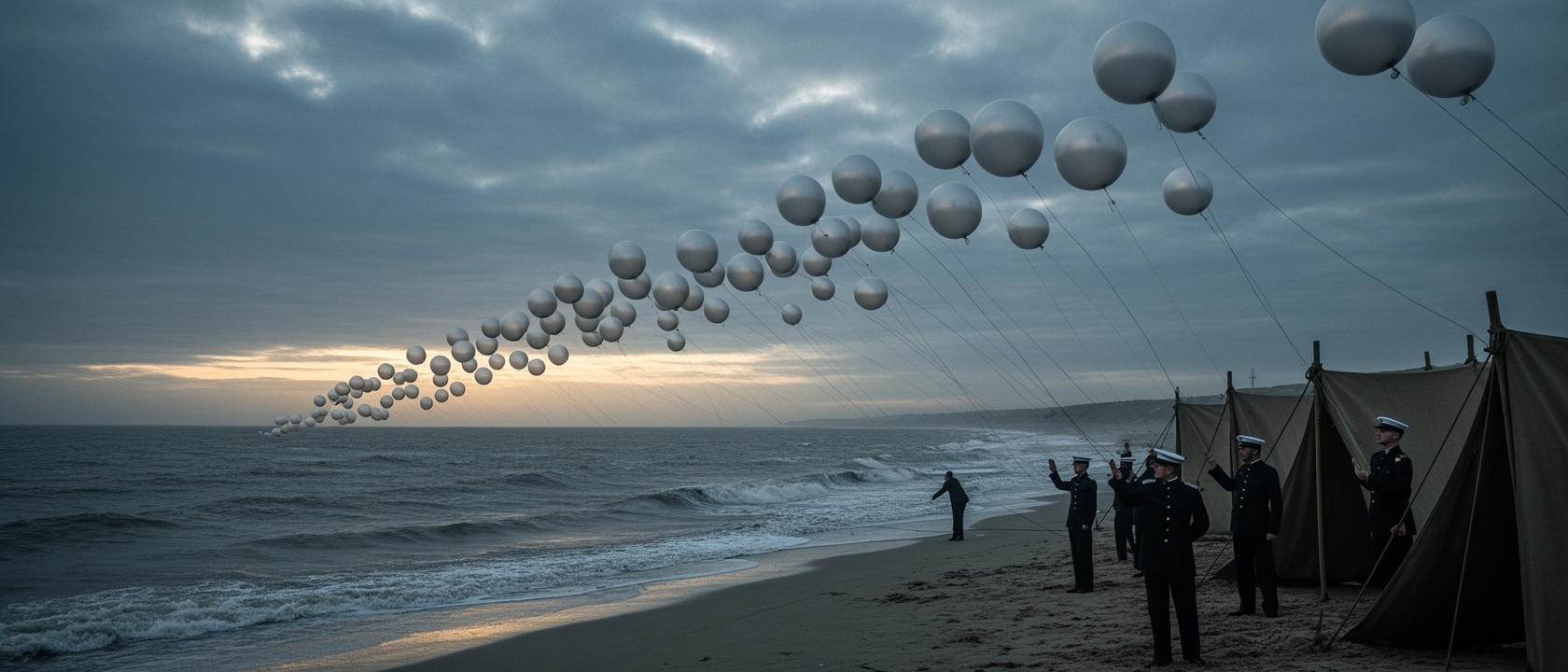
The 35-Shilling Saboteur
On July 12, 1942, a latex weather balloon drifted over occupied Europe, trailed a steel wire across a 110,000-volt transmission line near Leipzig, and triggered a catastrophic failure at the Böhlen power station. The explosion and fire knocked 250 megawatts of generating capacity offline and caused an estimated £1 million in damage. The balloon cost 35 shillings to make.
This was Operation Outward, Britain’s largely forgotten balloon offensive. Between March 20, 1942 and September 4, 1944, the Royal Navy launched 99,142 balloons toward Germany, averaging over a hundred a day, peaking at 1,000 on favorable days. The Germans responded by scrambling up to 250 fighter aircraft a day to intercept them.
The Atmospheric Gamble
The core problem with an unmanned balloon is obvious: you cannot steer it. Britain’s planners were banking on geography. Above roughly 16,000 feet, the prevailing airflow over northwest Europe runs west to east. Launch a balloon from England’s east coast under the right conditions and the atmosphere carries it over Germany. That same eastward flow meant Germany could not easily retaliate in kind.
The idea had its origins in an accident. On the night of September 17, 1940, a gale tore several British barrage balloons from their moorings. They crossed the North Sea and, by morning, had shorted power lines, blocked railways, and brought down a radio tower in Denmark and Sweden. The damage reports reached Prime Minister Winston Churchill, and an embarrassing mishap became an operational question worth answering.
Engineering the Descent
A slow-burning fuse, lit at launch, was calibrated to burn out over German-controlled territory. A pressure valve vented hydrogen to begin a gradual descent, while a dripping can of mineral oil made the balloon lighter to arrest the fall. The payload then deployed at a useful altitude.
Six payload types existed in total. The wire rig, 656 feet of hemp cord with 295 feet of steel wire hanging below, was designed to drift across high-voltage lines and create a phase-to-phase short circuit that Germany’s grid protection equipment was not built to handle quickly, causing breakers to fail, pylons to collapse, and fires to start. The incendiary types included white phosphorus grenades, canisters of jellied gasoline, and paraffin-soaked wood wool bundles designed to catch in tree crowns and ignite fires large enough to divert German manpower. A small explosive charge rounded out the destructive options, and propaganda leaflets made up the sixth type.
Golf Courses and the Wrens
The entire operation ran from the Felixstowe Ferry Golf Club in Suffolk, under the cover name “Boom Defence Unit,” staffed by about 230 people. A significant portion were members of the Women’s Royal Naval Service, the Wrens, who handled much of the preparation and launch work. Balloons were inflated with hydrogen inside canvas windbreaks and sprayed with water to dissipate static charge. On favorable days, launches ran from 10 a.m. to 4 p.m.; by August 1942, the team was releasing as many as 1,000 balloons a day. Two additional sites opened at Oldstairs Bay near Dover and Waxham in Norfolk.
The Cost of Countermeasures
The Böhlen strike remains the operation’s most documented single outcome: the trailing wire shorted the line, threw a generator out of synchronism, bent the rotor shaft, and the station caught fire. German engineers recorded 520 major disturbances on lines of 110,000 volts and above during the ten-month stretch from March 1942 through the end of January 1943, a period in which roughly 25,000 Outward balloons had been launched.
Germany’s response was expensive. Engineers manufactured more than a million new cable clamps to prevent pylon collapse, then discovered the clamps caused disconnections under ordinary wind and ice loads. The Luftwaffe kept committing up to 250 aircraft a day to intercept balloons that cost 35 shillings each. At least one balloon drifted back and knocked out power in Ipswich. But across 99,142 launches, the arithmetic stayed stubbornly lopsided: a single balloon had destroyed a power station worth £1 million, and the aircraft assigned to stop the next one cost far more than the target it was chasing.