The Hook: Chips, a Tube, and a Hidden Trick
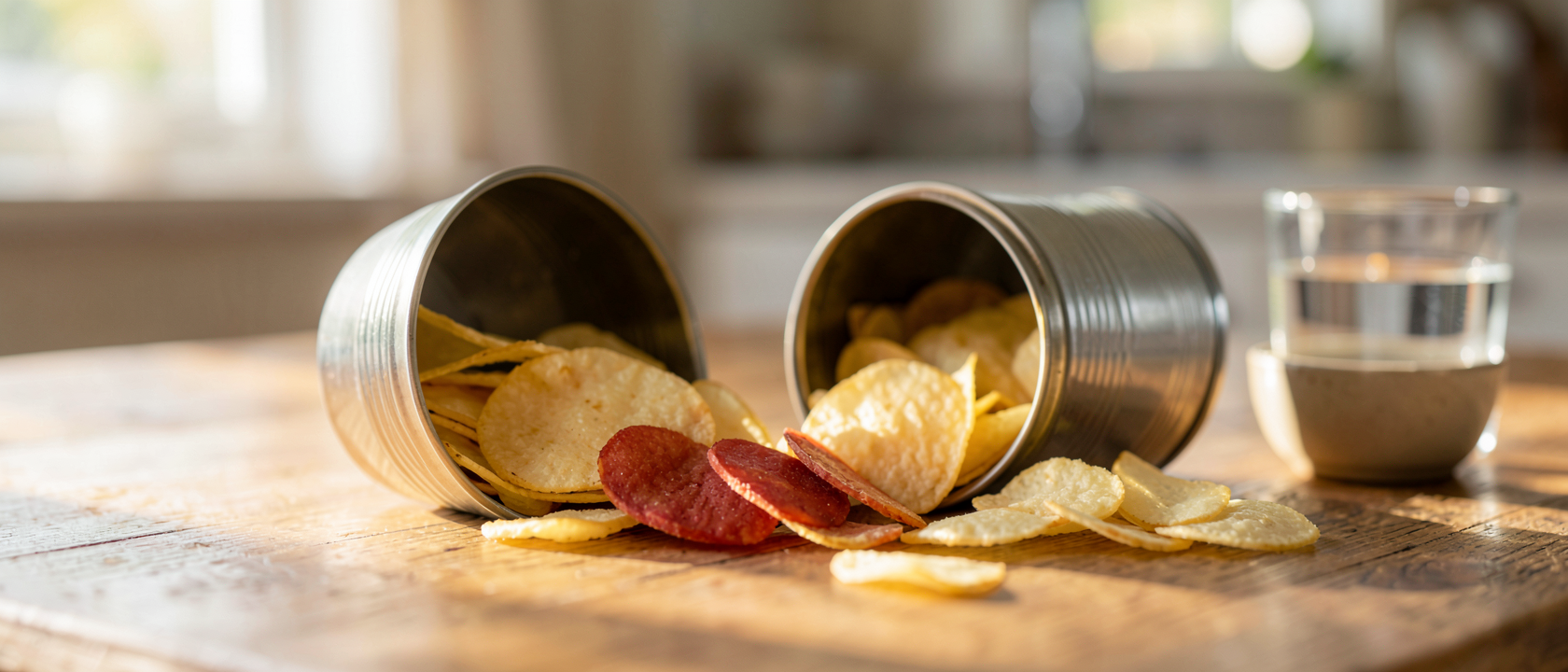
Picture a college lecture hall with video clips playing and a tube of Lay’s Stackables passed down the row. That was roughly the setup Cornell researchers built for 98 students, ages 17 to 21, who thought they were simply snacking during a guest lecture series. What none of them knew: inside some tubes, a single chip had been dyed red and slipped in at a fixed interval, like a marker hidden in a deck of cards.
Nobody announced it, and nobody explained what the red chip meant, or whether it meant anything at all. Yet by the end of the clip, students eating from the marked tubes had eaten noticeably fewer chips than those holding a plain, unmarked stack.
The Mystery: Nobody Was Told Anything
This wasn’t a diet tip, a calorie warning, or an instruction to watch portions. Nobody told the students to stop at the red chip. There was no conscious rationing, no willpower on display, no counting happening in anyone’s head.
So what slowed them down? If it wasn’t awareness and it wasn’t instruction, something had to be working below the surface, shaping behavior without ever reaching conscious thought.
The Reveal: An Edible Stop Sign
Brian Wansink of Cornell’s Food and Brand Lab, who ran the study with Andrew Geier of Yale University and Paul Rozin of the University of Pennsylvania, offered a simple explanation: the red chip worked like a checkpoint built directly into the food.
Most snacking runs on habit more than hunger: hand meets tube, tube meets mouth, repeat, often while distracted by a screen, exactly as these students were. As Wansink put it, “people generally eat what is put in front of them if it is palatable,” and some rely on visual cues, like an empty plate, to know when to stop. The colored chip simply offered an earlier one. Inserting a marker into the package, he said, helps people “monitor how much they are eating and interrupt their semiautomated eating habits,” without ever spelling out what the marker was for.
The Numbers: How Much Less, Exactly
In the first experiment, red chips appeared every 7th chip (one serving, per the package label) or every 14th chip (two servings). The 7-chip group ate 20 chips on average; the 14-chip group ate 24. The unmarked control group ate 45.
The second experiment tightened the spacing to every fifth or every tenth chip, and the gap grew wider: 14 chips and 16 chips eaten on average, against a control of 35. In both experiments that’s roughly half the intake of the unmarked tube, about 250 fewer calories by the researchers’ estimate. People in the marked groups could also guess their own chip count within one chip, while the control group underestimated their intake by about 13 chips.
The Bigger Picture: Why This Beats a Nutrition Label
The study, “Red Potato Chips: Segmentation Cues Can Substantially Decrease Food Intake,” went online in Health Psychology on February 6, 2012, and drew wider media coverage in May 2012, including a report from ABC News on May 23, 2012. Wansink called it perhaps the largest practical way yet found in the research to cut food intake, and said marking modest portions could become a real tool against overeating.
The reason it works is almost ordinary: nobody reads a serving-size label while half-watching a video and reaching into a bag. A visual marker built into the food skips that step, since it asks nothing to be remembered or decided. An earlier, separate study by Wansink and Barbara Kahn found a similar pattern with variety: people offered M&M’s in 10 colors ate 99 on average, versus just 56 among those given seven colors, even though color changed nothing about taste. Visual pattern shapes how much we eat more than printed numbers do. Once that clicks, it’s hard not to notice it everywhere, in fill lines on portion cups, plate sizes, even the bars tracking screen time.
The Open Question: What We Still Don’t Know
Nobody has pinned down the mechanism behind that pause. Researchers can describe the pattern, not what happens in the brain the instant a red chip registers. It’s also unclear whether the effect holds outside a lab, with a different snack, an older crowd, or repeated exposure, since a trick the brain misses once might get caught the tenth time.
No chip company has put red dividers into a bag on store shelves. Separately, in 2017, statisticians raised concerns about the methods behind other, unrelated Wansink papers after a publisher flagged sample-size problems in a 2013 study; that doesn’t undo these chip results, but it’s a fair reason to treat any single study, however clever, with some skepticism. For now, the red chip remains what it was in 2012: a demonstrated effect still waiting for a real bag, a real shelf, and someone who isn’t watching a lecture at all.