The Anime Duel That Was Never Meant to Be Seen
A Familiar Duel, Redrawn
On February 17, 2018, a short clip appeared on Twitter (now X) that stopped a lot of scrolling thumbs. It was the lightsaber duel between Obi-Wan Kenobi and Darth Maul from The Phantom Menace (Star Wars: Episode I), the one that kicks off right after Maul cuts down Qui-Gon Jinn and the fight turns personal. Except this version wasn’t live-action. It was hand-drawn, in the loose, kinetic line work of Japanese anime, and it moved like something pulled straight out of a real series.
There was no studio credit attached, no press release, no official tie-in framing. Just a tweet from the handle @ariariariari_, with a caption that translated roughly to “I just wanted to try drawing it once…” The account belonged to Arifumi Imai, a working animator, not someone picking up a tablet for the first time. That detail matters more than it looks, because it changes the question the clip raises.
Why Redraw What Already Exists?
Imai’s credits include One Punch Man, Naruto: Shippuden, and Attack on Titan, three shows built around some of the fastest, hardest-to-draw action in anime. Earlier in his career he also worked on the animated film Batman: Gotham Knight, spent time at the studio Production I.G before going freelance in 2012, and had built a reputation since around 2008 for directing high-speed racing and fighting sequences.
So here is the puzzle. Someone with that kind of experience chose to spend hours hand-drawing, frame by frame, a fight that was already finished, filmed, scored, and memorized by a generation of fans. Nobody commissioned it. Nothing about the clip was polished or presentation-ready. It’s rough, mostly black and white, clearly unfinished. Why do that kind of work on a scene that already exists, and then post it looking like a sketch instead of a showcase?
It’s a Workout, Not a Product
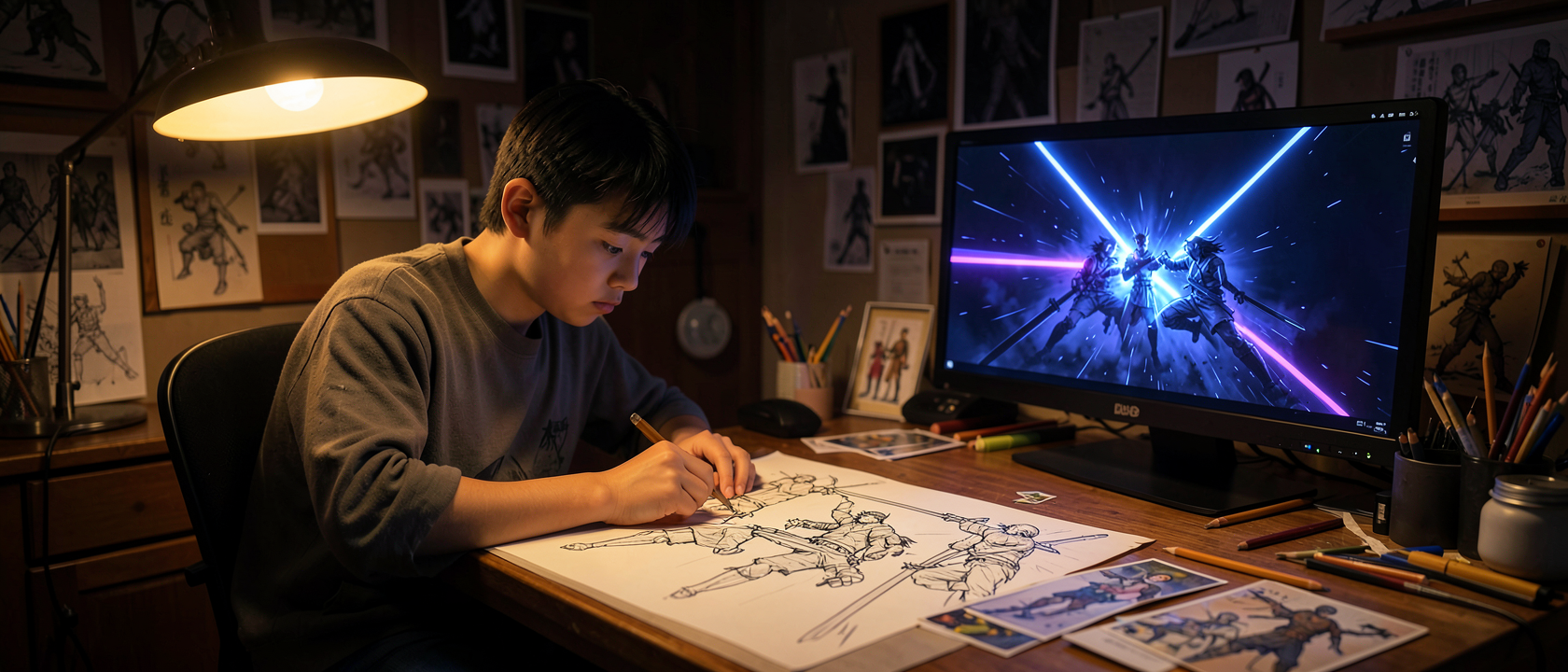
The answer is a technique animators use constantly, just rarely in public: redrawing existing footage, frame by frame, as pure practice. Dancers run drills, musicians play scales, and action animators often study motion by hand-copying something that already moves well, usually taken from live-action film, sports footage, or choreographed performance.
The goal isn’t to reproduce the scene exactly. It’s to isolate one variable at a time: how weight shifts through a strike, how timing builds tension before contact, how far apart two bodies need to stay on screen for an audience to read the action clearly. When the choreography already exists, you’re not inventing a fight, you’re studying how one moves, which frees up every bit of attention for the how instead of the what.
Seen that way, the Phantom Menace duel is close to ideal practice material: fast, physically intricate, with two clearly staged fighters and readable spacing. It’s exactly the kind of sequence that forces an animator to get the mechanics right or watch the whole thing fall apart. Imai’s sketch wasn’t a tribute reel. It was closer to a gym session, and the roughness was intentional. Finishing the drawing was never the goal; understanding the motion was.
How Private Practice Went Public
None of this was built for an audience. It got out the way a lot of real skill-building does: someone shared it, someone else noticed, and it kept traveling. The clip was picked up by GeekTyrant and later written up by Neatorama in an article by Zeon Santos, published March 12, 2018, by which point a private exercise had quietly connected two traditions that almost never touch: Hollywood’s live-action fight choreography and Japan’s hand-drawn anime, without anyone planning for it.
That’s the part worth noticing. The work that actually builds skill is usually invisible, buried in sketches and reps nobody was meant to see, until one of them accidentally gets loose.