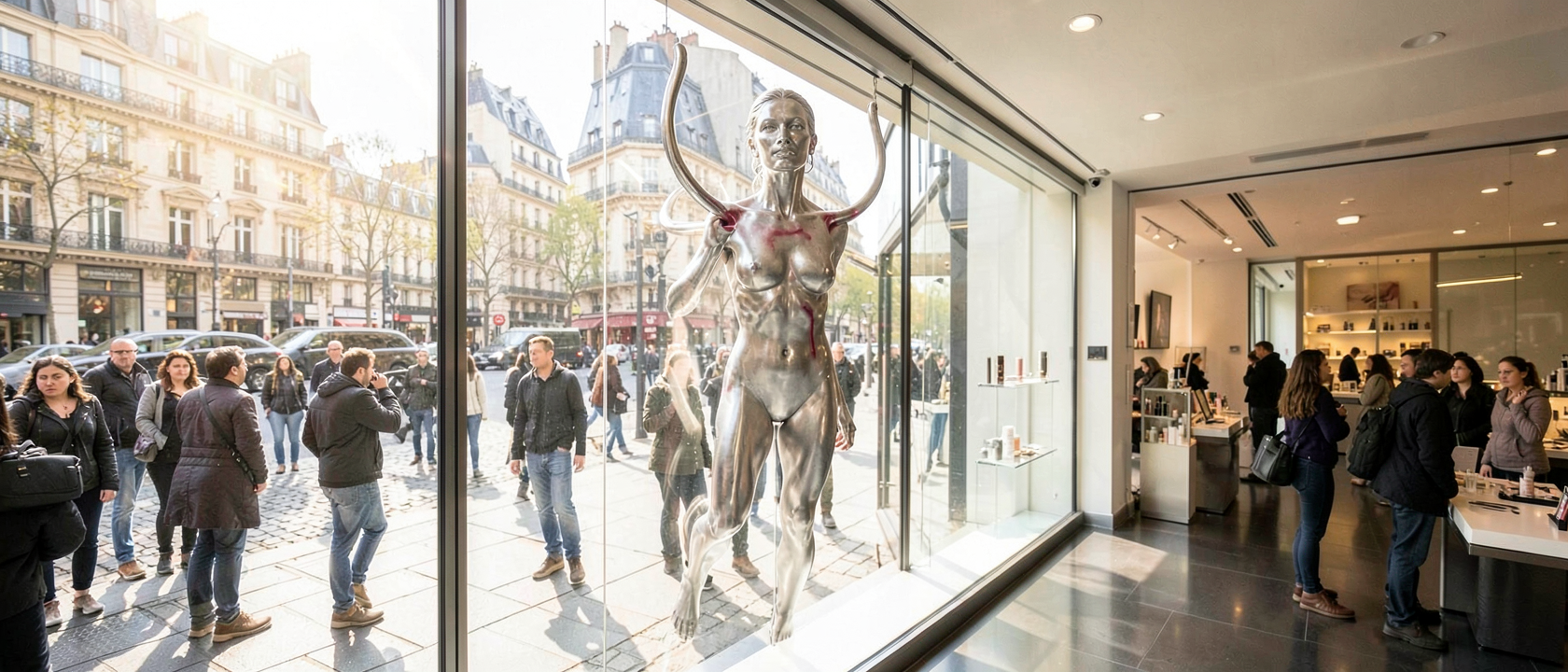
The Window You Couldn’t Walk Past
On July 2, 2009, shoppers moved past a Lush Cosmetics store in southern Paris the way they always do, nobody glancing twice at the display glass. Then the window stopped being ordinary.
A woman hung inside it, painted silver from head to toe, arms slack, head tipped back. Oversized fishing hooks pierced the skin at her shoulder blades, her body stretched upward as if something invisible were hauling her toward the ceiling, her skin faintly streaked with blood. She didn’t move or speak. For 15 minutes she hung there above the cosmetics displays while pedestrians on the busy boulevard slowed, stopped, and stayed.
Why Not Just Hold a Sign?
Flyers are cheap, chants carry down a street, a sign takes five minutes to make. So why choose something this uncomfortable, something that takes planning, risk, and real pain to pull off?
Most people have trained themselves to tune protest out. Placards blur into a city’s background noise the same way ads do. A body suspended by hooks in a shop window doesn’t file away that easily. You can scroll past a sentence; you can’t scroll past a person. Becoming the message, instead of carrying one, is a bet about how attention actually works.
Meet the Woman Behind the Hooks
The woman was Alice Newstead, a British performance artist, animal rights activist, and former Lush employee. Rather than illustrate a shark’s suffering with a photo, she made her own body stand in for one: hooks through the shoulder blades, a harness at her feet, her shape mimicking something hauled up out of the water.
The performance lasted about 15 minutes, and a real crowd gathered on the sidewalk, some confused, some visibly unsettled, all paying attention in a way a leaflet never earns. This approach has a name in performance art: embodied protest, where the body carries the message instead of describing it. The goal isn’t to be read, it’s to be witnessed, involuntarily, by anyone walking past.
The Numbers She Was Standing In For
This wasn’t shock for its own sake. The International Fund for Animal Welfare estimates that around 100 million sharks are caught every year through commercial and sport fishing, a figure later research suggested might be conservative, with some estimates running as high as 273 million. IFAW also notes that shark attacks kill fewer than 10 people worldwide in a typical year. Set those numbers side by side and the imbalance is hard to miss.
Reporting from around the time of the protest also cited some shark species dropping by more than 80 percent over the preceding decade, roughly four out of every five animals gone from those populations. That figure hasn’t been independently verified since, but it was the number circulating when Newstead stepped into that window. She wasn’t performing a metaphor detached from data; she was standing in for a decline already underway.
Were the Hooks Real?
It’s natural to assume the hooks were a prop, rigged to look painful without real risk. The truth sits in between. Reporting from the time describes the hooks actually piercing the skin at her shoulder blades, with blood visible at the site. But her body weight during those 15 minutes wasn’t hanging from that piercing: her feet were fitted into a harness, and the harness did the actual lifting toward the ceiling.
So the hooks were real, and so was the blood, but what kept her suspended and safe was engineered separately from what looked most brutal. That combination, genuine pain paired with controlled safety, is exactly what made the image land. It wasn’t a stunt dressed up to resemble suffering. It was suffering made visible enough that no one walking past could pretend not to notice.
Getting Weird as a Real Strategy
The Paris window wasn’t a one-off. Newstead had staged a nearly identical suspension in a Lush store window on London’s Regent Street in 2008, and later repeated the protest at a Lush store in San Francisco’s Marina District. Lush backed the cause further too, partnering with the conservation group Sea Shepherd and creating a “Shark Fin Soap” bar made from seaweed and sea salt to raise money for the campaign.
The pop-culture site Oddee later listed the Paris stunt as one of 10 unusual protests it had cataloged, and that detail matters: this wasn’t an isolated burst of eccentricity, but a move activists reach for again and again, because outrage wrapped in the bizarre gets photographed, talked about, and remembered in a way a leaflet on a corner never is.
That’s worth noticing the next time something strange stops you mid-scroll. The weirdness isn’t incidental. It’s the mechanism, and most people feel it work on them without ever asking why.