A Tree That Breathes Out Methane (Wait, What?)
When you picture sources of methane, you probably think of cows, landfills, or swampy wetlands. Trees don’t usually make that list, but some of them should.
Melaleuca quinquenervia, the paperbark tree, is a wetland species native to Australia with bark that peels off in soft, papery sheets. Like several other trees rooted in soggy, low-oxygen soil, paperbark releases methane, a greenhouse gas that traps far more heat than carbon dioxide in the short term.
The same tree also appears to quietly destroy a large share of the methane it makes before that gas ever reaches open air. That’s not as contradictory as it sounds.
The Trick Isn’t in the Tree
Trees don’t have lungs, stomachs, or anything resembling an internal filter, so if methane is disappearing somewhere between the wood and the atmosphere, the tree itself can’t be doing that work directly. Researchers zeroed in on an unlikely spot: the bark itself, and specifically the microscopic life living on and inside it. What they found there had nothing to do with the tree’s own biology and everything to do with its tiny tenants.
Meet the Bark’s Tiny Tenants
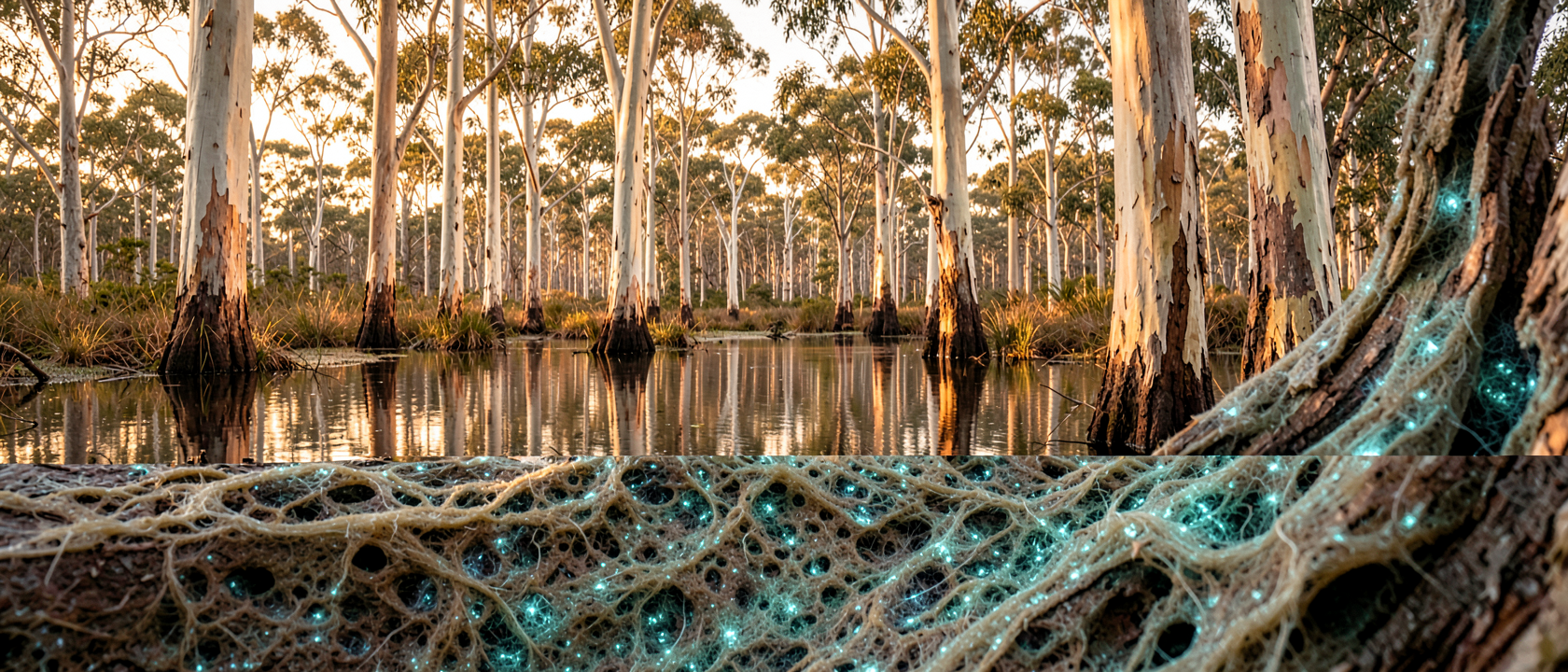
In a study published in Nature Communications on April 9, 2021, ecologist Luke Jeffrey and colleagues at Southern Cross University in Australia found that paperbark bark hosts colonies of methane-oxidizing bacteria, mostly from a group called Methylomonas.
These microbes eat methane as fuel and release carbon dioxide as a byproduct. Since carbon dioxide traps far less heat than methane, this swap meaningfully softens the climate impact of the gas moving through the bark.
The scale is notable: these bacteria made up as much as 25% of the entire microbial community living in the bark, and they were consuming roughly 36% of the methane the tree produced before it ever escaped into the air.
A Custom-Built Microhabitat
Why would bark, of all places, become a haven for these microbes? Because it has exactly what methane-eating bacteria need: darkness, moisture, and a steady supply of methane seeping outward from the tree’s wet, low-oxygen tissue, like a damp basement that always grows its own patch of mold, or a compost pile with a microclimate all its own.
A tree’s bark and wood do more than hold it upright. They frame an entire ecosystem invisible to anyone glancing at the trunk from a few feet away.
Not Just a Source, Also a Sink
This finding complicates a story that used to sound simple: wetland trees emit methane, end of story. It turns out the same tree can be both a source of the gas and a partial filter for the emissions it creates.
That distinction matters for anyone trying to measure a forest’s real footprint. Earlier estimates of methane released by trees like paperbark may not have accounted for this in-bark filtering, meaning some past calculations could have overstated how much methane actually reached the atmosphere. A tree’s raw methane output isn’t the full picture; its net output is.
Is Paperbark Special, or Just the First One We Noticed?
Methane escaping from trees isn’t new to science. It was first documented in cottonwood trees back in 1907, then largely ignored for close to a century. A 2018 review revived interest in the subject, describing tree methane as a genuinely new frontier of the global carbon cycle.
That timeline hints at how young this field still is. Scientists don’t yet know whether other tree species host similar bacterial communities in their bark, which exact strains or chemical pathways might be at work elsewhere, or how much these patterns shift across different climates and wetland types. Paperbark may turn out to be one example among many, or it may be an unusual case. For now, that’s genuinely unknown.
What This Could Mean for How We Plant Forests
As reforestation and wetland restoration projects expand worldwide, this kind of detail stops being a curiosity and starts being useful. Knowing which trees emit methane, and which ones also neutralize a chunk of it on their own, could shape which species get planted where.
That doesn’t mean writing off methane-emitting trees altogether. Many wetland species, paperbark included, carry out ecological roles that have nothing to do with greenhouse gases. The point is closing the gap between what we assume a tree does and what it actually does: methane produced, methane consumed, carbon dioxide absorbed, all counted together instead of separately.
Planting paperbark in a restoration project means planting more than a wetland tree. It means planting the bacteria tucked into every strip of its bark, already at work before a single leaf unfurls.